
We’ve all been there: you’ve just grabbed a steaming latte, tucked it into your car’s cup holder or started your morning walk, only to notice a persistent, annoying drip running down the side of the cup. You tighten the lid, press down on the edges, and yet the coffee keeps escaping, staining your shirt or making your hands sticky. It feels like a betrayal. After all, the packaging is often marketed as secure and reliable.
The truth is that the “leak-proof” label is one of the most misunderstood terms in the food service industry. While it sounds like a guarantee, it is often more of a goal than a universal reality. Understanding why this happens requires looking past the cardboard sleeve and into the hard science of high-volume manufacturing. If you are a business owner sourcing stock, working with a reliable disposable plastic coffee cup manufacturer is the first step toward quality, but even the best engineering faces challenges when billions of units are involved.
The Myth of the Perfect Seal: Why “Leak-Proof” is Misleading
In the world of professional food packaging, there is a technical distinction between being leak-proof and being leak-resistant. Most disposable cups are designed to be the latter. A truly leak-proof container would require a threaded screw-top or a specialized gasket, which isn’t cost-effective for a high-traffic café environment. Instead, we rely on a friction-fit lid.
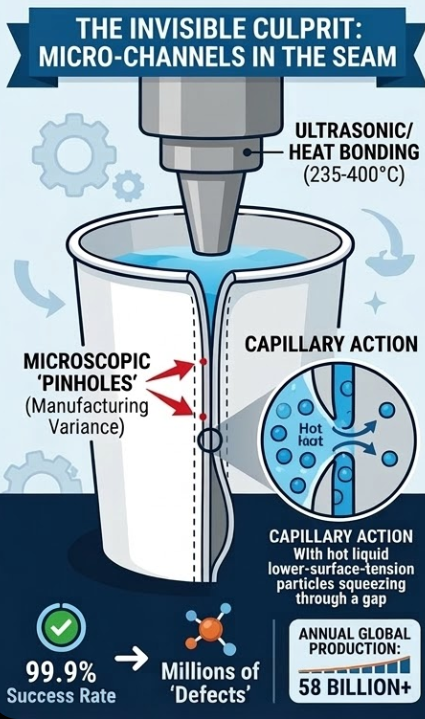
When a PP coffee cup factory in China produces millions of units, they are balancing speed, cost, and material integrity. Even with a 99.9% success rate, the sheer volume of global production—exceeding 58 billion cups annually—means that millions of “defective” cups naturally enter the ecosystem. Most drips aren’t caused by a massive hole, but by a convergence of physics and tiny manufacturing variances that the average consumer never sees.
The Invisible Culprit: The Side Seam Struggle

If you look closely at your cup, you will see a vertical line where the material overlaps and is bonded together. This is the side seam, and it is the primary reason for most leaks. During production, a specialized coffee cup supplier for bulk orders uses high-frequency heat or ultrasonic bonding to fuse this seam at temperatures ranging from $235\text{–}400^\circ\text{C}$.
If the temperature fluctuates by even a fraction of a percent, or if the machine’s pressure is slightly uneven, a microscopic channel—often called a “pinhole”—is created. You can’t see it with the naked eye, but hot coffee is incredibly efficient at finding these gaps. Because hot liquid has lower surface tension than cold water, it can migrate through these micro-channels via capillary action, eventually pooling under the lid rim and dripping down the side.
The Seam-Spout Conflict: A Geometry Problem
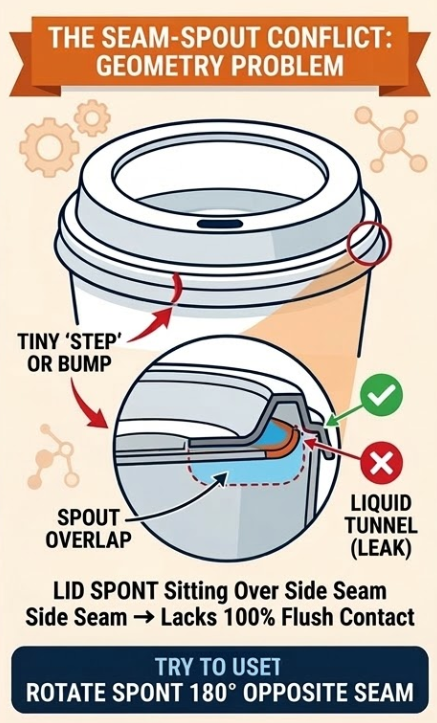
One of the most common reasons a perfectly good cup starts dripping is a simple alignment error. Every lid has a drinking spout, and every cup has a side seam. When these two points overlap, you have a recipe for a mess. The side seam creates a tiny “step” or a bump on the rim of the cup. While it might only be a fraction of a millimeter thick, it is enough to prevent the plastic lid from sitting 100% flush against the rim.
This creates a tiny tunnel. As you tilt the cup to take a sip, the liquid doesn’t just go through the spout; it also escapes through that tiny tunnel created by the seam. This is why you often see coffee bubbling up from the base of the lid rather than the hole itself. If you are a procurement manager, choosing a premium coffee cup manufacturer for international trade ensures that the rim-rolling process is precise enough to minimize this “step,” but user placement still matters.

Fix #1: The 180-Degree Lid Rotation Trick
The most effective way to stop an instant drip is also the simplest. If your cup is leaking from the lid area, look for the vertical seam on the cup body. Most people unknowingly put the lid on so the spout is near the seam. To fix this, pop the lid off and rotate it so the drinking spout is exactly 180 degrees opposite the side seam.
By doing this, you ensure that the area of the lid where the most liquid pressure occurs (the spout) is resting against the smoothest, most uniform part of the cup’s rim. This eliminates the “tunnel effect” and forces the lid to create a tighter friction seal. It’s a 30-second fix that solves about 80% of common leakage issues instantly.
Fix #2: The “Palm-Press” Technique
Most people try to seal a coffee lid using their thumbs or fingers, pressing around the edges one section at a time. This often leads to an uneven seal where one side is clicked in, but the other has a slight gap. Instead, place the cup on a flat surface and use the flat of your palm to apply firm, downward pressure to the center of the lid.
You are looking for a distinct “click” or “snap” sound. This indicates that the lid’s internal groove has fully engaged with the rolled rim of the cup. If you only press the edges, you might inadvertently “oval” the cup, making it harder for the lid to grip. Professional OEM coffee cup suppliers for global brands design their lids with specific tolerances for this “snap-fit,” but it requires even pressure to activate correctly.
Fix #3: Respecting the Headspace
In an effort to provide value, many baristas fill cups to the very brim. While this seems generous, it is actually a primary cause of lid failure. When a cup is overfilled, there is no room for the liquid to move when you walk or drive. This creates “hydraulic ram” pressure—every time you move, the liquid slams against the lid, looking for a way out.
Furthermore, hot coffee releases steam. If there is no air gap (headspace) between the liquid and the lid, the steam pressure builds up rapidly. Since air can be compressed but liquid cannot, the steam will eventually force the liquid out through the vent hole or the rim seal. Always leave about 1.5cm of space at the top. This “buffer zone” allows the pressure to equalize and prevents the coffee from being physically pushed out of the container.
Material Science: Why High-Grade Coatings Matter
Not all paper or plastic cups are created equal. The internal lining of a paper cup is usually a thin layer of Polyethylene (PE) or a compostable PLA. If the coating is too thin, the paper fibers absorb the hot liquid, causing the structure to soften. Once the rim of the cup softens, it loses its “springiness,” and the lid can no longer maintain a tight grip.
This is a common issue with budget-grade supplies. If you are a distributor looking for longevity, sourcing from an eco-friendly coffee cup manufacturer with ISO certification is vital. Higher-grade linings can withstand temperatures near boiling for much longer periods without losing structural integrity, which keeps that lid-to-rim connection tight until the very last sip.
How to Spot a “Weak” Cup Before the First Sip
You can actually predict if a cup is going to leak before you even pour the coffee. Check the bottom of the cup for the “knurling”—the textured pattern where the bottom disc meets the cup walls. If the texture is uneven or looks “smudged,” it’s a sign that the machine calibration was off.
Next, give the empty cup a very gentle lateral squeeze near the top rim. A high-quality cup from a reliable coffee cup factory for B2B partners will feel stiff and bounce back to a perfect circle. If the cup feels flimsy or the seam looks like it is starting to peel away under slight pressure, that cup is a high-risk candidate for leaking. It’s better to ask for a fresh cup then than to deal with a coffee-stained lap later.
Finding the Permanent Solution
For those who are tired of the daily gamble with disposable containers, the only true “leak-proof” solution is a high-quality reusable mug with a silicone gasket. However, for the billions of us who rely on the convenience of the “to-go” culture, these small adjustments in lid orientation and pressing technique are life-savers.
By understanding the mechanics of the side seam and the physics of steam pressure, you can take control of your morning caffeine routine. The next time you see a drip starting to form, don’t panic. Just rotate, press, and sip. Knowledge of the manufacturing process doesn’t just help the industrial coffee cup supplier for large scale distribution; it helps the everyday consumer enjoy their coffee without the mess.