
If you work in food packaging procurement long enough, you’ll notice something interesting. Buyers rarely ask what PP 5 plastic is. Instead, they ask why one microwave container keeps its shape while another bends after a few minutes of heating. They ask why a takeaway bowl survives a 40-minute delivery route while a similar-looking product arrives leaking in the customer’s bag.
That is usually where the conversation around Polypropylene #5 begins.
PP 5 plastic has become one of the most widely used materials in foodservice packaging, but the reason has very little to do with technical definitions and everything to do with operational reliability. Whether you manage a restaurant chain, source packaging for a distributor, or develop private-label food products, understanding how PP performs in real business environments can help you avoid costly packaging mistakes.
Why Procurement Teams Keep Choosing PP 5
A few years ago, a meal-prep company approached a packaging consultant after receiving a growing number of customer complaints. The meals themselves were popular, but the containers were becoming a problem. Some lids loosened during transport. Others warped when customers reheated food. Returns increased, customer satisfaction dropped, and the issue eventually reached the purchasing department.
The company tested several alternatives before settling on polypropylene.
What changed was not just the material. Their packaging became more predictable. Containers could move from cold storage to microwave heating without significant deformation. Warehousing became easier because units stacked consistently. Delivery partners reported fewer damaged orders.
This is one of the biggest reasons PP 5 remains popular. Buyers are not simply purchasing plastic. They are purchasing consistency.
Many companies searching for a reliable custom PP 5 food container manufacturer are ultimately trying to solve operational issues rather than material issues. They want fewer complaints, lower replacement costs, and smoother logistics.
The Real Advantage Is Not Heat Resistance Alone

Most articles about polypropylene immediately mention that it is microwave safe. While that is true, it only tells part of the story.
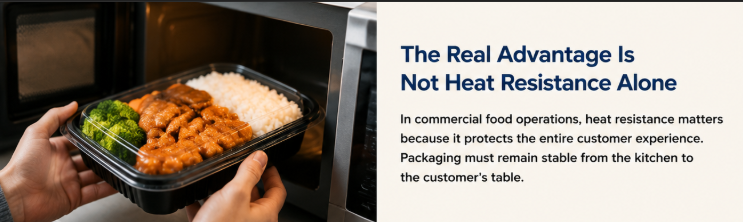
In commercial food operations, heat resistance matters because it protects the entire customer experience. Imagine a restaurant delivering rice bowls, pasta dishes, or hot entrées throughout a city. Packaging must remain stable from the kitchen to the customer’s table. If a container softens during transport or loses structural strength during reheating, the food may arrive looking completely different from what the brand intended.
This is why procurement managers often prioritize PP over materials that may offer better transparency but lower temperature tolerance.
A growing number of businesses now work directly with a PP 5 packaging supplier for restaurant chains because they need packaging systems that function reliably across multiple locations. Consistency becomes more important than appearance when thousands of orders are moving through the supply chain every day.
Where PP 5 Performs Best
One mistake many buyers make is assuming every food package has the same requirements.
A salad brand, for example, may focus heavily on visibility and presentation. A meal-delivery company may care more about temperature retention and structural integrity. A supermarket prepared-food program may prioritize shelf life and stackability.
PP performs particularly well when food is expected to experience multiple environments before consumption.
A container may be filled with hot food in a commercial kitchen, stored temporarily during staging, loaded into a delivery vehicle, placed in a refrigerator by the customer, and later reheated in a microwave. Not many packaging materials handle that entire journey comfortably.
This flexibility explains why businesses frequently seek an OEM polypropylene container factory when launching new foodservice packaging programs. The material adapts well to different food categories without requiring major operational changes.
The Hidden Cost of Choosing the Wrong Material
Most procurement teams focus heavily on unit price during supplier evaluation. While pricing matters, experienced buyers know that packaging costs extend far beyond the invoice.
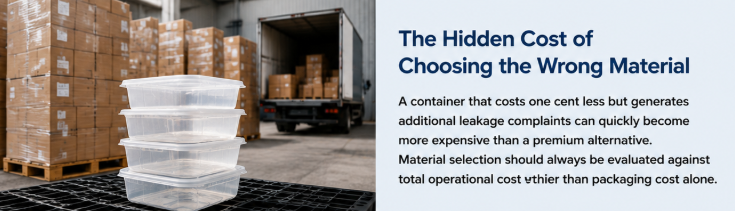
A container that costs one cent less but generates additional leakage complaints can quickly become more expensive than a premium alternative.
One distributor supplying convenience-store meal programs learned this lesson during a seasonal product launch. Their initial packaging looked acceptable during testing. However, after several weeks of distribution, stores began reporting damaged containers and inconsistent lid performance.
The issue wasn’t manufacturing quality. The material simply wasn’t suitable for the transportation conditions involved.
After transitioning to products sourced from a polypropylene food packaging manufacturer for bulk orders, complaint rates declined significantly. The unit cost increased slightly, but the overall program became more profitable because product losses decreased.
For purchasing departments, this is an important distinction. Material selection should always be evaluated against total operational cost rather than packaging cost alone.
Why Supplier Experience Matters More Than Many Buyers Realize
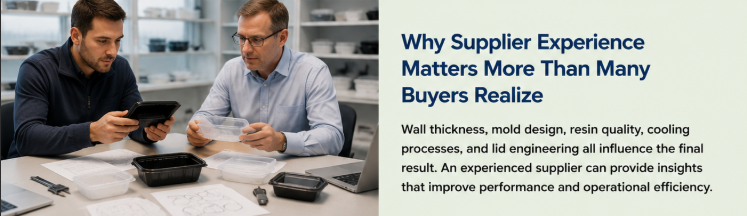
Two PP containers can look almost identical while performing very differently in practice.
Wall thickness, mold design, resin quality, cooling processes, and lid engineering all influence the final result. This is why experienced procurement teams spend time evaluating suppliers rather than focusing solely on product catalogs.
An established custom polypropylene tray supplier often provides insights that go far beyond manufacturing.
They may recommend structural adjustments that improve stacking performance. They may identify opportunities to reduce material usage without sacrificing strength. They may also suggest modifications that improve automated filling efficiency on production lines.
These recommendations rarely appear on specification sheets, yet they can have a meaningful impact on operational performance.
Comparing PP 5 With Other Packaging Materials
Buyers often ask whether PP is always the best choice.
The answer depends on the application.
PET is frequently selected when visual presentation is the primary objective. Its transparency helps showcase fresh food products effectively. However, PET generally does not offer the same microwave performance as polypropylene.
CPET performs well in high-temperature applications and is commonly used in ready-meal programs. However, it may involve higher production costs depending on the project requirements.
PLA and bagasse products continue gaining attention because of sustainability initiatives. For some businesses, these materials align well with brand positioning. For others, performance limitations and regional waste-management infrastructure remain important considerations.
This is why companies often consult a PP meal container supplier for foodservice distributors before making a final decision. The right material depends on how the product will actually be used rather than what appears most attractive in marketing materials.
Sustainability Is Changing the Conversation
Several years ago, conversations about packaging focused primarily on cost and performance.
Today, sustainability plays a much larger role.
Many restaurant groups, retailers, and food manufacturers are under increasing pressure to reduce environmental impact. As a result, buyers are paying closer attention to recyclability, material recovery systems, and packaging lifecycle considerations.
PP has benefited from this shift because it is widely recyclable in many markets and can integrate into existing recycling streams more easily than some alternative materials.
Businesses working with an OEM PP 5 packaging manufacturer for private label projects increasingly request documentation related to recyclability, compliance, and material sourcing. These discussions are becoming standard during supplier evaluations rather than optional considerations.
What Smart Buyers Evaluate Before Placing an Order
Experienced procurement teams rarely approve packaging based solely on samples.
Instead, they evaluate how the packaging performs throughout the entire supply chain.
They look at warehouse stacking conditions, transportation distances, storage temperatures, reheating requirements, and customer usage patterns. They assess whether lids remain secure after repeated handling. They test how containers perform under realistic operational conditions rather than ideal laboratory scenarios.
Companies sourcing from a polypropylene container factory serving food brands often achieve better outcomes because they approach packaging as part of a larger operational system.
The objective is not simply to buy containers.
The objective is to support product quality, customer satisfaction, and business growth.
Final Thoughts
PP 5 plastic remains one of the most practical materials available for food packaging because it addresses real operational challenges rather than theoretical ones. Its popularity is not driven by marketing trends or industry buzzwords. It is driven by years of proven performance across restaurants, meal-delivery companies, food manufacturers, distributors, and retail food programs.
For procurement professionals, the most important question is not whether polypropylene is microwave safe. The more valuable question is whether it can support the way your business actually operates.
In many cases, the answer is yes.
That is why businesses continue partnering with a custom PP 5 container supplier for food packaging brands, investing in packaging programs designed around reliability, scalability, and long-term operational efficiency rather than short-term cost savings alone.