
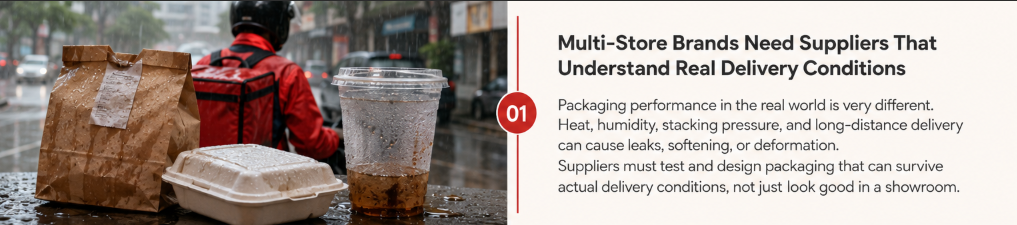
A regional fried chicken chain in Southeast Asia recently expanded from 12 stores to nearly 40 locations within a year. Sales were growing fast, delivery orders were climbing every month, and the management team believed the hardest part of scaling would be labor and kitchen operations.
It turned out packaging became the bigger problem.
Several stores started reporting that burger boxes softened during long-distance delivery. Different batches of drink lids no longer sealed the same way. One city received containers that stacked properly, while another received slightly different dimensions that jammed storage shelves inside the kitchen. During a major promotional campaign, one supplier suddenly delayed shipment for almost a week, forcing multiple stores to purchase temporary replacement packaging locally.
Customers did not know the problem came from the supply chain. They only saw leaking drinks, crushed meals, and inconsistent brand presentation.
This is where many growing restaurant brands start to realize something important: once a company operates across multiple locations, takeout packaging is no longer just a purchasing category. It becomes part of operational stability.
That is why experienced restaurant groups no longer choose suppliers based only on quotation sheets. They evaluate whether a supplier can continue supporting growth when order volume, delivery pressure, and store count all increase at the same time.
Expansion Often Exposes Weak Packaging Supply Systems
A supplier that works perfectly for five stores may completely fail at fifty.
This is one of the most common mistakes growing restaurant brands make during expansion. Early-stage purchasing decisions are usually based on flexibility and low minimum order quantities. Small suppliers often perform well in the beginning because communication is fast and sample turnaround is simple.
But large-scale restaurant operations create entirely different pressures.
As delivery volume increases, packaging consistency suddenly matters more than most operators expect. A small variation in cup lid tightness may not seem serious during product testing, but across thousands of daily orders, even minor inconsistencies can create refund requests, rider complaints, and negative platform reviews.
Many restaurant operators discover that the issue is not whether a supplier can produce packaging once. The real question is whether they can reproduce the same result continuously under high-volume demand.
This is why experienced procurement teams increasingly prefer working with a custom takeout packaging manufacturer that already understands multi-location operational requirements instead of suppliers that mainly focus on low-volume trading business.
In large restaurant systems, packaging failures rarely happen inside meeting rooms. They happen during dinner rushes, rainy weather deliveries, or nationwide promotional campaigns when operational pressure peaks.
A supplier that cannot maintain stable production during those moments quickly becomes a liability rather than a cost-saving partner.
Multi-Store Brands Need Suppliers That Understand Real Delivery Conditions
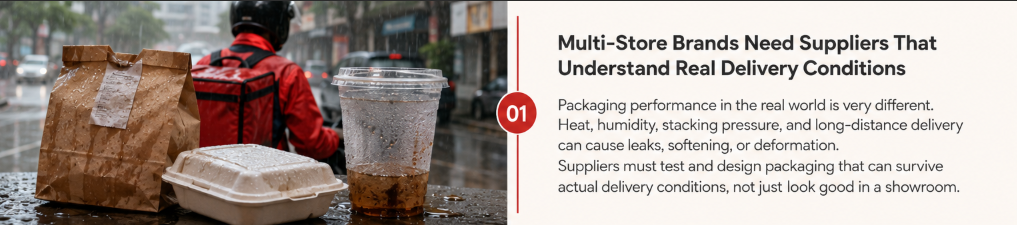
One major problem in the food packaging industry is that many factories understand manufacturing but do not fully understand delivery environments.
Packaging performance inside a showroom is very different from performance inside a rider bag traveling 40 minutes through heavy traffic in humid weather.
This becomes especially obvious in high-temperature and high-humidity markets. Steam accumulation, condensation, oil penetration, and stacking pressure all affect packaging performance during transport. Containers that appear strong during sample evaluation may soften after prolonged heat exposure. Lids that initially seal well may loosen after repeated movement during delivery.
Restaurant brands operating at scale cannot afford to discover these problems after rollout.
That is why more operators now prefer partnering with an OEM takeout packaging supplier capable of evaluating real transportation conditions instead of simply offering catalog products.
Experienced restaurant procurement managers often test packaging in ways that smaller operators never consider. Some simulate long-distance delivery routes. Others conduct stacking pressure tests during peak-hour packaging preparation. Some evaluate whether containers maintain structural stability after sitting under heat lamps for extended periods.
These are not technical laboratory exercises. They are operational survival checks.
Because once a brand expands across dozens of stores, even small packaging failures multiply rapidly across the system.
High-Volume Supply Stability Matters More Than Low Pricing
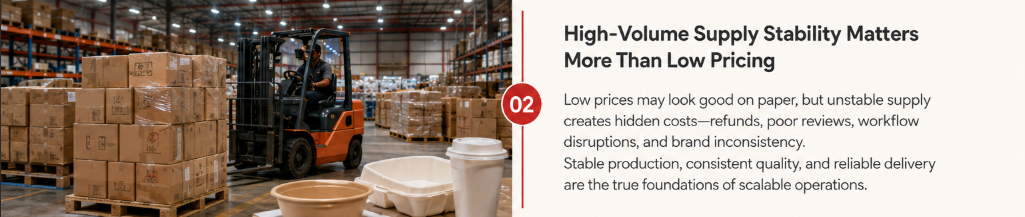
One of the most expensive mistakes restaurant brands make is choosing suppliers based mainly on unit cost.
On paper, switching to lower-priced packaging may appear financially efficient. But many restaurant groups later realize that cheap packaging often creates hidden operational expenses far larger than the original savings.
A leaking soup container does not only waste packaging cost. It may trigger customer refunds, rider compensation, food replacement, negative reviews, and damage to brand trust. Softened containers can reduce food presentation quality, especially for premium burger, steak, or rice bowl concepts that depend heavily on visual appearance during delivery.
For multi-store operations, inconsistency becomes even more dangerous.
If one region receives slightly different packaging dimensions, kitchen workflows may slow down. Storage systems may no longer fit correctly. Automated cup dispensers may jam. Staff may begin sourcing local replacement products independently, creating brand inconsistency across locations.
This is why many scaling restaurant groups eventually move away from short-term sourcing logic and begin building relationships with a high-volume takeout packaging factory that can support stable long-term supply planning.
Large operators understand that the real cost of packaging problems rarely appears on the invoice itself. It appears inside operational disruption.
Mature Procurement Teams Evaluate Supply Chain Depth, Not Just Products
One major difference between small restaurant operators and mature chain brands is how they evaluate suppliers.
Smaller buyers often focus primarily on product appearance and pricing. Larger restaurant groups usually investigate the supplier’s operational infrastructure behind the product.
For example, experienced procurement teams often ask questions such as:
Can the supplier maintain output during seasonal demand spikes?
Do they operate multiple production lines?
Can they support regional warehouse replenishment?
How do they manage raw material fluctuations?
What happens if one factory experiences production interruption?
These questions matter because restaurant expansion creates unpredictable pressure. New store openings, platform campaigns, and seasonal menu launches can dramatically increase packaging demand within short periods.
A supplier without scalable systems may struggle to respond quickly.
This is one reason why many restaurant chains increasingly prefer cooperating with an ODM food packaging manufacturer that already serves large-volume foodservice clients instead of suppliers focused mainly on fragmented low-volume orders.
Operational maturity becomes just as important as product quality.
Packaging Standardization Directly Impacts Brand Consistency
As restaurant chains grow, standardization becomes one of the most difficult operational challenges.
Customers expect the same experience regardless of which location they order from. Packaging plays a surprisingly important role in maintaining that perception.
If one store receives brighter printing colors while another receives thinner materials, customers notice. If one region uses secure-fitting lids while another experiences leakage issues, delivery ratings begin to separate across markets.
Brand inconsistency often begins quietly through packaging variation.
This is why many restaurant groups eventually prioritize suppliers capable of strict batch control and standardized manufacturing systems. Working with an custom printed takeout packaging supplier allows brands to maintain stronger visual consistency while simplifying procurement management across multiple locations.
For growing chains, packaging is no longer just a container. It becomes part of customer perception, delivery experience, and operational discipline.
And unlike marketing campaigns, packaging problems appear in every single order.
Scalable Packaging Partnerships Support Faster Expansion
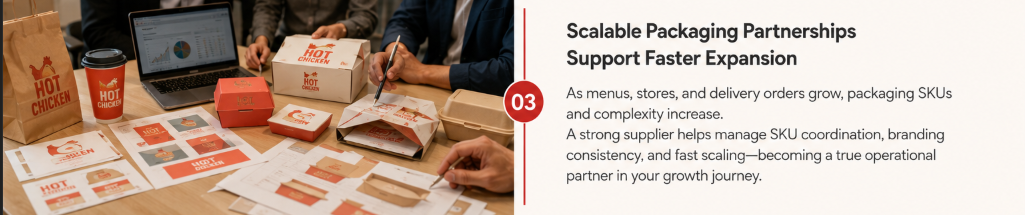
One interesting trend in the restaurant industry is that fast-growing chains increasingly prefer long-term packaging partnerships instead of frequently switching suppliers for marginal cost reductions.
This shift happens because expansion creates complexity.
As brands launch limited-time products, seasonal menus, and regional collaborations, packaging SKU counts increase rapidly. Managing different lid sizes, bowl formats, inserts, and branding versions across multiple cities becomes difficult without organized supplier support.
A capable supplier helps simplify this complexity rather than adding to it.
This is why more restaurant operators now work directly with a takeout packaging manufacturer for restaurant chains that can support SKU coordination, version management, and faster production scheduling.
The relationship becomes operational rather than transactional.
In many successful restaurant systems, packaging suppliers are involved early during menu planning discussions because packaging performance directly affects delivery execution. Some menu items may require ventilation adjustments. Others may need improved oil resistance or better stacking stability.
Suppliers that understand these operational details become far more valuable during expansion phases.
Reliable Supply Chains Protect Restaurant Growth
For restaurant brands operating multiple locations, packaging decisions eventually become growth decisions.
A company may survive occasional supply issues with ten stores. But at fifty or one hundred locations, packaging instability can affect customer experience across an entire region within days.
That is why sophisticated restaurant groups increasingly seek long-term cooperation with a bulk takeout packaging supplier for foodservice brands capable of supporting future expansion instead of only solving immediate purchasing needs.
The strongest suppliers are rarely defined only by pricing.
They are defined by whether they can maintain consistency during pressure, respond quickly during demand spikes, and continue supporting operational stability as restaurant systems become more complex.
Because for modern restaurant brands, especially those heavily dependent on delivery business, packaging is no longer a secondary operational detail.
It is part of the customer experience itself.