
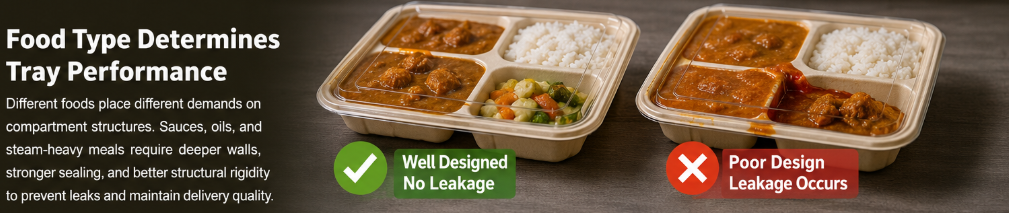
Restaurants rarely pay attention to packaging when operations run smoothly. Problems usually begin when order volume increases and packaging starts affecting delivery quality, kitchen speed, and customer satisfaction at the same time. A compartment tray that looked acceptable during sample approval may suddenly create issues once hundreds of takeaway meals move through restaurants every day. Sauces spill into adjacent sections, lids loosen during transport, or trays soften after reheating. For buyers, these are no longer packaging defects alone. They become operational losses.
This is why experienced sourcing teams no longer select trays simply by comparing catalog photos or chasing the lowest quotation. Buyers sourcing custom sugarcane compartment trays are usually trying to solve much larger business concerns involving transportation reliability, stacking efficiency, storage conditions, and long-term supply consistency.
Food Type Usually Determines Whether a Tray Works or Fails
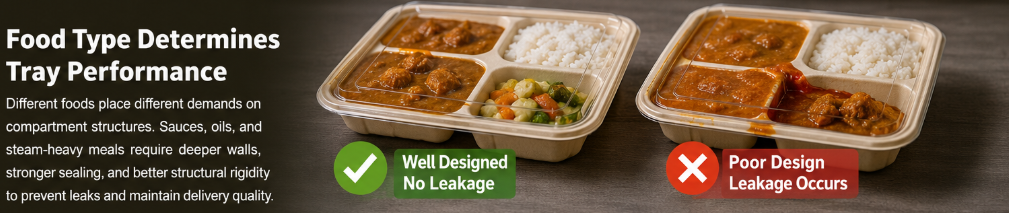
One of the most common sourcing mistakes happens when buyers evaluate trays without considering the actual meals being served. Different foods place completely different demands on compartment structures.
Dry meals are relatively forgiving. Fried foods, grilled items, and snacks can often perform well even in standard trays. The situation changes once sauces, oils, or steam-heavy meals enter the equation. Curry rice, noodle dishes, and sauced proteins quickly expose weaknesses in tray design. If compartment walls are too shallow, liquids overflow during delivery. If the tray structure lacks rigidity, the bottom begins flexing under heavier food portions.
Many restaurant operators discover these issues only after customer complaints increase. At that point, changing packaging becomes far more expensive than conducting proper testing at the beginning.
This is why large distributors often work directly with a custom sugarcane compartment tray manufacturer instead of purchasing generic stock models without operational evaluation. The tray needs to match real delivery conditions, not just showroom presentation.
Even small design details affect performance more than many new buyers expect. A slightly deeper compartment may improve sauce separation, but excessive depth can reduce stacking stability during transport. Some tray designs look visually attractive but slow down restaurant staff during busy hours because lids require too much pressure to close properly.
In large-scale takeaway operations, even a few extra seconds per order eventually become noticeable labor costs.
Universal Tray Designs Often Increase Costs Instead of Reducing Them
New buyers frequently believe using one tray size for multiple menu items will simplify inventory management. In reality, this decision often creates hidden inefficiencies.
Oversized trays increase shipping volume and carton space unnecessarily. Meals may also appear inconsistent because food portions occupy only part of the container. On the other hand, trays that are too compact create pressure on lids and increase the risk of leakage during transportation.
Businesses sourcing from a bagasse compartment tray supplier for restaurant chains usually evaluate tray dimensions alongside actual meal assembly rather than selecting packaging from specification sheets alone.
The financial impact becomes clearer once operations scale. Packaging that initially seemed inexpensive may later generate higher freight costs, customer complaints, and replacement expenses. Many experienced buyers eventually realize that the cheapest tray on paper often becomes the most expensive option operationally.
That is why practical testing matters far more than brochure comparisons.
Factory Evaluation Requires More Than Sample Inspection
A factory’s ability to produce attractive samples does not automatically mean it can maintain stable quality during mass production. This is one of the biggest differences between sourcing success and sourcing frustration.
Some suppliers prepare hand-selected samples with cleaner trimming, stronger wall thickness, and tighter lid fitting than their regular production batches. Buyers only notice the difference after containers arrive.
For this reason, companies working with an OEM molded fiber tray factory for foodservice brands often request random production samples rather than showroom samples. Random batch inspection reveals much more about actual production consistency.
Production photos are equally valuable during supplier evaluation. Catalog renderings rarely show warehouse conditions, packing procedures, or drying systems. Yet these operational details often determine whether trays remain stable during export shipping.
Factories with weak moisture management frequently produce trays that deform after long-distance ocean transport. The products may leave the factory in good condition but arrive softened or warped after exposure to humidity inside containers.
Experienced importers usually pay close attention to storage systems, pallet wrapping quality, drying procedures, and export carton protection because these factors directly affect usable inventory after arrival.
Certifications Alone Cannot Guarantee Reliable Performance
Many suppliers emphasize FDA, LFGB, or compostability certifications during negotiations. While these documents are important for compliance purposes, experienced buyers know certifications alone do not guarantee stable production quality.
A tray may technically pass food-contact standards while still performing poorly during real-world usage. Uneven pulp density can cause cracking after microwave reheating. Weak structural pressure during molding may create inconsistent lid fitting. Slight dimensional variation can slow down restaurant operations significantly.
Companies sourcing through a sugarcane food packaging supplier for takeaway businesses often care more about long-term consistency than presentation documents.
This becomes especially important for chain restaurants using automated workflows or standardized kitchen systems. If trays vary slightly between production batches, staff efficiency drops immediately. Lids stop fitting smoothly, stacks become unstable, and packaging stations slow down during peak service hours.
Reliable production consistency is often more valuable than an impressive certification list.
Smart Customization Improves Operations Instead of Creating Extra Costs
Customization becomes expensive when buyers focus entirely on appearance rather than functionality. Many packaging projects encounter unnecessary delays because branding decisions are made before operational requirements are fully understood.
Embossed logos usually perform better than heavy surface printing for delivery-focused businesses. Printed branding can fade after exposure to grease, friction, or condensation during transportation. Embossing tends to maintain a cleaner appearance over time, especially for high-frequency takeaway operations.
Businesses cooperating with an ODM biodegradable compartment tray supplier for delivery platforms often choose subtle branding approaches that maintain product appearance after stacking, reheating, and transport.
Structural customization also requires careful planning. Mold revisions become costly when tray dimensions are finalized before food portions, delivery methods, or storage conditions are properly evaluated.
Experienced buyers usually confirm meal dimensions, reheating requirements, lid pressure, and transportation conditions before approving custom mold production. Without these discussions, factories often need repeated design adjustments later, increasing both lead time and development cost.
Freight Costs Frequently Change Procurement Decisions

Sugarcane compartment trays create unique freight challenges because the products are lightweight but consume substantial shipping volume. Small structural changes can dramatically affect container loading efficiency.
Importers sourcing from a custom bagasse tray manufacturer for international distributors typically pay close attention to nesting structure and carton dimensions because these details influence landed costs more than many first-time buyers expect.
A tray that appears only slightly taller may significantly reduce total units per container. Over multiple shipments, the resulting freight increase can exceed any savings gained from lower product pricing.
Export packing quality also plays a major role. Weak cartons compress during long-distance transportation, damaging trays near the bottom of pallet stacks. Once deformation begins, lid compatibility issues usually follow.
Buyers who experience large-scale freight damage rarely underestimate carton engineering again.
Moisture Exposure Creates Problems Long After Production Ends
Some packaging problems appear only after products enter warehouse storage. Trays that initially looked strong may soften gradually after prolonged humidity exposure.
This issue becomes particularly common during ocean shipping or rainy-season storage conditions. Companies purchasing through a compostable compartment tray factory for food distributors often request additional moisture protection for long transit routes because even small humidity changes affect molded fiber products.
Once trays begin absorbing excess moisture, dimensional stability decreases quickly. Lids become harder to secure properly, stacks lose alignment, and restaurant handling efficiency drops.
These operational problems rarely appear during initial factory inspection. They become visible only after transportation, storage, and daily usage combine over time.
For large foodservice operators, this can create serious workflow disruptions during busy meal periods.
Communication Quality Usually Predicts Long-Term Cooperation
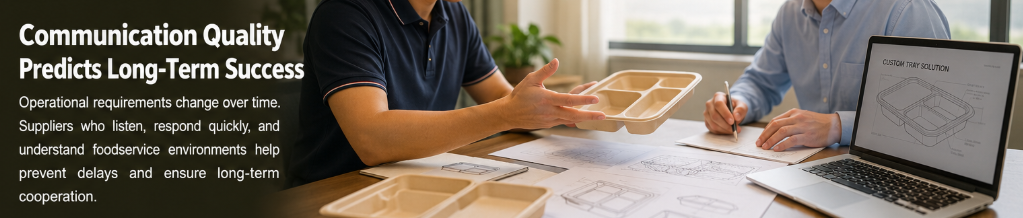
Price remains important in every sourcing decision, but communication quality often determines whether long-term cooperation succeeds smoothly.
Packaging requirements change frequently. Delivery methods evolve, menu items expand, branding updates occur, and restaurant operations adjust over time. Suppliers that communicate slowly or fail to understand operational concerns usually create more long-term risk than slightly higher-priced competitors.
Businesses working with an OEM sugarcane tray supplier for fast growing food brands often prioritize responsiveness because delays directly affect launch schedules and customer experience.
Experienced suppliers typically ask detailed operational questions early in the process. They want to understand delivery duration, reheating methods, storage conditions, food temperature, and stacking requirements before recommending tray structures.
These conversations usually reveal whether a supplier truly understands foodservice environments or simply focuses on selling production capacity.
Small Trial Orders Usually Prevent Expensive Mistakes
Experienced buyers rarely move directly into large-volume procurement after approving initial samples. Real operational problems often appear only after products enter restaurants and delivery systems.
Companies partnering with a molded pulp compartment tray factory for chain restaurants often begin with smaller trial orders specifically to evaluate long-term performance under actual working conditions.
During this stage, restaurants observe how trays perform during delivery, reheating, storage, stacking, and customer handling. Minor weaknesses that seemed unimportant during early evaluation often become highly noticeable once operations scale.
This slower testing process may initially seem inefficient, but it usually prevents far more expensive corrections later.
For wholesale buyers, selecting sugarcane compartment trays is no longer simply about replacing plastic packaging. The decision affects transportation reliability, labor efficiency, customer satisfaction, and long-term operational stability. Buyers who understand this early usually make far stronger sourcing decisions than those focused only on initial pricing.