

Retail returns are rarely caused by one dramatic product failure. More often, they build from small frustrations that shoppers didn’t expect when they clicked “buy now.” In the relish tray category, this pattern is especially visible. On product pages, trays often look elegant, spacious, and party-ready. But once they arrive in real kitchens, many fail where it matters most: practical use.
For retailers, this gap between visual promise and functional reality creates a costly cycle—negative reviews, frequent returns, customer distrust, and weaker repeat sales. While many assume material quality is the biggest issue, retail complaints suggest otherwise. The real trigger is often a design flaw hidden in plain sight: compartment structure that doesn’t match how consumers actually serve food.
For any custom relish tray manufacturer, understanding this problem is no longer optional. It directly affects retail survival.
The Real Problem Starts When “Pretty Design” Replaces Functional Design
A relish tray is not purchased simply to hold snacks. Consumers buy it because they want convenience during social moments—holiday hosting, family gatherings, office parties, or quick entertaining. They expect organized presentation, easy transport, and minimal mess.
The trouble begins when trays are designed more for shelf appeal than real serving conditions.
Many returned units share a similar story. Customers are not saying the tray is broken; they are saying it is frustrating. Compartments look deep enough online but prove too shallow in practice. Food shifts during transport. Wet and dry items mix. Crackers break. Dips spill into vegetables. This isn’t a manufacturing defect—it’s a user experience defect.
For an OEM relish tray supplier, this distinction matters because the consumer often doesn’t separate design failure from brand failure.
Why Shallow Compartments Are Quietly Driving Return Rates Up

Among all recurring complaints, shallow compartment depth may be the most underestimated retail killer.
A tray can appear visually modern with sleek low-profile sections, but if olives roll into cheese cubes or celery tips slide into dip before the party starts, the design has already failed. Consumers want containment, not decorative separation.
This issue becomes worse during transportation from kitchen counter to dining table. Even a few steps can shift lightweight snacks if the base lacks depth or grip texture. What looked organized instantly becomes chaotic.
Retailers then absorb the fallout:
“Not practical.”
“Too messy.”
“Smaller than expected.”
“Only looks good in photos.”
For a relish tray factory for retail chains, compartment engineering should prioritize food stability over minimalist aesthetics.
The Center Dip Holder: Small Feature, Big Return Trigger

One of the most common design features marketed as a selling point is the central dip compartment. In theory, it improves convenience. In reality, poorly executed dip holders are a major source of dissatisfaction.
When the center cavity is too shallow, too narrow, or structurally unstable, consumers quickly notice. Salsa tips. Hummus spills. Dressing leaks. Once that happens, surrounding compartments become contaminated.
This flaw is particularly damaging because it undermines the tray’s core purpose—organized presentation.
A poorly designed center section often signals rushed product development rather than thoughtful user testing. For a serious bespoke relish tray supplier for supermarket brands, center-slot compatibility with standard dip containers can significantly reduce complaint rates.
Lid Design Failures Often Matter More Than Tray Material
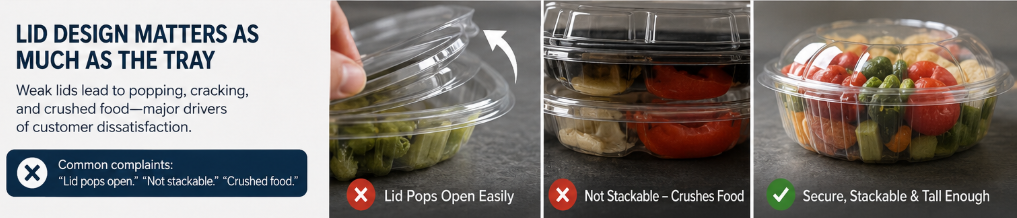
Retail buyers often overfocus on tray material thickness while overlooking lid functionality. Yet consumer frustration frequently spikes not when the tray feels lightweight, but when the lid fails under normal use.
A lid that snaps loosely, collapses under stacking pressure, or pops open in the refrigerator creates immediate disappointment. Even worse, dome lids that lack sufficient height crush food presentation before guests arrive.
This is why lid engineering is a hidden priority for any private label relish tray manufacturer targeting grocery or e-commerce sectors.
Customers may tolerate average plastic. They rarely tolerate food disruption.
The most successful products often win not by having premium materials, but by ensuring:
secure closure, stack resistance, refrigeration stability, and reliable reopening.
Retail Returns Increase When Compartments Ignore Real Food Sizes
Another major flaw appears when tray dimensions are designed around abstract shapes instead of actual serving foods.
Consumers do not fill relish trays with identical cubes. They use deviled eggs, celery sticks, crackers, sliced peppers, pickles, and mixed appetizers. When sections are too narrow, too curved, or awkwardly proportioned, users are forced to overcrowd or underutilize space.
This creates an emotional response stronger than simple inconvenience—it feels deceptive.
The tray promised versatility but delivered limitation.
For an odm relish tray manufacturer for hospitality distributors, testing with common party foods rather than design mockups can reveal structural weaknesses before retail launch.
Decorative Features Can Accidentally Increase Return Risk
Retail innovation often pushes visual upgrades like rotating trays, sculpted handles, or ultra-clear lids. These additions may photograph well, but many create practical liabilities.
Rotating bases can jam or destabilize weight distribution. Raised handles reduce fridge compatibility. Thin transparent lids often crack more easily during storage.
Consumers generally appreciate innovation only when it improves function. If innovation adds complexity without solving real problems, it can accelerate returns.
For a relish tray supplier for big box retailers, product development should ask one question first:
Does this feature improve hosting, storage, or transport—or only marketing visuals?
Why Retailers Should Study “Convenience Failure,” Not Just Damage Reports
A common mistake in return analysis is focusing only on physical defects. But many relish tray returns stem from something less visible: convenience failure.
Convenience failure happens when:
the tray is hard to clean,
food slides too easily,
the lid is unreliable,
or the sections don’t support intended use.
These products may technically arrive undamaged, yet still generate dissatisfaction.
For a custom party tray factory for volume buyers, this insight is critical. Reducing visible defects is not enough. The product must also perform consistently in realistic social settings.
What Wholesale Buyers Should Actually Audit Before Ordering
The smartest buyers no longer evaluate relish trays based only on appearance, cost, or packaging. They increasingly test based on usage friction.
That means reviewing:
How stable is food during movement?
Can the lid survive stacking?
Does the center dip holder fit standard portions?
Are compartments functional for mixed appetizers?
Does cleaning create frustration?
A reliable food serving tray manufacturer for commercial procurement understands that low return rates begin with scenario-based product testing, not cosmetic upgrades.
The Design Flaw Costing Retailers the Most
So which specific flaw triggers the highest return frequency?
In many cases, it is not one isolated defect but a broader structural miscalculation: compartment and lid systems designed for visual merchandising instead of real-life food behavior.
When tray geometry ignores movement, moisture, food size, and transport, returns become predictable.
This is where successful brands separate themselves. They stop designing for product photos and start designing for customer outcomes.
For any wholesale relish tray supplier for private brands, lowering returns means engineering around actual consumer hosting behavior—not imagined showroom perfection.
Final Thought: Better Design Protects More Than Sales
A returned relish tray is not just one lost transaction. It can mean wasted logistics, damaged brand trust, poor product rankings, and missed future purchases.
In retail, the most expensive flaw is often the one that seems minor during design approval but becomes impossible to ignore in customer kitchens.
The brands winning this category are not necessarily using the thickest plastic or the flashiest design. They are the ones solving practical frustrations before they happen.
For every relish tray manufacturer for B2B packaging buyers, the message is clear: stop treating design as decoration. In retail, design is return prevention.