
Frozen food logistics can look efficient on paper—until the packaging starts failing before the product even reaches the shelf. For buyers sourcing relish trays for frozen vegetables, pickled assortments, deli kits, or prepared food distribution, durability in freezing cold chain environments is not a minor specification. It directly impacts freight loss, customer complaints, sealing reliability, and repeat purchase confidence.
Many businesses focus heavily on food quality while underestimating how quickly the wrong tray can create expensive downstream problems. A relish tray that performs well in standard storage may crack, warp, or lose seal integrity when exposed to sub-zero warehousing, refrigerated transportation, and freeze-thaw handling cycles. For importers, distributors, and private label brands, this often turns a low-cost packaging decision into a long-term operational liability.
Choosing the right tray is less about selecting a container and more about protecting product stability across every stage of cold chain movement.
Your Cold Chain Environment Should Decide the Tray—Not Just Price
A common mistake buyers make is sourcing based on unit cost alone. In freezing logistics, that shortcut can become costly fast.
A tray moving through -18°C standard freezer storage has very different performance requirements than one exposed to -40°C blast freezing or international refrigerated shipping. Some trays survive warehouse storage but fail during pallet stacking, loading dock transfer, or last-mile delivery where repeated temperature shifts create material stress.
This is why experienced procurement teams begin by evaluating actual operational conditions. How long will the product remain frozen? Will it be stacked under heavy load? Does the tray contain moisture-heavy or acidic contents that could weaken certain materials over time? Is the packaging going directly to retail display or industrial foodservice?
These questions matter more than appearance because cold chain damage often happens from compounded stress, not a single freezing event. A seasoned OEM relish tray manufacturer should be able to align tray structure with your logistics reality, not just quote dimensions.
Material Choice Is Where Most Relish Tray Failures Begin

Not all plastics respond to freezing temperatures equally, and this is where many sourcing decisions quietly go wrong.
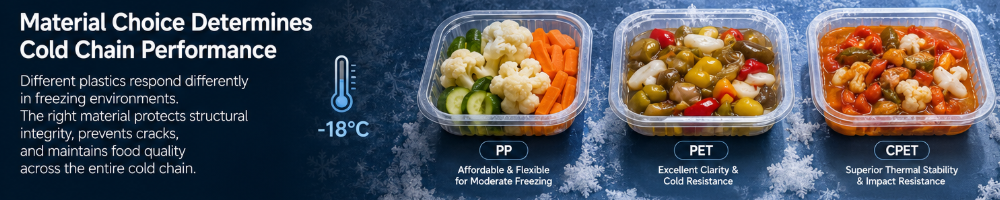
Polypropylene may offer affordability and flexibility for moderate cold storage, making it attractive for budget-conscious operations. However, depending on formulation, it may not always deliver the impact resistance needed for aggressive deep-freeze distribution.
PET often performs better in maintaining clarity and cold resistance, but structural design still matters. Transparent trays may look retail-ready while still lacking the toughness required for long-haul cold chain movement.
CPET generally provides stronger thermal stability across freezing and reheating ranges, which can make it a strategic option for brands balancing freezer durability with end-user convenience.
OPS, while useful in some packaging formats, may become too brittle in lower temperature environments where impact risk is high.
This is why smart buyers avoid asking, “What is the cheapest tray?” and instead ask, “Which material minimizes total landed damage cost?” A reliable relish tray supplier for frozen food distributors understands that lower upfront material costs can be erased by breakage claims and repacking expenses.
Thickness Alone Doesn’t Guarantee Freeze Resistance
A thicker tray does not automatically mean a stronger tray.
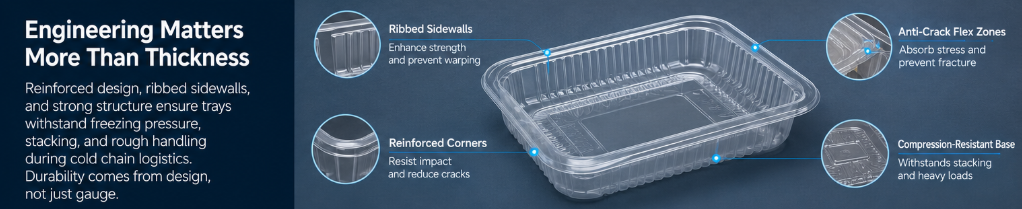
This assumption leads many buyers to overpay for material while still receiving structurally weak packaging. In cold chain conditions, durability often depends more on engineering than gauge.
Reinforced corners, ribbed sidewalls, compression-resistant bases, and anti-crack flex zones all influence how a tray performs under freezing pressure. A poorly designed thick tray may still fracture at vulnerable stress points, especially when stacked or dropped during handling.
For wholesale buyers, requesting performance validation is far more valuable than requesting “thicker plastic.” A qualified custom relish tray factory for export packaging should provide freeze-thaw cycle testing, drop resistance benchmarks, and compression data that reflects actual transport realities.
Packaging should not just survive freezing—it should survive frozen logistics.
Seal Integrity Can Be More Expensive Than Tray Breakage

Some of the most damaging cold chain failures happen even when the tray itself remains intact.
Low temperatures can alter lid fit, shrink sealing films, or create micro-gaps that compromise freshness. Moisture intrusion, freezer burn, and leakage can all stem from weak sealing performance rather than visible structural damage.
For relish trays containing brined vegetables, sauces, or segmented deli assortments, seal failure can trigger contamination concerns and retail rejection. In many cases, one faulty seal can cost more than a cracked tray because it affects product trust.
This is why buyers should evaluate tray-and-lid compatibility as a complete system. An experienced ODM relish tray supplier for private label brands typically approaches packaging as an integrated protective solution rather than isolated components.
Cold chain durability is not just about surviving impact—it is also about preserving containment.
Freight Efficiency and Damage Reduction Often Matter More Than Unit Cost
A tray that costs two cents less may look like a purchasing win. But if it increases damage rates during shipping, it can quietly drain profitability.
Cold chain packaging failures often create hidden expenses through return freight, labor for repacking, insurance claims, inventory loss, and customer dissatisfaction. For distributors operating on volume, even a small breakage percentage can significantly affect margin.
This is especially true for international shipments where long transit windows amplify structural weaknesses. Pallet compression over weeks of storage can expose tray design flaws that short domestic tests may miss.
That is why experienced sourcing teams focus on total cost of ownership. A dependable relish tray manufacturer for bulk food packaging helps buyers reduce breakage ratios, improve stacking performance, and stabilize long-term logistics outcomes.
In cold chain procurement, durability often protects profit more effectively than low price.
Standard Trays Work for Some Buyers—But Not All
Off-the-shelf trays can serve businesses with basic operational demands, especially in shorter regional distribution cycles. But as logistics complexity increases, standard packaging may start creating limitations.
Brands with automated filling lines, unique portion sizing, multi-compartment needs, or retailer-specific shelf dimensions often benefit from custom tooling. In freezing environments, customization can also improve wall geometry, lid retention, and anti-fracture performance.
This does not mean every buyer needs full customization immediately. But scaling brands should evaluate when standard packaging stops supporting growth.
A strategic bespoke relish tray manufacturer for commercial foodservice can often improve not only packaging durability, but also operational efficiency, branding consistency, and freight optimization.
The right tray should fit both your product and your business model.
What Serious Buyers Should Ask Before Placing a Large Order
The best sourcing decisions usually come from asking better questions.
Rather than focusing only on MOQ or lead time, buyers should verify tested temperature ranges, material composition, stacking performance, seal compatibility, and whether virgin or recycled resin is used.
A trustworthy relish tray factory for international buyers should be transparent about validation standards because freezing environments expose weak claims quickly.
If a supplier cannot clearly explain how their tray performs in real cold chain conditions, the risk often shifts directly to the buyer.
Procurement success is rarely about finding the fastest quote. It is about finding the tray least likely to fail after purchase.
The Right Relish Tray Protects More Than Product
When cold chain packaging performs well, it reduces breakage, protects freshness, strengthens retailer confidence, and supports brand reputation. When it fails, the opposite happens—often at scale.
For modern food brands, packaging is no longer just a vessel. It is a supply chain safeguard.
Choosing the right frozen-ready relish tray means balancing material science, logistics pressure, seal reliability, operational efficiency, and long-term cost control. Buyers who approach this strategically often outperform competitors who purchase based only on immediate savings.
Working with an experienced relish tray supplier for enterprise procurement can mean the difference between stable distribution and recurring packaging loss.
In freezing cold chain environments, the best relish tray is not simply the one that holds food. It is the one that consistently protects your margin from factory floor to final destination.