
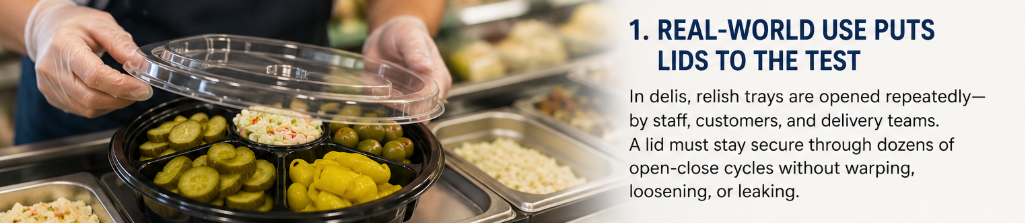
In a busy deli, a relish tray rarely gets opened just once. Staff refill sections during prep, customers lift lids while choosing sides, and delivery teams stack trays under pressure before they ever reach a refrigerated shelf. That means the real test of a relish tray lid is not how secure it feels when brand new—it is whether it still snaps shut after repeated use without warping, loosening, or leaking.
For deli operators, a loose lid is not a minor annoyance. It can mean dried-out pickles, mixed compartments, sauce spills, customer complaints, and wasted product. For procurement teams, it often leads to a bigger question: why do some trays stay secure through dozens of open-close cycles while others fail after a few uses?
The answer is rarely just “thicker plastic.” In reality, long-term lid retention depends on packaging engineering, material memory, mold precision, and how well the tray matches real deli operating conditions. Understanding these factors helps buyers avoid costly mistakes when choosing from a custom relish tray manufacturer or evaluating new packaging options.
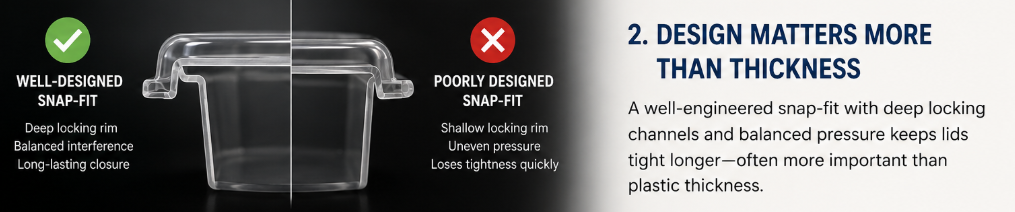
Why Tightness Changes After Repeated Opening
A relish tray lid may feel perfectly sealed on day one, but repeated flexing changes everything. Every time a lid is lifted, the hinge bends, the locking rim stretches, and the snap-fit structure experiences stress. Over time, weak designs lose their original grip.
This is especially common in deli environments because lids are often opened from one side rather than evenly lifted. That uneven force can distort the rim faster than lab-style testing predicts. A tray that performs well in factory demos may fail much sooner in actual store use.
This is why experienced buyers working with an OEM relish tray supplier often ask about cycle testing rather than first-use seal strength. Knowing whether a lid still retains closure after 20, 30, or even 50 openings gives far more useful insight than a one-time snap test.
Snap-Fit Design Often Matters More Than Plastic Thickness
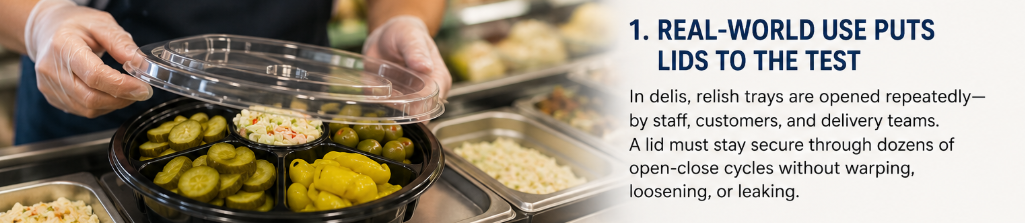
Many buyers assume a thicker lid automatically means better performance. In practice, lid geometry often matters more.
A poorly designed thick lid may still loosen quickly if the locking edge is shallow or the rim alignment is inconsistent. By contrast, a well-engineered snap-fit with deeper locking channels and balanced interference can maintain closure even with lighter material.
The best-performing deli trays often use audible-click closure systems, where users feel and hear secure engagement. This matters because employees can confirm closure instantly during high-speed prep.
When sourcing from a relish tray factory for foodservice packaging, buyers should pay attention to rim depth, lock symmetry, and hinge stress points—not just gauge thickness.
Material Memory: Why Some Plastics Recover Better
Repeated opening tests the memory of plastic. Some materials return to their original shape after flexing, while others gradually deform.
Polypropylene (PP) generally performs better for repeated-use deli lids because it offers stronger hinge resilience and better elastic recovery. PET, while often clearer and visually appealing, can become brittle in refrigerated settings and may lose locking force faster over time.
This distinction matters for businesses balancing presentation with functionality. A premium-looking tray may impress at first glance, but if the lid weakens after several uses, presentation quickly becomes irrelevant.
For buyers evaluating a PP relish tray manufacturer for deli chains, material selection should align with use frequency, refrigeration cycles, and customer interaction—not aesthetics alone.
Hinges Are Often The First Failure Point
In many cases, the lid itself is not the problem—the hinge is.
Integrated hinged lids are convenient, but weak hinge geometry often creates the earliest structural failure. Thin fold lines, overextended opening angles, or stress concentration can cause whitening, cracking, or loss of alignment.
Once hinge fatigue begins, even a strong locking rim may no longer align correctly. That is why quality suppliers often reinforce hinge zones or limit opening angles to preserve long-term structure.
A professional hinged relish tray supplier for supermarkets should be able to explain hinge fatigue prevention, not just sealing features.
Mold Precision Directly Affects Repeated Closure
Even excellent designs can fail if manufacturing precision is inconsistent.
Tiny dimensional errors in mold tooling can create uneven snap pressure. One side may lock tightly while another gradually loosens. Over large production runs, inconsistent cavity performance can result in varying lid quality within the same order.
This is especially important for high-volume deli programs, where thousands of trays are used weekly. Poor tolerance control can multiply small defects into widespread customer complaints.
That is why experienced procurement teams often prioritize suppliers with advanced tooling validation, especially when working with a custom deli relish tray factory producing private-label packaging.
Cold Storage Changes Everything
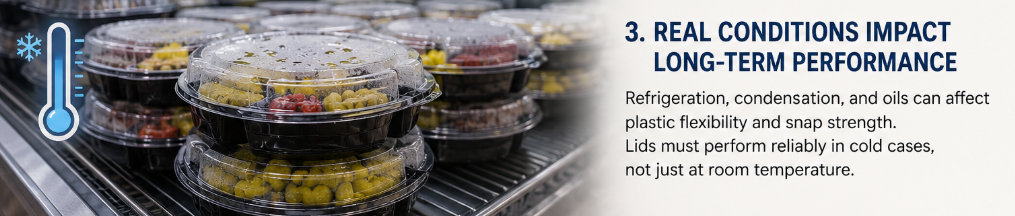
Refrigeration adds another layer of stress. Low temperatures can alter plastic flexibility, especially in PET-based trays. A lid that closes securely at room temperature may become stiffer, less forgiving, or more brittle after hours in cold display.
At the same time, condensation and product oils can interfere with snap edges, making lids feel inconsistent.
For delis displaying prepared foods all day, packaging must be chosen for cold-case performance—not just warehouse testing.
A reliable refrigerated relish tray manufacturer understands that deli packaging must function under real merchandising conditions, not controlled showroom environments.
User Behavior Also Impacts Lid Lifespan
Packaging design cannot be separated from human behavior.
Employees rushing through prep may repeatedly overbend lids. Customers may open trays from corners instead of designated lift tabs. Delivery staff may stack trays under uneven pressure.
The best packaging designs account for misuse by reinforcing vulnerable points and maintaining performance despite imperfect handling.
This practical durability is often what separates an average tray from one sourced through an experienced ODM relish tray supplier for retail distribution.
Common Procurement Mistakes That Lead To Loose Lids
Many lid issues begin before trays even arrive in-store.
Buyers often focus too heavily on unit price, overlooking mold life, closure retention, or hinge fatigue. Others prioritize crystal-clear appearance without considering repeat-use performance.
Another common issue is branding placement. Heavy embossing or custom logo structures too close to sealing rims can weaken closure geometry.
This is why companies sourcing from a branded relish tray manufacturer for private label should review design modifications carefully to ensure visual customization does not compromise function.
How Smart Buyers Evaluate Lid Security
The most effective buyers think beyond specsheets.
Instead of asking, “Is this lid tight?” they ask:
How many open-close cycles has it passed?
How does it perform after refrigeration?
Does the hinge whiten after repeated flexing?
Is closure consistent across production batches?
These operational questions reveal whether a supplier truly understands deli realities.
Working with an experienced relish tray supplier for grocery operations often means better answers, better testing, and fewer field failures.
Tight Lids Are About Total Packaging Engineering
A relish tray lid that stays tight after repeated opening is not the result of one feature—it is the outcome of design intelligence, material resilience, precision manufacturing, and real-world usability.
For deli businesses, the goal is not just preventing spills. It is protecting freshness, preserving presentation, reducing shrink, and minimizing customer frustration.
Choosing the right tray means looking beyond first impressions and focusing on long-term operational reliability. The right food-grade relish tray manufacturer for commercial deli use does more than produce containers—they help businesses reduce complaints, improve shelf performance, and protect product quality across every open-and-close cycle.