
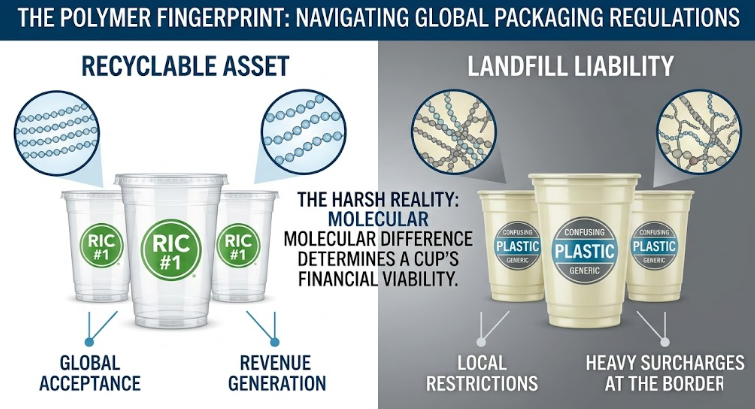
Navigating the minefield of global packaging regulations has become a full-time headache for procurement officers. It is no longer enough to simply buy “plastic”; the financial viability of your inventory now hinges on the chemical “fingerprint” of the resin. Determining which cup is a recyclable asset and which is a landfill liability requires a deep dive into polymer science and local waste economics. For instance, an operations manager coordinating with a plastic cold cup manufacturer must demand precise Resin Identification Codes (RIC) to ensure their bulk orders don’t get slapped with heavy “non-recyclable” surcharges at the border.
The harsh reality is that a cup’s transparency is often deceptive. A custom PET cup supplier might deliver a product that looks identical to a cheaper alternative, yet the molecular difference determines whether that cup is reborn as a new container or sits in a landfill for five centuries. In a B2B context, the commercial logic is driven by “stream purity”—the more uniform your material, the higher its secondary market value. If you are sourcing for a massive stadium or a multi-national cafe chain, the recyclability of your waste stream isn’t just a PR win; it’s a mitigation strategy against the rising costs of industrial waste disposal.

The PET Paradox: Why Type 1 Rules the Market
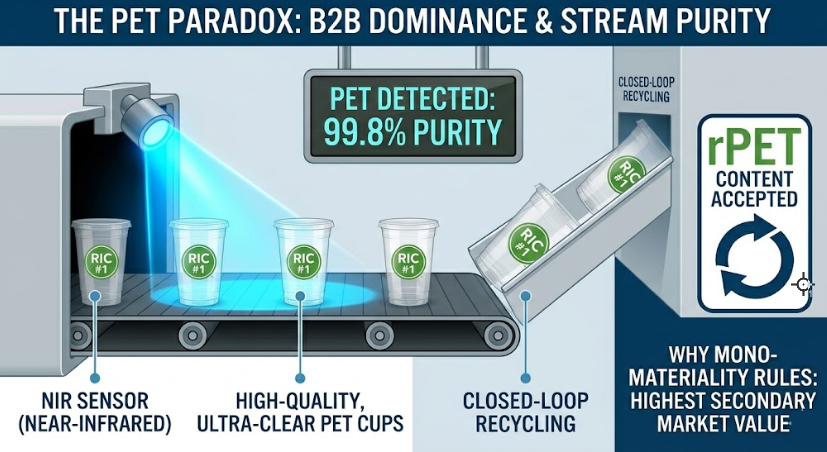
Polyethylene Terephthalate (PET) is the undisputed king of the circular economy. Its dominance isn’t accidental; it’s the only plastic with a truly mature, globalized recycling infrastructure. Unlike other resins that “downcycle” into lower-quality park benches, PET can undergo multiple mechanical washes and remains food-grade. High-volume distributors often vet a disposable drink cup factory based on their ability to handle rPET (recycled PET) content without losing structural clarity. This is the “gold standard” because the carbon footprint of the product drops significantly when the loop is closed.
However, from an export perspective, the stakes are higher. An OEM plastic cup exporter needs to guarantee that no additives or “slip agents” have been introduced during the molding process that could trigger a rejection at a municipal sorting facility. Even a small percentage of contamination can ruin a multi-ton bale of recycled plastic. Therefore, professional buyers prioritize mono-material designs—essentially, keeping the cup, the lid, and the straw within the same polymer family to simplify the recovery process for the end-user.
Polypropylene and the Heat Resistance Hurdle
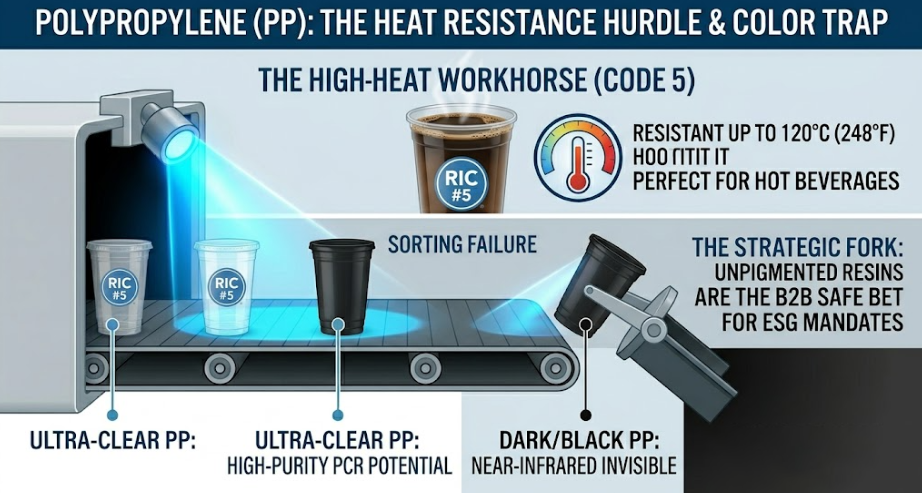
Then there is Polypropylene (PP), the “Workhorse” (Code 5). Known for its high melting point and chemical resilience, PP is the go-to for hot lattes and microwaveable soups. While the material is technically 100% recyclable, the infrastructure to collect it is often fragmented compared to PET. When you are negotiating with a PP beverage cup wholesaler, the conversation shouldn’t just be about price-per-unit; it should be about the “post-consumer resin” (PCR) potential. Modern sorting plants use infrared sensors to pick out PP, but if the cup is dyed black or a dark opaque color, those sensors often fail, sending perfectly good plastic to the incinerator.
This creates a strategic fork in the road for a plastic cup supplier for wholesale buyers. To stay compliant with evolving ESG (Environmental, Social, and Governance) mandates, many suppliers are shifting toward ultra-clear PP. This allows the material to be more easily identified by automated systems. For a B2B buyer, the “safe bet” is always clear or unpigmented resins. It ensures that the product remains “visible” to the recycling loop, maintaining the brand’s reputation for environmental stewardship without sacrificing the thermal performance that PP provides.
The “Untouchables”: Why Certain Plastics Fail
The most frustrating part for many procurement teams is the “ghost” materials—plastics that look recyclable but aren’t. Polystyrene (PS/Code 6) is the prime example. It’s lightweight and cheap, yet most municipal programs won’t touch it because it breaks into tiny, unmanageable shards during transport. Similarly, the industry is seeing a surge in PLA (Polylactic Acid) “compostable” cups. While marketed as green, PLA is a nightmare for traditional recyclers. If a PLA cup from a professional beverage container manufacturer accidentally slips into a PET recycling stream, it acts like a poison, lowering the melting point of the entire batch and rendering the recycled plastic useless for high-pressure molding.
This “cross-contamination” is the silent killer of recycling efficiency. Procurement managers must act as the first line of defense, ensuring that their supply chain doesn’t mix incompatible materials. A dual-material cup—one that uses a plastic liner fused to a paper exterior—might look eco-friendly, but unless the two layers can be separated with zero residue, it is effectively non-recyclable. The move toward “mono-materiality” is the only logical path for firms looking to avoid the logistical nightmare of specialized waste sorting.
Future-Proofing the Procurement Strategy
The window for “ignoring” the end-of-life cycle of packaging is closing fast. With the EU and several US states introducing “Plastic Taxes” based on the percentage of non-recyclable material in a shipment, the bottom line is directly tied to chemical purity. Partnering with a reliable plastic cup factory that offers transparent material data sheets (MDS) is no longer a luxury—it’s a survival tactic. You need to know exactly what is in your plastic to defend your margins against future legislative shifts.
Securing a contract with a wholesale clear cup supplier that prioritizes NIR-detectable resins ensures that your company stays ahead of the curve. By focusing on high-purity PET and PP while aggressively cutting out PS and PLA, a business can stabilize its supply chain and avoid the volatility of “unrecyclable” waste markets. In the end, the most recyclable cup is the one that is engineered from the start to be found, cleaned, and reused. Those who master this material logic today will be the ones who lead the B2B packaging market tomorrow.