
In the high-volume world of food packaging, “microwave safe” is a term often thrown around by marketing departments, but for a procurement lead, it is a technical minefield. When you’re managing a global supply chain, a single batch of melting cups doesn’t just mean a refund—it means a potential brand crisis. The reality is that “plastic” is an umbrella term for dozens of distinct polymers, each with its own thermal ceiling. If you are currently vetting a custom plastic cup manufacturer, your focus must shift from surface-level aesthetics to the specific Melt Flow Rate (MFR) and heat deflection temperature (HDT) of the resins in play.
1. Polypropylene (PP): The Indispensable Industry Benchmark
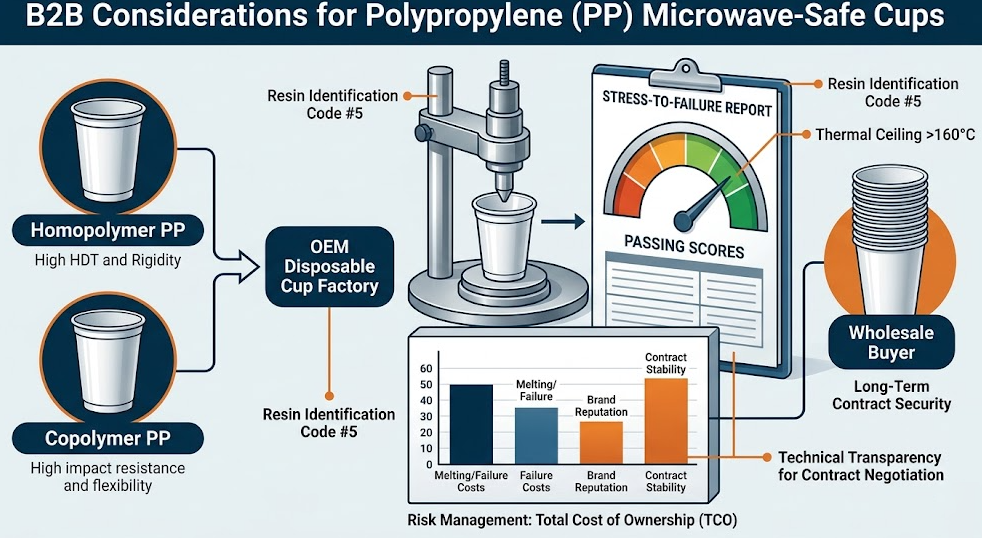
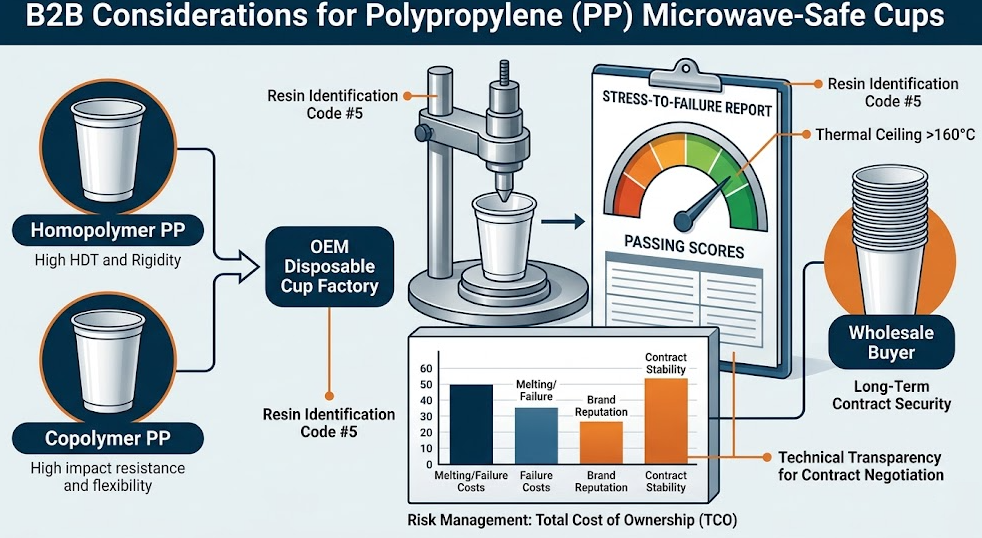
If you look at the bottom of a microwave-ready container, you will almost always see the #5 recycling symbol. Polypropylene is the bedrock of this industry for a reason: its melting point sits comfortably above 160°C. However, from a B2B perspective, not all PP is created equal. When sourcing from an OEM disposable cup factory, you need to distinguish between homopolymers and copolymers. Homopolymers offer higher stiffness and heat resistance—perfect for those “extra-hot” coffee applications—while copolymers offer better impact resistance at lower temperatures.
The commercial logic here is about risk management. A reliable polypropylene cup supplier shouldn’t just send you a sample; they should provide a “stress-to-failure” report. This data tells you exactly how many minutes the cup can withstand a 1000W microwave cycle before the rim loses its seal. For wholesale buyers, this technical transparency is the only way to justify a long-term contract.
2. CPET (Crystallized PET): For High-Heat Precision

Most people know that standard PET (Code #1) is a disaster in the microwave—it warps at just 70°C. But Crystallized PET (CPET) is the exception that proves the rule. By adding nucleating agents and adjusting the cooling process, manufacturers create a material that can handle temperatures up to 220°C. For a premium plastic cup factory for global distributors, CPET is the “luxury” option. It has the glass-like rigidity of PET but handles heat better than standard PP.
If your client base involves “ready-to-eat” premium meals or hospital catering, CPET is your strongest play. It feels substantial in the hand and doesn’t get “greasy” or soft when exposed to oils. When negotiating with an industrial-scale plastic cup producer, ask about their crystallization percentage. Higher crystallization means better heat stability, which is exactly what your high-end clients are paying for.
3. MFPP (Mineral-Filled Polypropylene): The Cost-Effective Hybrid
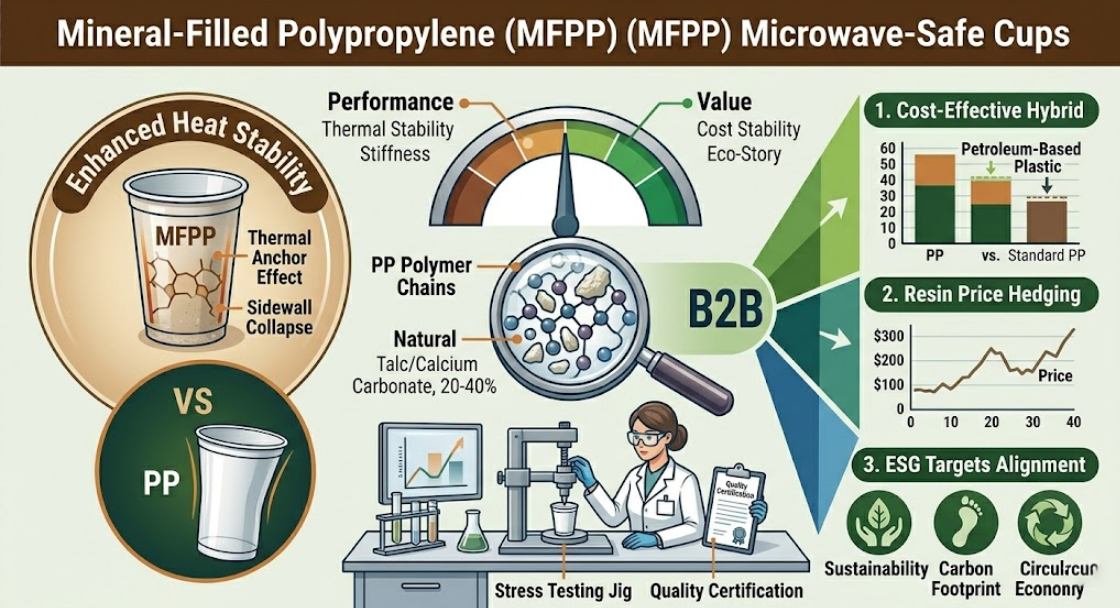
In the current economic climate, everyone is looking for a way to hedge against fluctuating resin prices. This is where Mineral-Filled Polypropylene (MFPP) comes in. By blending PP with 20% to 40% natural minerals like talc or calcium carbonate, a specialized plastic cup factory for B2B clients can create a cup that is actually more heat-stable than pure PP. The minerals act as a thermal anchor, preventing the polymer chains from moving too much when the temperature spikes.
But the real B2B advantage is the “eco-story” combined with cost. MFPP uses less petroleum-based plastic, which appeals to the ESG (Environmental, Social, and Governance) targets of major retailers. It’s a win-win: you get a microwave-safe product that is stiffer and more resistant to “sidewall collapse,” often at a more stable price point than pure resin.
4. High-Heat HDPE: The Durable Specialty Choice
While less common than PP, specific grades of High-Density Polyethylene (HDPE, Code #2) are engineered for microwave use, particularly for heavy-duty food containers. HDPE has a high strength-to-density ratio, making it incredibly tough. When you work with a leading custom cup supplier for food chains, you might find HDPE being used for “reusable” microwave-safe lines. It doesn’t have the clarity of other plastics, but for industrial kitchens and bulk meal prep, its durability is unmatched.
The “Gram Weight” Trap: Why Safety is a Physical Metric
You can have the best CPET resin in the world, but if the factory thins out the walls to save 0.5 cents per unit, the cup will fail. This is the “Gram Weight” trap. A microwave-safe cup must have enough material density to absorb thermal energy without losing its “hoop strength.”
When you audit a professional plastic drinking cup manufacturer, pay attention to their “clamping force” and mold precision. A cup with uneven wall thickness will develop “thin spots” during the thermoforming process. These spots become the points of failure in a microwave. A professional plastic cup manufacturer for bulk orders will have automated optical inspection (AOI) to kick out any unit that doesn’t meet the minimum thickness threshold. As a buyer, your “Total Cost of Ownership” (TCO) increases every time a thin-walled cup fails and causes a leak.
Regulatory “Paper Trails” and B2B Compliance
In international trade, a “microwave safe” claim without an SGS or FDA migration report is a massive liability. These tests don’t just check if the plastic melts; they check for “Overall Migration” (OM) and “Specific Migration Limits” (SML). You need to know that at 100°C, the plastic isn’t shedding its chemical additives into the consumer’s food.
Any certified plastic cup wholesaler worth their salt should be able to produce a Declaration of Compliance (DoC) on demand. If they hesitate, they are likely cutting corners on resin quality. In the EU and US markets, the burden of proof is on the importer. Partnering with a custom cup supplier for food chains that maintains a “gold standard” lab on-site is the best way to future-proof your business against evolving food safety laws.
Strategic Sourcing: The Bottom Line
Choosing the right type of microwave-safe plastic cup is a balance of polymer science and commercial grit. Whether you opt for the versatility of PP, the high-end performance of CPET, or the structural stability of MFPP, your choice defines your brand’s reliability.
Don’t just buy a commodity; buy a technical solution. Look for a manufacturer that talks about crystallization rates, mineral loads, and wall-thickness tolerances. In the high-volume B2B world, the most expensive product isn’t the one with the highest unit price—it’s the one that fails in the end-user’s microwave. Your supply chain is only as strong as the polymer science behind it.