
For restaurants, salad chains, meal prep brands, and food delivery operators, packaging failure rarely feels like a packaging problem—it feels like a customer retention problem. A sugarcane salad bowl that arrives bent, soggy, or leaking can instantly downgrade the perceived quality of the meal inside, no matter how fresh the ingredients are. Many food businesses switch to sugarcane bowls for sustainability goals, but operational reality quickly sets in: eco-friendly means little if the bowl cannot survive a 30-minute delivery route.
The real challenge is not simply buying compostable bowls. It is making sure those bowls maintain structure from kitchen assembly to customer doorstep. For operators sourcing from a sugarcane salad bowl manufacturer for restaurant chains, sturdiness should be treated as a performance requirement, not a bonus feature.
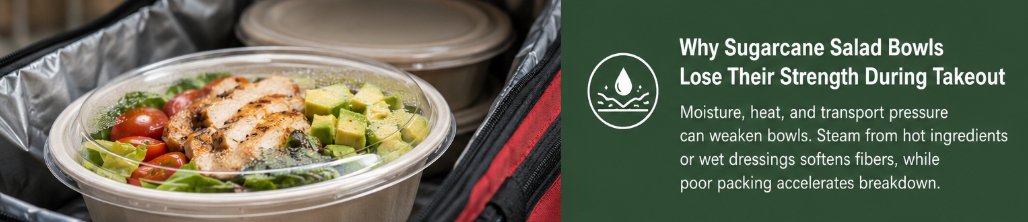
Why Sugarcane Salad Bowls Lose Their Strength During Takeout

Sugarcane fiber bowls are often chosen because they balance sustainability with a cleaner brand image, but they are still vulnerable to structural breakdown when used incorrectly. Most bowl failures happen because businesses focus only on material type and ignore the combined pressure of food moisture, temperature, and transport.
A cold salad with light greens may perform well in almost any bowl, but once ingredients like grilled chicken, quinoa, warm rice, avocado, or dressing are added, moisture and weight increase significantly. Steam from freshly cooked proteins can soften fibers faster than expected, while acidic dressings can weaken the interior surface over time. This is where many operators realize that not all sugarcane bowls are built for the same use case.
Choosing from an oem salad bowl supplier for foodservice brands without checking moisture resistance or compression strength often leads to bowls that perform well on paper but fail in real delivery conditions.
Bowl Thickness Is More Important Than Most Buyers Think

One of the biggest purchasing mistakes is assuming all sugarcane bowls offer similar durability. In practice, wall thickness and pulp density make a major difference. Thin bowls may reduce upfront cost, but under stacked delivery conditions, they are far more likely to flex or buckle.
High-density double-pressed sugarcane bowls generally offer better rigidity, especially when carrying heavier mixed salads or grain bowls. Reinforced rims also matter because the rim often absorbs pressure from lids, stacked bags, and courier handling. A weak rim can distort under pressure, causing lid separation or sidewall collapse.
Experienced buyers working with a custom salad bowl factory for private label packaging often prioritize compression-tested bowl designs over basic commodity models because structural consistency directly impacts complaint rates.
Moisture Control Starts Before Packaging Selection
Even the best bowl can fail if food is packed poorly. Many takeout issues blamed on packaging are actually caused by kitchen assembly habits. Warm ingredients placed directly into bowls create steam, and trapped condensation slowly softens the bowl interior during transit.
Allowing hot proteins or grains to cool slightly before sealing can dramatically improve bowl integrity. Separating dressings into side containers also reduces liquid saturation. Strategic layering helps too—placing dry greens or grains between wet ingredients and the bowl base can create a natural moisture buffer.
This operational mindset is especially important for brands sourcing from a bagasse salad bowl supplier for meal delivery companies, where packaging performance depends as much on kitchen process as product quality.
Lid Fit Can Make Or Break Bowl Stability
Restaurants often focus heavily on bowl material while underestimating the lid system. In reality, poor lid design can accelerate bowl damage. A lid that snaps too tightly may compress the rim and weaken structural form, while a loose lid increases spill risk during movement.
For delivery-heavy businesses, lid compatibility should be evaluated as a complete packaging system. Secure closure, steam venting options, and vertical stack stability all influence whether bowls stay intact. Some suppliers now design bowl-lid combinations specifically for high-mobility foodservice environments.
This is why sourcing from a sugarcane bowl and lid manufacturer for delivery kitchens can often outperform mixing bowls and lids from multiple vendors with inconsistent fit standards.
Delivery Conditions Are Often The Hidden Stress Test

A sugarcane bowl may hold up perfectly on a countertop but fail inside a crowded courier bag. Delivery introduces vibration, stacking, tilt angles, and weight compression. Long-distance transport or multiple stacked orders can expose weaknesses that short in-house tests miss.
Businesses that rely heavily on third-party delivery platforms should test bowls in realistic scenarios, including 30–45 minute trips, stacked order simulations, and hot/cold mixed meals. Secondary packaging such as support trays or reinforced carriers may be necessary for larger salads or protein bowls.
For procurement teams, partnering with an odm compostable salad bowl manufacturer for distributors often provides access to more transport-tested designs rather than generic off-the-shelf products.
Cost Savings Can Backfire Quickly
It is tempting to choose the cheapest bowl that appears visually acceptable, especially when managing food cost margins. But packaging cost should be evaluated against refund rates, replacement orders, and negative reviews. Saving a few cents per bowl can become expensive if structural failures create customer dissatisfaction.
A collapsed bowl does more than spill food—it can damage brand trust. Customers may interpret poor packaging as poor food quality, even if the meal itself is excellent. In competitive takeout markets, presentation reliability often matters as much as taste.
That is why many scaling brands source through a wholesale sugarcane salad container factory for QSR brands with performance consistency rather than lowest-cost commodity sourcing.
Matching Bowl Type To Menu Type Matters
Not every sugarcane bowl is suitable for every menu category. Lightweight salad-only operations may need less structural reinforcement than poke brands, rice bowl concepts, or meal prep services. Using a standard salad bowl for heavier hot meals is one of the fastest ways to create packaging issues.
Businesses should align bowl specifications with:
portion weight, moisture level, heat retention, delivery distance, and stacking frequency.
For example, salad concepts focused on dine-in or short-distance takeaway may prioritize aesthetics and moderate rigidity, while delivery-first kitchens often need thicker walls and reinforced bases.
Brands working with a private mold salad bowl manufacturer for enterprise buyers can often customize bowl dimensions and strength around their specific menu architecture.
Supplier Questions Smart Buyers Always Ask
The strongest B2B buyers do not simply request pricing—they ask performance questions. Before placing larger orders, it is worth verifying whether the bowl has been tested for oil resistance, hot food tolerance, lid retention, and load-bearing capacity.
Important considerations include:
How long can the bowl hold hot food without softening?
How does it perform with dressing-heavy meals?
Can it withstand stacked transport?
Are custom thickness options available?
A qualified eco-friendly salad bowl supplier for global food packaging importers should be prepared to discuss these practical benchmarks, not just sustainability certifications.
The Bottom Line: Sturdy Takeout Starts With System Thinking
Keeping sugarcane salad bowls firm and sturdy is not about finding one “perfect” bowl. It requires combining the right material specifications, menu compatibility, kitchen packing practices, lid systems, and delivery logistics into one cohesive process.
For food businesses, the goal is simple: customers should remember the freshness of the meal, not the failure of the container.
When operators treat sugarcane bowl sourcing as a strategic packaging decision rather than a commodity purchase, they reduce complaints, improve customer confidence, and create a more reliable takeout experience. In modern foodservice, bowl durability is not just packaging—it is part of the product itself.