
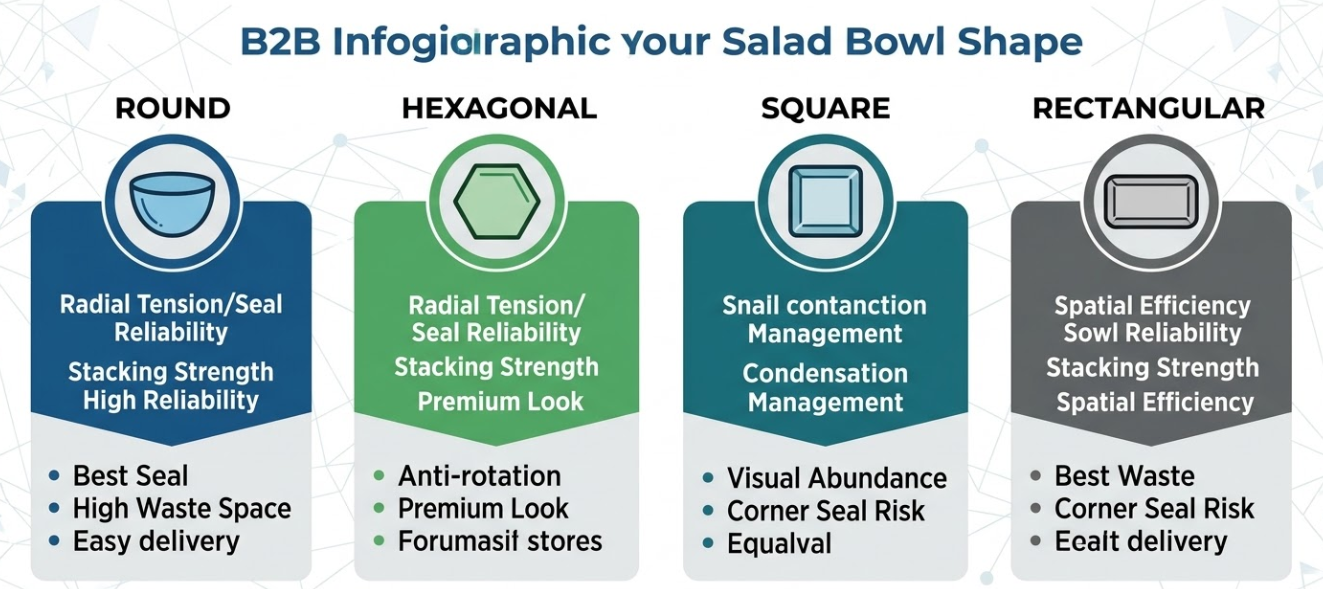
In the sophisticated world of B2B food supply chains, a single design decision can dictate the thin margin between a premium customer experience and a logistics nightmare. For healthy fast-casual brands, a salad bowl is far more than a simple vessel; it is a mobile engineering solution. When we analyze which shape reigns superior, we are evaluating how structural geometry preserves leaf turgidity, prevents dressing leakage, and maintains presentation under the brutal conditions of third-party delivery.

The Physics of Shape: Why Geometry Dictates Freshness
From a structural engineering perspective, the shape of a salad bowl dictates the distribution of radial tension along the rim. Round bowls, with their perfect symmetry, allow the lid to apply uniform downward pressure, making them the gold standard for preventing fluid migration. However, the delivery environment is rarely a controlled laboratory. In real-world scenarios, delivery riders often stack four to six containers in a single thermal bag. Under this vertical load, a poorly designed rim can suffer micro-deformations, leading to immediate seal failure.
Furthermore, condensation management is a critical factor in shape selection. Since salads often combine warm proteins with chilled greens, moisture buildup is inevitable. If the walls are too vertical, condensation droplets slide directly into the base, wilting delicate arugula or spinach. A sophisticated custom eco-friendly salad bowl manufacturer will engineer specific side-wall tapers to channel moisture away from the greens, effectively extending the “shelf-life” of the product during its transit from the kitchen to the customer’s desk.
Hexagonal Bowls: The Structural Dark Horse
In recent years, the hexagonal salad bowl has surged in popularity within the B2B sector, becoming a hallmark of premium lifestyle brands. This shape, inspired by the biomimicry of honeycombs, offers exceptional structural rigidity. Each of the six corners acts as a vertical reinforcement pillar, providing significantly higher crush resistance compared to traditional circular designs. For procurement officers looking to differentiate their brand, partnering with an innovative hexagonal paper salad bowl factory allows for a visual upgrade that signals modernity and structural integrity.
In a delivery bag, hexagonal containers exhibit superior anti-rotation properties. While round bowls tend to pivot and slide against one another, the flat facets of a hexagon create stable contact points with adjacent containers or the walls of the delivery box. This reduction in kinetic movement ensures that meticulously placed toppings—like avocado slices or roasted seeds—remain in their intended positions. This balance of utility and aesthetics is why they are frequently recommended by premium disposable salad bowl suppliers for high-end cafes.
Round Bowls: The Unstoppable Efficiency Standard

Despite the rise of geometric alternatives, the round bowl still commands over 60% of the global takeaway market. This dominance is rooted in manufacturing speed and cost-effectiveness. Because the molds are simpler and require less complex tension management during the forming process, production cycles are faster and waste rates are lower. For high-volume franchises where cost per unit is the primary KPI, securing a reliable bulk round salad container supplier is the most direct path to protecting operational margins.
In leak-resistance testing, round bowls offer the highest tolerance for error. Without corners to act as stress points, the lid-to-rim contact is continuous. This makes round containers particularly effective for “wet” salads or grain bowls with high oil content. However, their weakness lies in spatial efficiency. In a standard rectangular delivery bag, the “dead space” between round containers can exceed 22%, meaning fewer orders per trip and higher logistics costs over time.
Square and Rectangular: Masters of Visual Real Estate
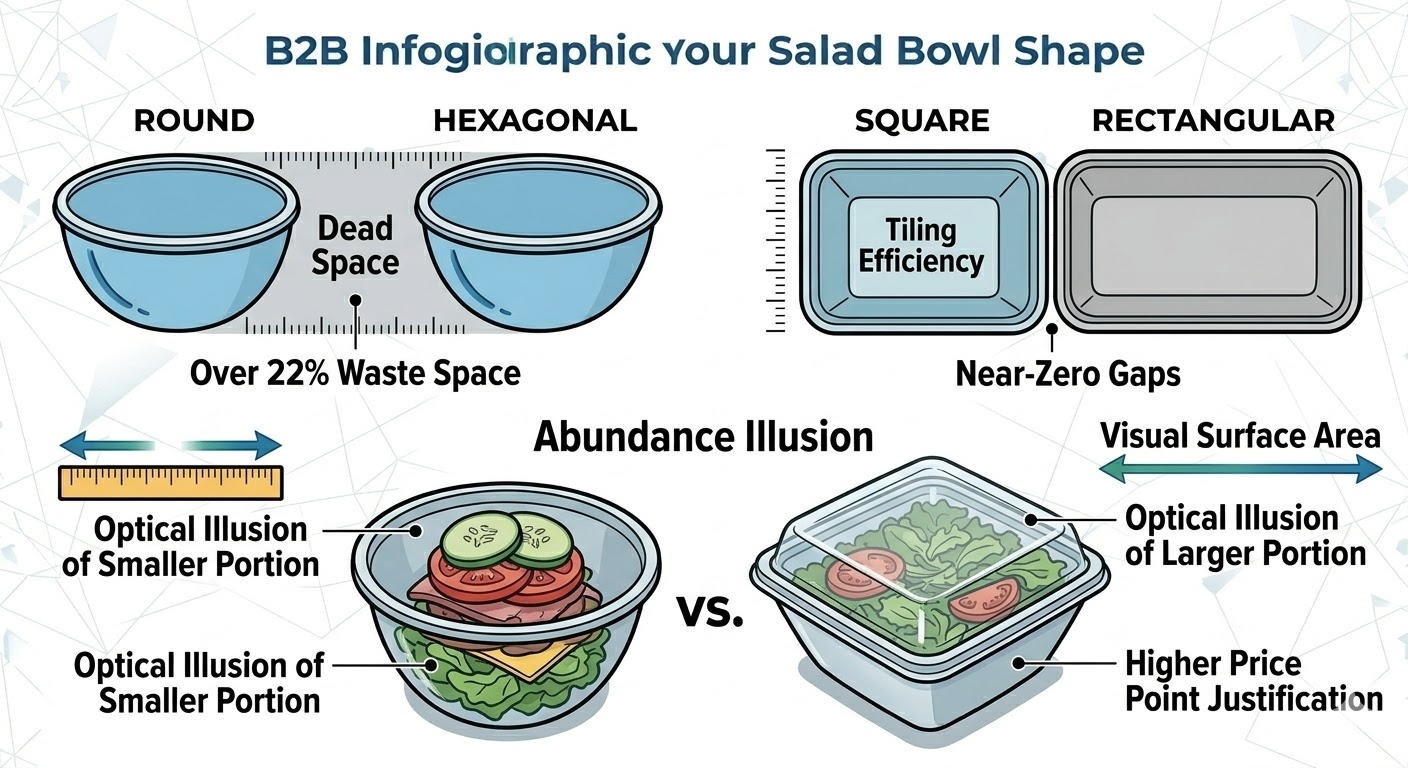
If your brand identity revolves around the “abundance” of ingredients, square or rectangular bowls are indispensable. The flat-bottom design allows toppings to be spread horizontally rather than stacked vertically. This creates an optical illusion of a larger portion size, justifying a higher price point. Many professional square plastic salad bowl manufacturers for meal prep brands emphasize that square formats allow consumers to see every ingredient at a glance, which builds immediate trust in the quality of the produce.
Logistically, square bowls are the champions of space utilization. They can be tiled perfectly inside a delivery bag, reducing air gaps to near zero. This is vital for “ghost kitchens” or high-capacity fulfillment centers that need to maximize every square inch of their delivery fleet. However, square lids require more precise engineering, as corner seals are often prone to lifting. Therefore, rigorous vibration testing is essential before committing to a long-term supply contract.
The Material-Shape Synergy
Choosing a shape without considering the substrate is a mistake. Bagasse, for instance, offers a tactile rigidity that performs exceptionally well in hexagonal forms, providing a “premium organic” feel. For brands pushing for zero-waste targets, selecting sustainable plant-based salad bowl factories for eco-conscious enterprises ensures the container maintains its geometric form even when exposed to high-humidity environments.
In contrast, transparent PET or PLA is best suited for square and rectangular formats. The clarity of the material combined with the wide surface area of the lid maximizes “appetite appeal.” Research indicates that transparent square containers in cold-chain delivery can see a 30% higher click-to-buy conversion rate compared to opaque round counterparts. However, for warm salads, PP or heavy-duty paper is mandatory to prevent heat-induced warping.
Final Decision: Which Shape Wins?
The ultimate choice depends on your specific business model. If you operate a high-volume, mid-market chain where speed and cost-control are paramount, the classic round paper bowl remains the safest investment. However, if you are scaling a premium brand where unboxing and social media presence are key growth drivers, the hexagonal bowl provides the structural “wow factor” needed to stand out.
Before placing a bulk order, it is advisable to request samples from a trusted industrial salad bowl wholesale distributor to conduct a “30-minute stress test.” Observe how each shape handles the combination of vibration, stacking pressure, and sauce saturation. Only then can you be sure which shape truly protects your culinary craft.