
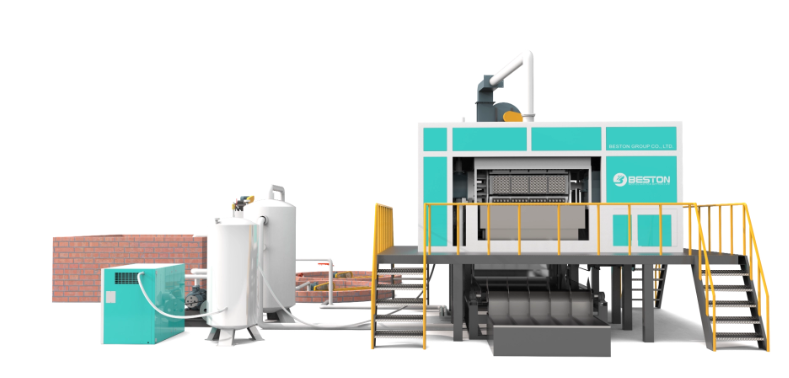
The phrase “raw material for egg tray machines” sounds straightforward, but it causes more confusion than almost any other topic in molded pulp packaging. Many new buyers assume it refers to the steel, motors, or structural components of the machine itself. In reality, it almost never does.
When manufacturers talk about raw materials in this context, they are talking about what goes into the machine, not what the machine is made of. Specifically, they mean the fiber material that is turned into pulp, shaped in molds, and dried into egg trays. Once that distinction is clear, the question becomes much easier to answer—and also more practical.
At its core, egg tray production relies on fiber that can be broken down in water, evenly suspended, and molded under pressure. Whether that fiber comes from recycled paper or plants matters less in theory than it does in daily operation. Cost, availability, strength, and market expectations usually decide long before sustainability slogans enter the conversation.
What “Raw Material” Actually Means in Egg Tray Production
Egg trays are molded pulp products. That means they begin as fiber suspended in water, not as sheets or rolls. The machine does not “cut” trays from paper; it forms them from slurry. Because of that, only materials that can be pulped efficiently are relevant.
In practice, most raw materials fall into two broad groups. The first is recycled paper pulp. The second is plant-based fiber pulp, which includes materials like sugarcane bagasse, bamboo, wheat straw, and wood pulp. Each behaves differently once it enters the pulping system, and those differences show up in cost, product quality, and production stability.
Understanding these differences early prevents unrealistic expectations later.
Recycled Waste Paper Pulp: The Industry Default

If you walk into a typical egg tray factory anywhere in the world, chances are high that recycled waste paper is the primary raw material. This is not because it is perfect, but because it works well enough at the lowest overall cost.
Waste paper pulp usually comes from a mix of old newspapers, used cartons, office paper, and other post-consumer sources. The exact blend varies by region. Areas with strong recycling systems tend to have cleaner, more consistent input material. Regions with weaker sorting systems often deal with higher contamination levels.
The biggest advantage of waste paper pulp is availability. It exists everywhere, year-round, and in large volumes. That consistency matters more than many buyers realize. A factory that cannot secure stable raw material supply will struggle no matter how advanced the machine is.
Cost is the second major factor. Compared to plant fibers, recycled pulp is significantly cheaper in most markets. For standard egg trays sold into price-sensitive markets, that difference often determines whether a product is viable at all.
There are limits, however. Fibers from recycled paper are shorter and weaker due to repeated processing. Trays made from waste paper pulp generally have lower strength and poorer moisture resistance. Ink residue and surface contamination can also affect appearance and hygiene, which is why this material is rarely used for high-end or food-contact–sensitive packaging.
Still, for standard egg trays, industrial transport trays, and domestic markets where price dominates, recycled paper pulp remains the default choice for a reason.
Plant Fiber Pulps for Higher Requirements
As expectations change, especially in export and food-related markets, manufacturers often look beyond recycled paper. Plant fiber pulps offer cleaner surfaces, stronger fibers, and better environmental messaging—but they also introduce new challenges.
Sugarcane Bagasse Pulp
Sugarcane bagasse pulp comes from agricultural waste left after sugar extraction. Its fibers are longer and more uniform than recycled paper fibers, which improves strength and surface quality. Trays made from bagasse tend to feel sturdier and cleaner to the touch.
One of the main reasons manufacturers choose bagasse pulp is food safety perception. It is commonly associated with food-grade packaging and biodegradable tableware. For markets that require higher hygiene standards or certifications, this matters.
The trade-off is cost and supply stability. Bagasse pulp is typically more expensive than waste paper pulp. Supply can also be seasonal, depending on local sugar production cycles. Not every pulping system is optimized for bagasse either, which may require adjustments in equipment or process parameters.
Because of this, bagasse pulp is often used for premium egg trays, export products, or brands that actively market sustainability.
Bamboo Pulp
Bamboo pulp occupies a similar space but pushes further toward the high end. Bamboo fibers are strong, dense, and associated with rapid renewability. From a branding perspective, bamboo carries strong environmental value.
In production, bamboo pulp produces trays with good strength and smooth surfaces. However, processing bamboo fiber requires more energy and specialized equipment. Outside of regions where bamboo is locally abundant, supply chains can be complex and expensive.
As a result, bamboo pulp is rarely chosen for mass-market egg trays. It is more common in niche products, high-end packaging, or export-focused lines where material cost is secondary to brand positioning.
Wheat Straw and Other Agricultural Fibers
Wheat straw, rice straw, and similar fibers are often discussed as alternatives, but their use is highly regional. These fibers can be renewable and locally available, but they are harder to process consistently.
Fiber length, impurities, and seasonal availability all complicate large-scale production. While technically viable, these materials are usually adopted only when local conditions strongly favor them or when subsidies or regulations encourage their use.
Virgin Wood Pulp: Strength Comes at a Price
Virgin wood pulp, whether from hardwood or softwood, offers the most predictable fiber quality. Softwood pulp provides longer fibers and higher strength, while hardwood pulp offers better surface uniformity.
From a performance standpoint, wood pulp produces strong, stable trays. From a business standpoint, it is difficult to justify in most cases. The cost is significantly higher than recycled pulp, and the environmental narrative is less favorable unless certifications are in place.
Because of this, virgin wood pulp is generally reserved for special applications where strength is critical and cost sensitivity is low.
Defining “Best” in Practical Terms
Asking for the “best” raw material only makes sense when the goal is defined. For some manufacturers, best means cheapest. For others, it means strongest, cleanest, or most marketable.
Cost and supply stability usually come first. A slightly weaker tray that can be produced consistently is better than a premium tray that depends on unstable raw material supply.
Physical performance matters next. Compression strength, stacking behavior, moisture tolerance, and airflow all affect how trays perform during transport and storage.
Hygiene and compliance increasingly influence decisions, especially for export markets. Material cleanliness, contamination control, and certification compatibility can outweigh small cost differences.
Environmental considerations add another layer. Recyclability, biodegradability, and carbon footprint are now part of many purchasing decisions, even if they are not the primary driver.
Matching Material to Business Goals
For large-scale, cost-driven production, recycled waste paper pulp remains the most rational choice. It balances price, availability, and acceptable performance.
For manufacturers targeting food-grade or export markets, sugarcane bagasse pulp often offers the best compromise between strength, cleanliness, and sustainability.
For premium or brand-driven positioning, bamboo pulp or blended plant fibers can support higher pricing and differentiation.
In many real factories, the answer is not a single material but a blend. Mixing recycled pulp with a percentage of bagasse or wood pulp can improve strength and appearance without doubling costs. These hybrid formulas are common precisely because they allow flexibility.
Practical Factors That Matter More Than Material Lists

Regional supply chains shape material decisions more than technical comparisons. What works in one country may be unrealistic in another.
Target markets also matter. Domestic buyers often prioritize price. Export buyers often prioritize compliance and perception.
Equipment compatibility cannot be ignored. Some fibers demand better screening, water treatment, or refining. Ignoring these requirements leads to unstable production.
Finally, consistency matters. A slightly imperfect tray that performs the same way every day is more valuable than a perfect tray produced inconsistently.
Final Perspective
There is no single best raw material for egg tray machines. There is only the material that fits your cost structure, supply environment, equipment, and market expectations.
The reason recycled waste paper pulp dominates the industry is not habit. It is economics. Higher-end materials exist for good reasons, but they serve specific goals, not universal ones.
The best raw material is the one that lets your factory run smoothly, your customers stay satisfied, and your margins remain predictable. Everything else is secondary.