
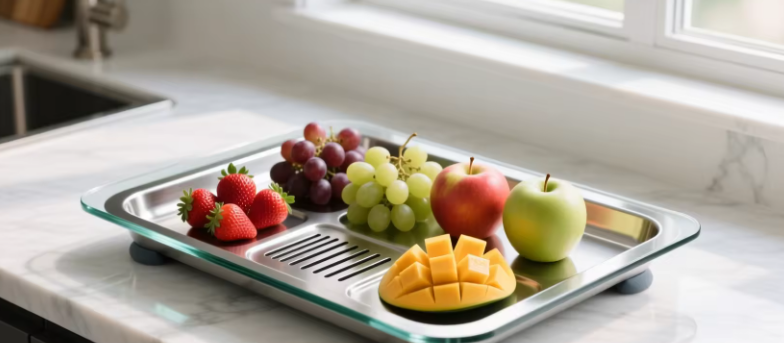
Fruit trays are rarely discussed until something goes wrong. A tray cracks during transport, condensation ruins the display, or stacked fruit starts bruising for reasons no one can immediately explain. By that point, the issue is already blamed on logistics or handling, even though the material of the tray often played a quiet role from the beginning.
The idea that one material works best in all situations is convenient, but it doesn’t match how fruit trays are actually used. A tray that performs well in a refrigerated retail case may fail during delivery. Another that looks refined on a table may be impractical outdoors. Material choice only makes sense when it follows usage, not the other way around.
That distinction is where many decisions fall apart.
Why Material Problems Rarely Show Up at First

Most fruit trays look fine when empty. The problems start later. Weight exposes weak structure. Cold environments change how surfaces behave. Moisture highlights flaws in clarity and rigidity. These are not theoretical issues. They show up during stacking, transport, and storage—often when adjustments are no longer possible.
Material choice influences how a tray flexes under load, how it responds to temperature shifts, and how it ages after repeated use. It also shapes perception. Clear trays tend to suggest freshness, while opaque ones shift attention toward function rather than appearance.
Disposal adds another layer. Some materials fit neatly into existing recycling systems. Others depend on facilities that may not exist locally. What looks sustainable on paper doesn’t always translate into real-world outcomes.
Starting With How Fruit Trays Are Actually Used
Material discussions often start too early. Usage should come first.
In retail, trays are part of the visual decision-making process. Shoppers rarely touch the product. They judge quickly, through clarity, shape, and color. Trays must stay stable in cold conditions and stack cleanly without deforming.
Delivery and food service change the priorities. Trays are handled multiple times, packed tightly, and exposed to vibration. Here, strength matters more than presentation. Minor impacts are unavoidable.
Home use introduces different expectations. Appearance matters more than durability. Trays may be reused occasionally and chosen for how they look on a table rather than how they survive transport.
Outdoor settings are less forgiving. Surfaces are uneven, handling is casual, and breakage becomes more likely. Safety and toughness take priority.
Once these patterns are clear, material choices stop feeling abstract.
What Really Separates One Material From Another

Several factors consistently shape performance.
Clarity influences presentation. Transparent materials highlight fruit color and condition, which matters in retail environments.
Structural behavior determines how a tray responds to stacking and load. Some materials hold their shape; others flex or crack under pressure.
Temperature tolerance affects reliability. Trays often move between room temperature and refrigeration. Materials that become brittle or cloudy over time create downstream issues.
Maintenance matters for reusable trays. Resistance to staining, scratching, and odor buildup determines whether reuse is practical or frustrating.
Finally, end-of-life handling defines whether a material’s environmental promise holds up outside controlled conditions.
How Common Plastic Materials Behave in Practice

Plastic dominates commercial fruit trays because it delivers consistency.
PET is widely used for retail displays. Its clarity supports presentation, and it performs reliably in cold storage. It is lightweight, stackable, and familiar to recycling systems in many regions. These traits make it a default choice for sealed retail trays.
PP approaches the problem differently. It sacrifices some clarity in exchange for toughness. PP resists cracking and handles repeated handling better, which suits delivery and food service environments.
PS and EPS are often chosen for cost-sensitive applications. EPS offers limited insulation benefits but faces growing disposal challenges. These materials still appear in the market, though their constraints are well understood.
PLA attracts attention for sustainability reasons. It is plant-based and compostable under specific conditions. In practice, those conditions are not always available. Without proper composting infrastructure, its benefits may be limited. PLA also tends to be less forgiving under heat and weight.
Where Reusable Materials Fit In
Reusable trays serve narrower roles.
Ceramic and porcelain focus on presentation. They work well in controlled settings but are impractical for transport-heavy use.
Glass offers clarity and easy cleaning, but weight and breakage limit flexibility.
Stainless steel prioritizes durability and hygiene. It performs well in professional kitchens but adds little to visual appeal.
Acrylic and wood are more situational. Acrylic suits outdoor use where breakage risk matters. Wood adds warmth but requires care to manage moisture and staining.
Matching Material to Reality
Patterns become clear when material follows use. Retail display trays benefit from PET’s clarity and cold stability. Delivery environments favor PP’s durability. Budget-driven applications still rely on PS or EPS, with known trade-offs.
Sustainability-focused operations must ensure disposal systems actually exist before choosing compostable materials. Home and event settings often prioritize appearance over longevity. Outdoor use demands impact resistance.
Where Choices Commonly Fail
Most failures come from ignoring context. Display trays pushed into delivery roles. Appearance-driven materials used outdoors. Cost savings that disappear through breakage and replacement.
Environmental assumptions also cause problems. Compostable does not automatically mean sustainable without infrastructure. Maintenance is often underestimated, especially with reusable materials.
Final Perspective
There is no universal best material for fruit trays. The right choice depends on environment, handling, and expectations. When materials are selected based on real usage rather than assumptions, trays perform predictably and create fewer issues downstream.
The best material is not the most advanced or the most promoted. It is simply the one that fits the situation without introducing unnecessary risk.