
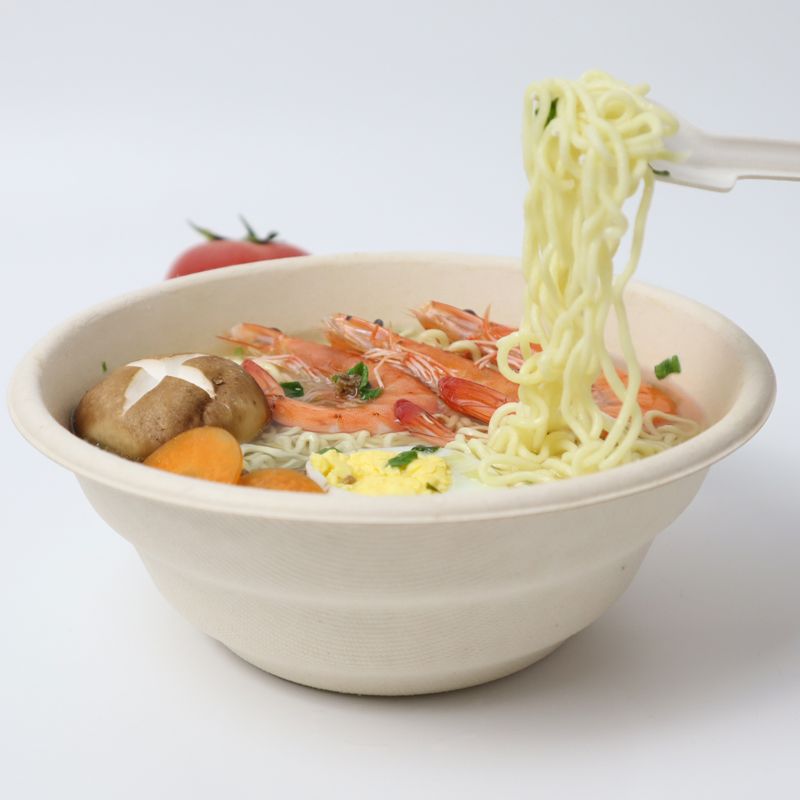
Why Buyers Started Taking Bagasse Ramen Bowls Seriously

Ramen bowls used to be an afterthought in disposable packaging. As long as the bowl held soup and didn’t collapse mid-meal, it passed. That mindset began to change when plastic bans became enforceable rather than theoretical, and when buyers realized that many “paper bowls” were simply plastic containers wearing a paper label.
Sugarcane bagasse entered sourcing conversations not because it sounded sustainable, but because it solved several problems at once. It came from agricultural waste rather than virgin resources. It did not rely on laminated coatings to hold liquid. And when manufactured correctly, it behaved more like a structural material than treated paper.
Ramen, however, is unforgiving. Hot broth stays in contact with the bowl far longer than coffee or soup-of-the-day. Steam builds under lids, reheating is common, and delivery adds another layer of stress. These conditions exposed the limitations of generic disposable bowls very quickly. As a result, many procurement teams stopped searching for “eco bowls” and began looking for a custom sugarcane bagasse ramen bowl manufacturer that understood real usage instead of catalog assumptions.
What Separates a Ramen Bowl from a Standard Bagasse Bowl
One of the most common sourcing mistakes is assuming that any bagasse bowl can function as a ramen bowl. In practice, shallow fiber bowls and deep ramen bowls behave very differently once liquid and heat are introduced.
A true bagasse ramen bowl is designed around thickness, density, and compression, not just shape. When wall thickness drops too low, the bowl may look fine when empty but soften rapidly after filling. When fiber density is inconsistent, micro-leaks appear long before the meal is finished. These failures rarely show up in product photos and are often missed until late-stage testing.
Well-made bagasse ramen bowls generally tolerate temperatures exceeding 120°C and remain stable during microwave reheating. They retain rim rigidity, which matters more than many buyers expect, especially when lids are involved. This is why experienced sourcing teams prefer working with a food-grade sugarcane bagasse ramen bowl factory for international buyers, where process control is treated as part of the product rather than an afterthought.
Compliance Is a Filter, Not a Marketing Feature
Sustainability claims are easy to make and difficult to verify. Certifications, while imperfect, remain one of the few reliable filters buyers can apply early in the sourcing process.
For exports to the United States, FDA food contact compliance and BPI compostability certification are often baseline expectations. In Europe, EN13432 plays a similar role. Chinese GB standards frequently appear in supplier documentation, but they do not replace international certifications and should not be treated as equivalents.
What matters just as much as holding certificates is how a supplier responds when asked to verify them. Factories that can quickly provide test reports, certificate numbers, and third-party documentation tend to be easier partners long-term. Buyers increasingly avoid suppliers who rely on vague assurances, preferring a sugarcane bagasse ramen bowl supplier with verified compliance records even if pricing is slightly higher.
FoodPackin and the Value of Long-Term Specialization
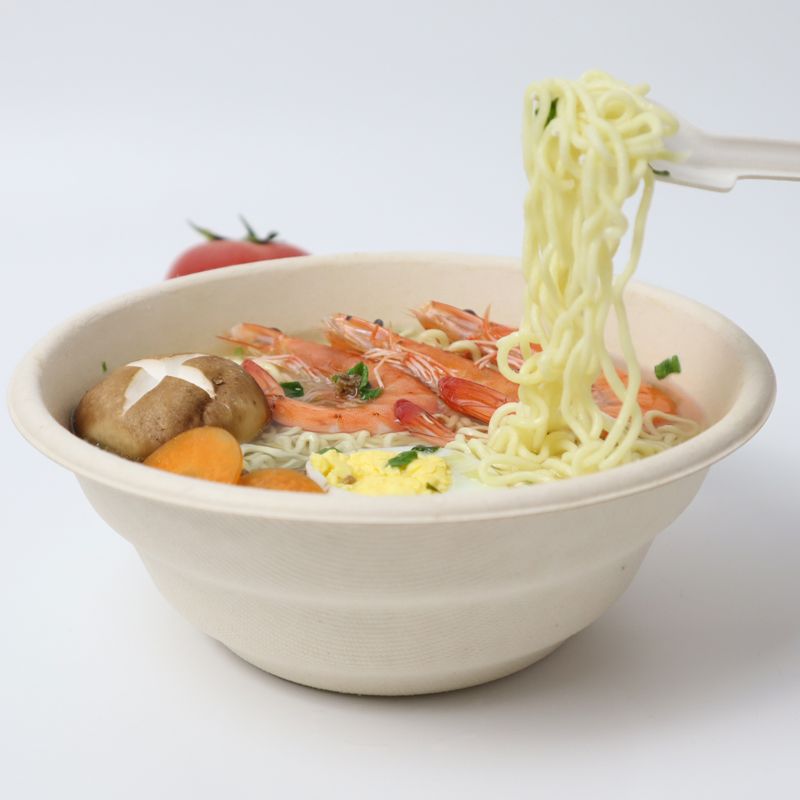
FoodPackin is often mentioned in sourcing discussions because it entered molded fiber packaging well before demand surged. That history shows in how the company approaches ramen bowls, treating them as a distinct category rather than a variation of standard bowls.
Its ramen bowl offerings typically fall in the 32oz and above range and are engineered to handle extended contact with hot liquids. The bowls maintain structural integrity during reheating, which reduces complaints in delivery-heavy use cases. Matching lids are part of the standard offering, helping buyers avoid compatibility issues.
FoodPackin is not positioned as a low-MOQ supplier. It tends to work best for buyers who already understand their specifications and are planning repeat orders. As a sugarcane bagasse ramen bowl manufacturer serving established foodservice operators, the company emphasizes consistency and certification readiness over rapid experimentation.
Guangzhou Huabao Industrial and Scale-Oriented Manufacturing
Guangzhou Huabao Industrial approaches bagasse ramen bowls from a different angle. Its focus is scale. Production systems are optimized for output stability, which appeals to buyers managing large, centralized procurement programs.
Huabao’s ramen bowls are not heavily customized, but they are predictable. Wall thickness and compression remain consistent across batches, which matters when distribution spans multiple regions. Pricing becomes more favorable as volumes increase, reflecting the factory’s manufacturing model.
For chain restaurants or distributors prioritizing uninterrupted supply, Huabao often functions as a high-volume sugarcane bagasse ramen bowl factory for bulk sourcing, where operational reliability outweighs design flexibility.
Xiamen EcoWare and Export-Focused Operations
Xiamen EcoWare built its business around markets with strict import and compliance requirements. This focus shapes everything from documentation practices to communication style.
EcoWare’s ramen bowls are commonly used in programs that require migration testing and traceable compliance records. Buyers supplying Western retailers often find that EcoWare’s familiarity with audits and documentation reduces onboarding time. Packaging formats also reflect export experience, supporting both retail and foodservice distribution.
For companies entering regulated markets, working with a sugarcane bagasse ramen bowl exporter for EU and US buyers can reduce friction that is otherwise discovered late in the process.
Bioleader Packaging and Private Label Flexibility
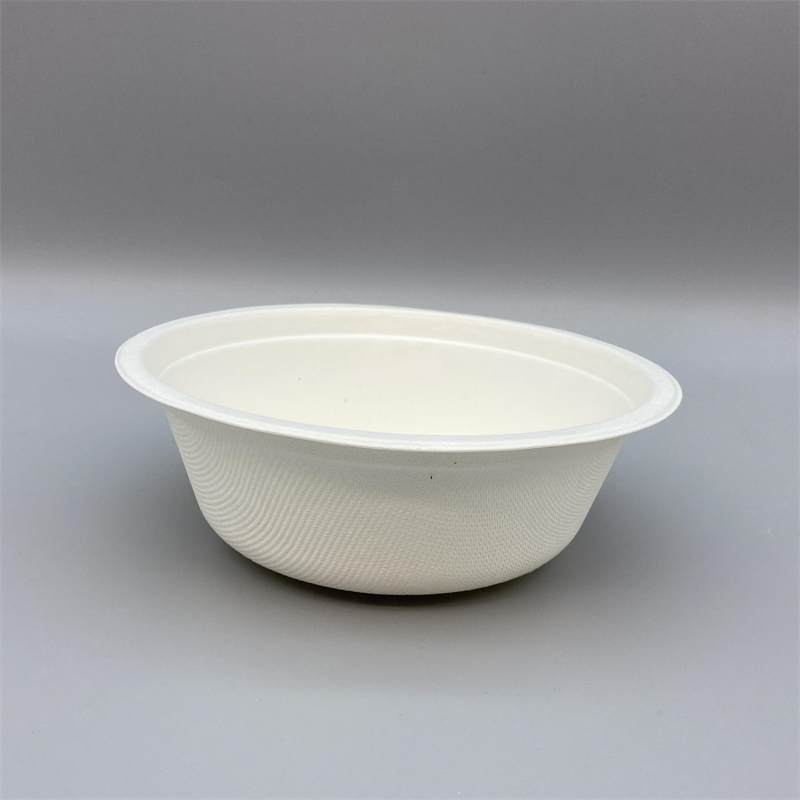
Bioleader Packaging appeals to buyers who view packaging as part of brand identity. Its ramen bowl offerings emphasize mold customization and embossed branding rather than printed coatings.
This approach allows brands to differentiate visually while maintaining compostability claims. Bioleader is accustomed to handling private-label projects and design confidentiality, which is increasingly important for emerging brands.
For buyers balancing aesthetics and performance, Bioleader often serves as an OEM sugarcane bagasse ramen bowl factory for private label development, where customization speed matters as much as unit cost.
Nature’s Packaging and Cost Discipline at Scale
Nature’s Packaging focuses on standardized production and cost efficiency. By sourcing bagasse from domestic sugar-producing regions, the company maintains relatively stable raw material inputs.
Its ramen bowls are designed for predictable, high-volume demand. Customization options are limited, but pricing becomes competitive for repeat orders. Buyers need to validate performance carefully, as lower-cost designs allow less tolerance for specification errors.
Nature’s Packaging is often selected as a cost-controlled sugarcane bagasse ramen bowl factory for large procurement programs, particularly when demand forecasts are stable and quality benchmarks are clearly defined.
How Buyers Actually Shortlist the Right Supplier
In practice, supplier selection rarely comes down to rankings. It comes down to fit. Buyers who succeed tend to start with performance testing rather than price negotiation. Hot liquid exposure, reheating behavior, and lid compatibility reveal more than specification sheets ever will.
Communication quality also matters. Suppliers who ask clarifying questions early usually cause fewer problems later. Factory audits, whether virtual or third-party, provide context that product pages cannot.
Ultimately, buyers looking for a reliable sugarcane bagasse ramen bowl manufacturer for long-term sourcing focus less on claims and more on how a supplier behaves when something goes wrong.
Final Perspective on Sourcing Bagasse Ramen Bowls from China
Sugarcane bagasse ramen bowls have moved beyond trend status. They are now part of standard packaging strategies in markets where sustainability requirements meet real performance expectations. China’s supplier base offers depth, but navigating it requires discipline.
By prioritizing material performance, verified compliance, and operational alignment, buyers can integrate bagasse ramen bowls into their supply chains without sacrificing reliability or credibility. The suppliers highlighted here represent different approaches to the same product category, giving buyers flexibility based on their own sourcing priorities.