
When you hold a smooth, matte cup of gelato on a sunny afternoon, a small sense of moral superiority often kicks in. You feel a world away from those “ocean-choking” plastic containers. However, beneath that rustic, wood-pulp exterior lies a secret that the packaging industry rarely broadcasts: your “eco-friendly” paper cup is a high-tech plastic hybrid.
Tearing Down the “Paper” Illusion

Step into any bulk PP ice cream cup factory, and you will see that a paper cup is actually a material sandwich. Raw paper pulp, on its own, would turn into a soggy mess within three minutes of contacting high-moisture, high-fat dairy. To maintain structural integrity, manufacturers must heat-press a razor-thin plastic lining onto the interior.
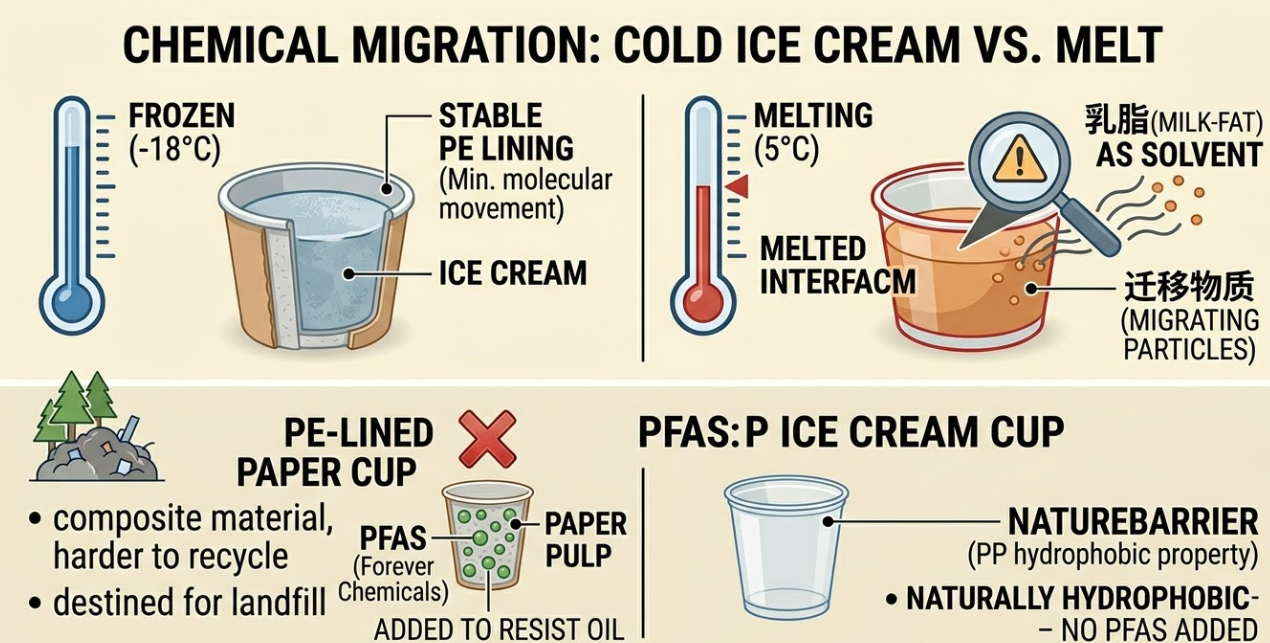
This lining is typically made of Polyethylene (PE) or Polylactic Acid (PLA). When you source from a custom PET ice cream cup supplier, you are choosing a monomaterial that avoids the recycling nightmare of composite paper. In contrast, paper cups contain plastic that makes up roughly 5% to 10% of the total weight. The irony is that because this plastic film is bonded so tightly to the fibers, these cups are rejected by most municipal recycling centers. They are destined for landfills, where they remain as stubborn as pure plastic, but with a higher carbon footprint from the pulping process.
The Chemical Leaching Question: Is Cold Really “Safe”?
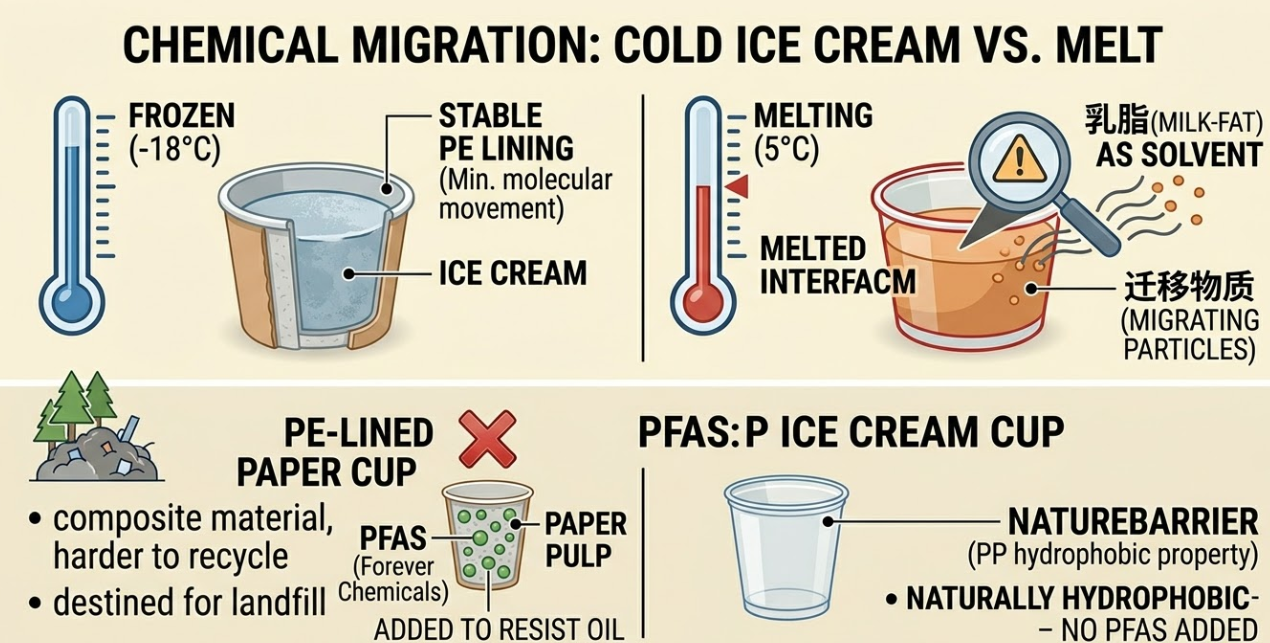
A common misconception in food safety is that chemical migration only happens with heat. While hot coffee certainly accelerates molecular movement, the high milk-fat content of ice cream acts as a unique “solvent.”
Traditional PE-lined cups may harbor trace catalysts from the manufacturing process. While stable at freezing temperatures, the risk profile shifts as the ice cream melts against the rim. For those seeking sustainable CPET ice cream cup solutions for business, it is vital to understand that the danger isn’t just on the inside.
When cups are nested—stacked one inside the other for shipping—the exterior ink of one cup sits directly against the food-contact surface of the next. This “set-off migration” can transfer heavy metals or volatile organic compounds (VOCs) from the branding into your dessert. Consequently, a reputable eco friendly PP ice cream cup manufacturer will prioritize high-purity resins to mitigate this invisible cross-contamination risk that often plagues low-quality paper variants.
The PFAS Shadow: A Risk Paper Has (That Plastic Doesn’t)
Beyond the plastic lining, paper cups face a threat that pure plastic containers do not: PFAS (Per- and Polyfluoroalkyl Substances). To prevent oils and fats from seeping through the paper fibers, some lower-tier pulp recipes are treated with these “forever chemicals.”
PFAS provide incredible grease resistance, but they are bioaccumulative and linked to endocrine disruption. Paradoxically, a container from a high-quality food grade PET ice cream cup supplier is often chemically “cleaner” in this specific regard. Because Polypropylene (PP) and PET are naturally hydrophobic and grease-proof, they require no added chemical coatings to keep the fat at bay. In the quest for “natural” aesthetics, we sometimes introduce more complex synthetic risks via treated paper.
Plastic’s Defense: Why PP and PET Often Win on Safety
In the cultural rush to demonize plastic, we often overlook the safety consistency of medical-grade polymers. Most high-end plastic ice cream cups are made from PP (Polypropylene) or PET (Polyethylene Terephthalate).
PP (Type 5) is a gold standard for food stability. It is chemically inert and remains rigid even at sub-zero temperatures without leaching. If you buy from a reliable clear PP ice cream cup wholesaler, you are getting a material that is highly predictable and 100% recyclable in most curbside programs. PET, while slightly less heat-tolerant, offers a superior oxygen barrier that keeps ice cream fresher for longer. Unlike the “composite” paper cup, a pure plastic cup is a single-material (monomaterial) product, making it far easier for the global recycling stream to process and reuse.
The PLA Myth: Marketing vs. Microbial Reality

To solve the “petroleum” problem, the industry introduced PLA (Polylactic Acid) linings—derived from corn starch and marketed as “100% compostable.” However, this is one of the greatest cognitive gaps in consumer awareness.
PLA is only “compostable” under industrial conditions: temperatures exceeding 140°F (60°C) and specific humidity levels found in professional facilities. In a backyard compost bin or a standard landfill, a PLA-lined cup will last nearly as long as a PE-lined one. For a premium brand PLA ice cream cup factory, this material serves the ESG (Environmental, Social, and Governance) reports of corporate clients more than it serves the actual earth. Without a closed-loop collection system, the “compostable” label is often just an expensive psychological comfort.
Hidden Allergens and the Certification Maze
In the deeper waters of packaging safety, a new risk has emerged: allergens. As innovation pushes toward “plant-based” materials, some biodegradable CPET ice cream cup manufacturer for wholesale brands have experimented with wheat bran or stalk-based fibers in their hybrid designs.
While these look incredibly earthy, they pose a severe risk to consumers with Celiac disease or severe wheat allergies. Gluten residues can migrate into the food as the cup moistens. Therefore, a “green” label is never enough. Professional buyers must look for FDA Food-Contact Notifications (FCN) and EFSA certifications that explicitly test for migration in fatty food simulators, rather than relying on poetic marketing copy.
The Verdict: How to Choose Your Cup
If your priority is absolute chemical stability, a clear PP (Type 5) plastic cup is arguably the safer, more transparent choice. It is a known quantity, free from PFAS, and highly recyclable. If you prefer the branding potential and “warmth” of paper, ensure you are partnering with a BPA-free PET ice cream cup supplier that guarantees food-grade purity and utilizes aqueous (water-based) coating technology rather than traditional plastic films.
Ultimately, the most “eco-friendly” choice isn’t found in a better disposable material, but in a shift in consumption. However, as long as the convenience of single-use exists, we must look past the green-washed surface. Safety isn’t determined by the color of the packaging, but by the transparency of the wholesale sustainable PP ice cream cup manufacturer behind it.