
In the high-stakes world of global procurement, the siren song of the “lowest unit price” has led many experienced buyers into a logistical graveyard. When scrolling through factory catalogs, a $1.80 plastic container seems like an easy win for the quarterly budget compared to a $4.50 premium alternative. However, for a professional brand manager or a high-volume distributor, the sticker price is merely the tip of a very dangerous iceberg. The reality is that low-quality materials don’t just result in a flimsy product; they trigger a catastrophic chain reaction that bleeds your logistics budget dry, erodes your brand equity, and complicates your relationship with even the most reliable bulk PP material Custom Lunch Box supplier for international brands.
The Iceberg of Low Unit Cost: Quantifying Hidden Failures
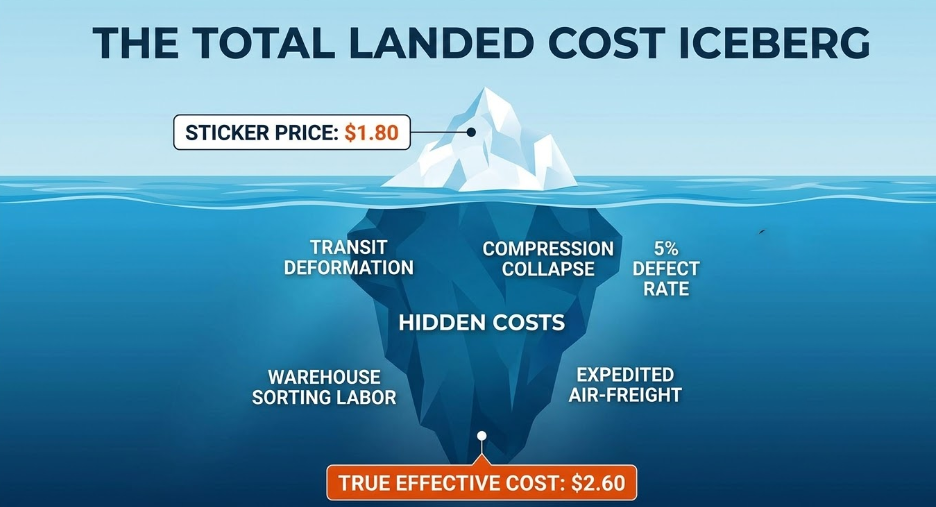
To understand why a “cheap” order is often the most expensive mistake a procurement team can make, we must look at the Total Landed Cost (TLC). When you partner with a low-cost recycled plastic Custom Lunch Box factory with unverified QC, you aren’t just buying lunch boxes; you are buying the high probability of transit deformation. Imagine a standard 40-foot container packed with 20,000 units. If the structural integrity of the base material is compromised to save 20 cents per unit, the bottom four layers of pallets often succumb to “compression collapse” under the weight of the stack. This doesn’t just damage the product; it creates unstable loads that can lead to workplace safety issues during unloading.
The financial ripple effect of a 5% defect rate on a 10,000-unit order is staggering. Most buyers mistakenly calculate this as a simple 5% loss of inventory. In reality, you must account for the billable hours spent by your warehouse team sorting the “dead on arrival” units, the cost of eco-friendly disposal, and the expedited air-freight fees required to ship replacements to angry B2B clients. When these variables are added to the spreadsheet, that $1.80 unit quickly jumps to an effective cost of $2.60, narrowing the margin gap significantly against a higher-quality premium tritan material Custom Lunch Box manufacturer for boutique retailers.
Logistics as a Profit Center: Material Strength and Stacking Efficiency
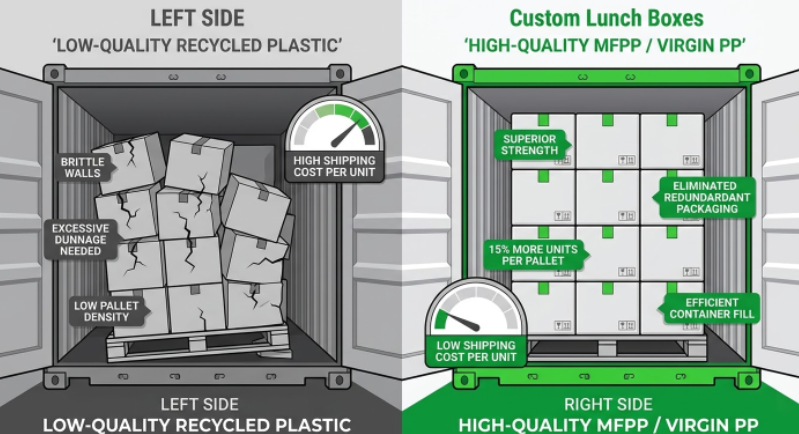
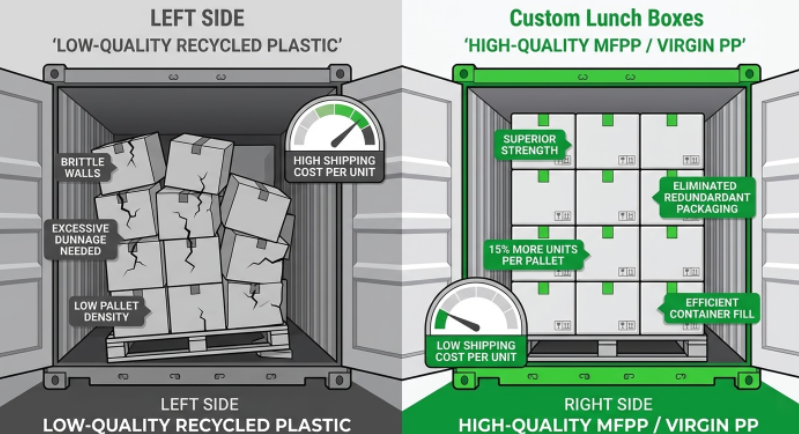
Smart logistics starts with material science. High-quality materials like virgin, food-grade PP or mineral-filled polypropylene (MFPP) offer a superior strength-to-weight ratio that directly impacts your shipping efficiency. Low-quality, recycled plastics often have inconsistent density, leading to brittle walls that crack under the vibrations of ocean freight. To compensate for this fragility, buyers are often forced to invest in double-walled corrugated shipping cartons and excessive internal dunnage like bubble wrap or PE foam. These “protective” extras increase the outer dimensions of your master cartons, effectively reducing your pallet density.
By choosing a reusable leak-proof PP Custom Lunch Box supplier for eco-conscious markets that prioritizes structural rigidity, you can often eliminate redundant packaging. High-integrity boxes allow for higher stacking heights in the warehouse and better “cube utilization” in the container. If you can fit 15% more units per pallet because the boxes don’t require bulky protective spacers, your per-unit shipping cost drops. In this scenario, the “expensive” box becomes the catalyst for a leaner, more profitable supply chain.
The Material Failure Matrix: Humidity, Heat, and Volatility
Material selection is not just about aesthetics; it’s about environmental survival. Paper and pulp-based products are currently trending due to plastic bans, but they are notorious for the “soggy bottom” effect. In humid transit hubs like Singapore or during the sweltering summer months in Australian ports, low-grade paper pulp absorbs atmospheric moisture, losing up to 40% of its structural load-bearing capacity. This leads to collapsed stacks and ruined branding.
Budget unpredictability is another major risk factor. The high volatility of raw material prices means that a quote from an unstable MFPP Custom Lunch Box manufacturer for food service might expire in as little as 48 hours, making long-term financial planning a nightmare for large-scale distributors. Conversely, investing in a long-term partnership with a durable BPA-free plastic Custom Lunch Box factory in China allows for more stable pricing structures and predictable margins. Understanding these material-specific failure points allows a procurement head to match the quality level to the specific climatic challenges of their target market, rather than just chasing a decimal point.
Strategic Positioning: Matching Quality to 2026 Market Triggers

As we move toward 2026, the global consumer’s definition of “quality” has shifted from purely functional to ethical and health-centric. In the USA and Australian markets, “BPA-free” is no longer a premium feature—it is the baseline for entry. Brands that try to cut corners by using non-certified resins risk more than just bad reviews; they risk massive legal liabilities and product recalls. A smarter strategy involves identifying the specific “value triggers” that justify a higher wholesale price.
For example, modularity and thermal insulation are currently driving the growth of the $1.78B insulated lunch box market. By working with an innovative OEM PP Custom Lunch Box designer for the fitness industry, a brand can move away from the “commodity trap” where every competitor is fighting over pennies. When you offer a product with a 12-hour thermal rating and custom-fit dividers, the conversation with the end consumer shifts from “Why does this cost $20?” to “This is exactly the tool I need for my lifestyle.” This perceived value protects your margins against the erosion caused by generic, low-quality competitors.
The Sourcing Process: Vetting and the 90-Day Pivot
Transitioning to a high-quality strategy doesn’t happen overnight, but it can be achieved within a single business quarter. The first step is moving beyond the “Alibaba surface layer” and engaging with specialized sourcing agents who understand the nuances of the Ningbo or Shenzhen manufacturing hubs. A professional agent doesn’t just look for a factory; they look for a production partner with a low historical defect rate and a transparent “Raw Material Traceability” system.
The vetting process should include a “stress-test” sample phase. Instead of just looking at a pristine sample in an office, subject the units to a 24-hour freezer test followed by a high-heat microwave cycle. If the lid warps or the seal fails, that microwave-safe plastic Custom Lunch Box supplier for school supplies is not a viable partner, regardless of how low their quote is. A 90-day roadmap should include a small-scale pilot order to verify the “Landed Cost” assumptions before committing to a full-scale rollout. This cautious approach allows you to identify potential logistical bottlenecks without risking your entire annual budget.
Conclusion: Building a Bottom Line That Lasts
In the final analysis, the pursuit of “cheapness” is a race to the bottom that nobody truly wins. The most successful brands in 2026 will be those that view their lunch box as a sophisticated piece of hardware rather than a disposable commodity. By accounting for the hidden costs of transit damage, maximizing pallet density through structural integrity, and aligning material choices with high-growth market segments, you transform your procurement department from a cost center into a profit engine.
The math is simple: fewer defects mean fewer returns; better stacking means lower freight bills; and a superior product means higher customer lifetime value. If your current sourcing strategy is focused solely on the unit price at the factory gate, you are likely leaving 20% to 30% of your potential profit in the trash heaps of broken plastic and collapsed cardboard. It is time to stop paying the “low-quality tax” and start investing in a supply chain that reflects the true value of your brand.