
In the competitive landscape of B2B food service, from high-end corporate catering to institutional meal programs, the “last mile” of food quality is often where brands are built or broken. You can employ the world’s most talented chefs and source the finest organic ingredients, but if that meal arrives in a container that transforms a crisp tempura into a damp sponge, the culinary effort is nullified. The reality is that soggy food isn’t just a kitchen error; it is a structural failure of the packaging. For procurement managers and brand owners, understanding that the transition from a standard container to a high-performance PP Custom Lunch Box manufacturer in China can be the difference between a one-time order and a lifetime contract.
The Invisible Drain: How Poor Packaging Erodes Your Bottom Line

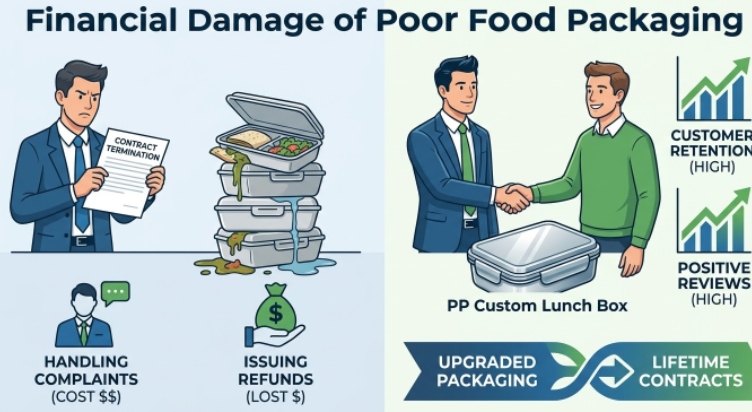
When we analyze customer churn in the food delivery and catering sectors, “food arrived cold” and “texture was soggy” consistently rank as the top two complaints. For a B2B buyer, these aren’t just minor inconveniences; they are brand-damaging events that lead to contract terminations. If a school lunch program or a corporate office park experiences consistent quality issues, they don’t blame the humidity; they blame the provider. By partnering with a reliable BPA-free PP Custom Lunch Box factory for bulk orders, brands can move beyond generic solutions that treat all food types as identical.
The cost of a “cheap” box is deceptively high. When you factor in the labor costs of customer service handling complaints, the financial hit of issuing refunds, and the astronomical cost of acquiring a new customer to replace a lost one, the price difference for an upgraded container becomes negligible. Investing in a wholesale CPET Custom Lunch Box supplier for catering brands allows a business to treat its packaging as an insurance policy for its reputation. High-quality presentation leads to high-quality reviews, and in an era of digital transparency, your packaging is your most visible brand ambassador.
The Physics of Failure: Why Standard Boxes Create “Sogginess”

To solve the problem of soggy food, we must first understand the thermal dynamics at play inside a closed container. When hot food is placed into a standard plastic or paper box, it releases steam. In a poorly engineered vessel, this steam hits the cold lid, condenses into water droplets, and rains back down onto the food. This “greenhouse effect” is the primary enemy of texture. Without calibrated ventilation or moisture-wicking structures, even the best-cooked meal will degrade within fifteen minutes of transit.
Standard consumer-grade boxes often lack the structural integrity to maintain a true seal while simultaneously managing internal pressure. This is why many procurement officers are now seeking a professional Tritan Custom Lunch Box manufacturer for global distributors who can offer advanced venting solutions. These vents are designed to allow just enough steam to escape to prevent condensation while retaining enough heat to keep the meal within the food safety “gold zone” of above 140°F. Furthermore, material porosity matters. Low-grade plastics can absorb oils and odors, which not only affects the current meal but can lead to a lingering “stale” scent that greets the customer the moment they open the lid.
Engineering the Solution: The Three Pillars of High-Performance Design
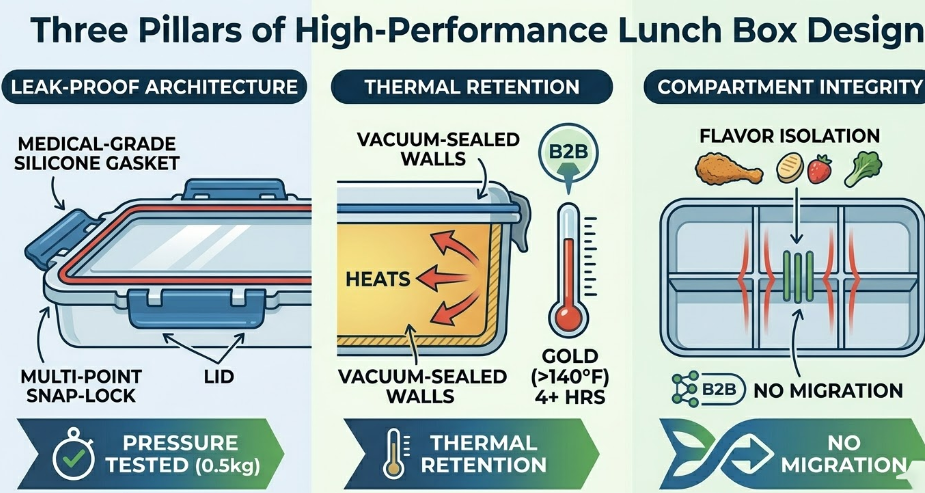
A true upgrade involves more than just a thicker wall; it requires a focus on leak-proof architecture, thermal retention, and compartment integrity. A leak is more than a mess; it is a sign of a failed seal that is also letting heat escape. Leading brands are now collaborating with a reliable MFPP Custom Lunch Box supplier for school programs to implement medical-grade silicone gaskets and multi-point snap-lock mechanisms. These systems undergo rigorous pressure testing to ensure that whether the box is sitting flat or tossed in a delivery bag, the contents—and the heat—remain exactly where they belong.
Compartment design is the second pillar. The “Bento method” isn’t just about aesthetics; it’s about flavor isolation. If the dressing from a salad migrates into the steamed rice, or if the steam from a side of vegetables softens a piece of grilled chicken, the meal is compromised. A leading Microwaveable PP Custom Lunch Box factory for eco-brands provides a solution through vertical sealing technology, where the lid features a molded silicone grid that presses firmly against every internal divider. This creates a series of micro-environments within a single box, ensuring that dry stays dry and wet stays wet.
Finally, thermal insulation must be a non-negotiable specification. While foam was once the standard, modern B2B buyers are looking for vacuum-sealed walls or high-density injected layers that offer superior heat retention without the environmental baggage of polystyrene. By working with an experienced Insulated PP Custom Lunch Box manufacturer for meal prep companies, brands can guarantee that food remains at a palatable temperature for over four hours, extending their delivery radius and opening up new market opportunities in distant suburbs or large-scale event venues.
Material Science: Balancing Aesthetics, Durability, and Perception
The material you choose sends a loud message about your brand’s values. In the current market, there is a significant shift toward 304-grade stainless steel and high-clarity, BPA-free polymers. Stainless steel, in particular, offers a sense of permanence and “premium-ness” that plastic cannot replicate. It is non-porous, incredibly easy to sanitize, and virtually indestructible, making it the ideal choice for subscription-based meal services where the containers are returned and reused.
However, for single-use or high-volume catering, the focus shifts to bio-based materials or high-recyclability plastics. The challenge here is ensuring these “eco-friendly” options don’t sacrifice performance. Many bio-materials fail under high heat or long-term moisture exposure. This is why identifying a reputable Compostable PLA Custom Lunch Box supplier for wholesale buyers is critical. You need a partner who has tested their compostable resins against real-world catering conditions—ensuring the bottom won’t fall out of a box filled with heavy, saucy biryani or pasta.
Customization also plays a role in ROI. A logo that peels off after one wash or fades in the sun makes a brand look amateur. Modern branding techniques like laser engraving on steel or In-Mold Labeling (IML) on high-grade PP ensure that your visual identity remains crisp for the lifetime of the product. This longevity turns a functional item into a mobile billboard, reinforcing brand recall every time the customer reaches for their lunch.
The Strategic Shift: How to Brief Your Supplier for Success
Transitioning to a higher-spec container requires a precise Request for Quotation (RFQ). Vague requests like “high quality” or “durable” lead to inconsistent samples and wasted time. Instead, procurement teams should define specific performance benchmarks: a required leak-proof rating (e.g., airtight under 0.5kg of pressure), a specific thermal decay curve (e.g., loss of no more than 5°C per hour), and a certified food-safety grade (FDA or LFGB).
When you approach a top-tier High-Heat CPET Custom Lunch Box factory for corporate gifting, you should also demand a clear Quality Control (QC) protocol. This includes a “drop test” from a height of one meter, a “microwave deformation test” for plastic components, and a “cycle test” for hinges and latches. By setting these standards upfront, you eliminate the suppliers who are merely “middlemen” and find the true manufacturing partners who understand the technical demands of the B2B food sector.
Ultimately, the upgrade to a custom-engineered lunch box is not an expense; it is a strategic investment in customer retention. In a world where food quality is often judged by the first bite, ensuring that bite is crisp, hot, and exactly as the chef intended is the most effective marketing strategy available. As the market for delivered meals continues to grow and diversify, the brands that win will be the ones that master the vessel as thoroughly as they master the ingredients. Stop letting your packaging sabotage your hard work; it’s time to build a container that works as hard as your kitchen does.