
The morning caffeine run used to be a simple ritual. But by mid-2026, that steaming latte in a “disposable” paper cup has morphed into a glaring financial leak. If you’re still walking into the office gripping a plastic-lined sleeve, you aren’t just sipping espresso; you are paying a recurring “convenience tax” that offers zero ROI. In an era where inflation and environmental levies have squeezed every margin, the reusable cup has shifted from a “green” lifestyle choice to a mandatory piece of personal infrastructure.
For the modern operator, this isn’t about saving the trees—it’s about stopping a slow-motion robbery of your disposable income. Whether you are an individual commuter or a procurement lead vetting a custom eco-friendly PP coffee cup manufacturer to overhaul your corporate gifting strategy, the data is undeniable. The era of the “free” paper cup is officially dead.
The Invisible Financial Hemorrhage of 2026
Most white-collar professionals drastically lowball their annual spend on “vessel convenience.” By 2026, the average price of a café-prepared drink in global hubs has surged, largely driven by labor costs and the “Disposable Cup Levy”—a mandatory surcharge now common in major cities. This isn’t just a few cents; it is a persistent drain that adds up to nearly $150 a year just for the trash you carry for ten minutes.
Think about it. A daily drinker spends roughly $2,000 annually on café visits. When you strip back the layers, you realize you’re paying a premium for a subpar experience. This is where the logic of a high-performance vessel—perhaps one sourced from a high-tier insulated PET coffee cup factory for global distributors—becomes a mathematical necessity. In a year where every dollar of personal overhead is under the microscope, killing this leak is the easiest financial win on your dashboard.
Reason #1: The 60-Day Break-Even (Real Math, No Fluff)
The most immediate catalyst for switching in 2026 is the standardized “Bring Your Own” (BYO) dividend. We’ve moved past the era of measly 10-cent discounts. Today, major chains and boutique roasters alike offer “Green Loyalty” multipliers. Using your own cup often triggers double-point rewards, effectively cutting the cost of every tenth drink to zero.
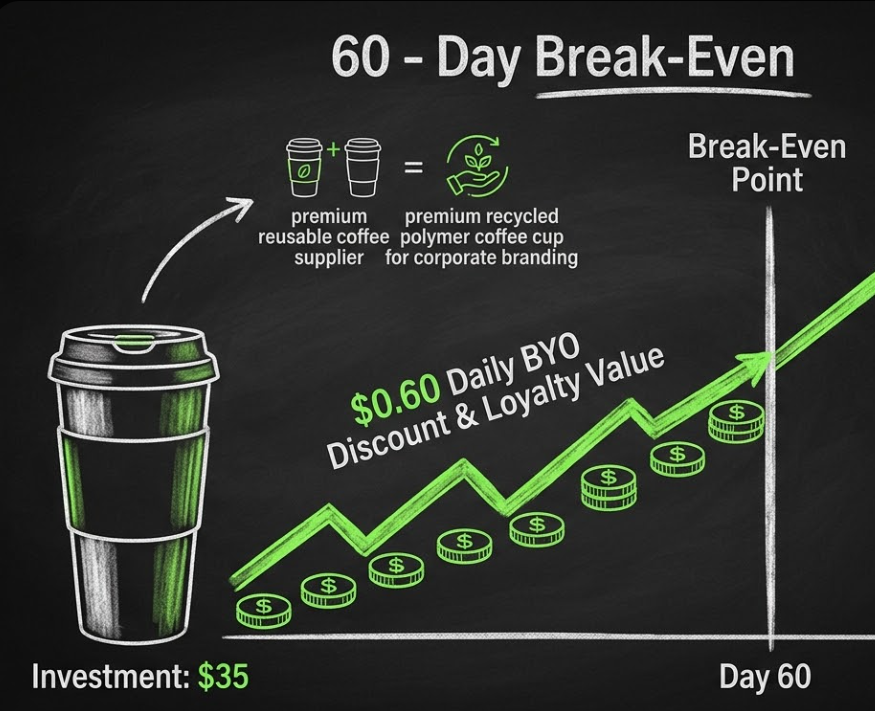
Let’s run the numbers. If you buy a professional-grade cup for $35 and snag a combined discount/loyalty value of $0.60 per fill, you hit the break-even point in just under 60 days. After that window, the cup is essentially printing money. For companies looking to impress clients, sourcing from a premium recycled polymer coffee cup supplier for corporate branding ensures that your gift provides tangible, daily cash-back value to the recipient. It’s one of the few office “assets” that pays for itself within a single fiscal quarter.
Reason #2: Performance That Disposable Tech Can’t Touch

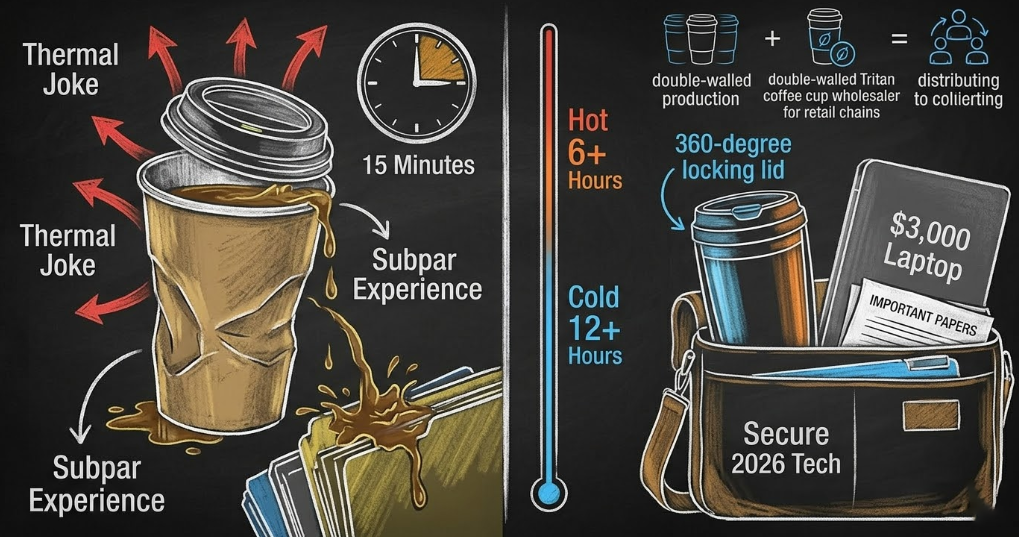
Beyond the ledger, there is the raw issue of quality. Let’s be honest: paper cups are a failed technology. They lose structural integrity the moment hot liquid hits the seal, and their thermal retention is a joke. Within fifteen minutes, your $7 specialty brew is lukewarm and flat.
The 2026 generation of reusables has turned the tide. Whether you use a model from a double-walled Tritan coffee cup wholesaler for retail chains or a bespoke ergonomic version, the gap is massive. These vessels hold a precise temperature for several hours. If you get stuck in a back-to-back Zoom marathon, your coffee is still enjoyable when you finally take a breath at noon. Plus, with the latest 360-degree locking lids, you can throw a full cup into a bag next to a $3,000 laptop without breaking a sweat—a level of security a paper lid will never offer.
Reason #3: The Health ROI and the Microplastic “Tax”

Health literacy has hit a tipping point in 2026. We now know that “paper” cups are a bit of a misnomer; they are almost universally fused with polyethylene liners. Recent 2025 studies have confirmed that high-temperature liquids accelerate the shedding of microplastics and chemical stabilizers directly into your drink.
Switching to a reusable vessel is a long-term play for your endocrine health. By opting for certified medical-grade polymers—standard fare for any OEM heat-resistant PP coffee cup factory—you eliminate chemical migration entirely. These high-grade materials are non-porous and food-safe, meaning they don’t hold “ghost flavors” from last week’s dark roast. In a world obsessed with longevity and “clean” living, what your coffee touches is just as important as the beans themselves.
Reason #4: Navigating the 2026 Regulatory Minefield
The environmental debate has shifted from “soft” ethics to “hard” regulation. In 2026, many jurisdictions have moved beyond voluntary recycling to outright bans on specific plastic-lined disposables. The “Latte Levy” is no longer an experiment; it’s a permanent fixture of urban life.
By owning your vessel, you bypass this regulatory friction. When a savvy brand chooses to work with a sustainable bio-based PET coffee cup manufacturer for eco-conscious brands, they aren’t just virtue signaling; they are future-proofing their lifestyle against carbon taxes and waste disposal fees. For the individual, it means you’re never caught off guard by a café that has run out of “compliant” cups or forced to pay a “shame surcharge” for being unprepared.
Reason #5: Professional Image and The “Quiet Luxury” Signal
In the high-stakes B2B world of 2026, your gear is your resume. Walking into a negotiation with a soggy, stained paper cup signals a lack of preparation and a focus on the short-term. On the flip side, a sleek, well-maintained reusable cup suggests a professional who values quality, durability, and personal organization. It’s a subtle social currency—a “handshake” before the conversation even starts.
The market has leaned into this “quiet luxury” aesthetic. The most respected models today often come from a specialized BPA-free Tritan coffee cup supplier that prioritizes minimalist ergonomics and sophisticated finishes over loud branding. These aren’t just containers; they are part of a curated professional toolkit. Just like a high-end watch or a tailored blazer, your choice of cup reflects your standards.
Choosing Your Asset: The 2026 Buying Guide
If you’re ready to stop the financial bleed, don’t just buy the cheapest option. You need a cup that won’t end up in a junk drawer. For the road warriors, high-impact reinforced PP is the indestructible gold standard.
If you are in a position of corporate procurement, the mission is to identify a reliable reusable polymer coffee cup factory for bulk orders that prioritizes longevity. A cup that leaks or breaks in a month is just another form of expensive waste. Look for dishwasher-safe certifications, replaceable silicone gaskets, and textured finishes that won’t chip after three weeks of heavy use.
The 80/20 Rule for Habit Stacking
The biggest hurdle isn’t the cost—it’s the habit. Most people buy the cup and then forget it on the kitchen counter. To win in 2026, you need to “stack” your habits. Place your cup next to your keys, or better yet, keep a dedicated “car cup” and an “office cup.”
Don’t chase perfection. If you forget your cup once a week, don’t sweat it. Even an 80% success rate diverts 250+ cups from the landfill and puts nearly $100 back in your pocket. As we move deeper into 2026, the trend is undeniable: the most expensive coffee on the menu is the one served in a “free” cup. Reclaim your money, protect your health, and upgrade your daily ritual. It’s time to switch.