
In the rapidly evolving landscape of 2026, the global food service industry has reached a tipping point. Sustainability is no longer a “premium option” tucked away in a corner of a product catalog; it has become the baseline for entry into major markets like the EU and North America. However, for procurement managers and brand owners, this shift has brought a new set of headaches. The market is currently saturated with “green” alternatives, yet a significant portion of these products fall under the umbrella of greenwashing—deceptive marketing that makes a product appear more environmentally friendly than it actually is.
The central challenge lies in the term “bio-based.” Just because a container is derived from plants doesn’t mean it’s a miracle for the planet. To make a decision that actually protects your brand and the environment, you have to look beyond the “earthy” brown textures and dig into the hard science of Life Cycle Analysis (LCA), chemical additives, and end-of-life infrastructure.
The Bio-Based Trap: Beyond the “Plant-Based” Label

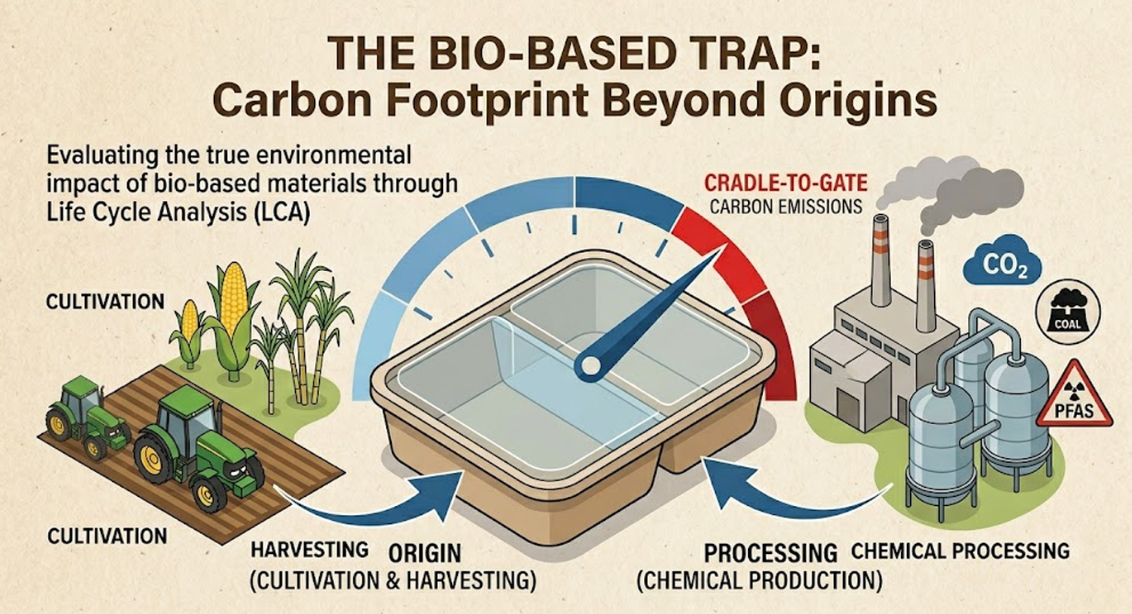
Let’s start with a hard truth: a material’s origin is only half the story. When a supplier tells you their lunch box is made from corn or sugarcane, they are telling you where it was “born,” not how it lived or where it will die. This is where the first layer of greenwashing often hides. A truly professional bio-based custom lunch box supplier for global distributors must be able to account for the carbon footprint generated during the cultivation, harvesting, and—most importantly—the chemical processing of these raw materials.
For example, if a bio-based polymer like PLA is produced using energy-intensive methods in a region still heavily reliant on coal power, its “cradle-to-gate” carbon emissions might actually rival those of traditional petroleum-based plastics. Furthermore, the land-use debate remains a sticking point. Are we using arable land that should be growing food to produce disposable packaging? These are the uncomfortable questions that high-integrity brands are starting to ask. Without a verified LCA report, “bio-based” is just a buzzword designed to soothe a consumer’s conscience without delivering measurable environmental impact.
Breaking Down the “Big Four”: Material Realities vs. Marketing Hype
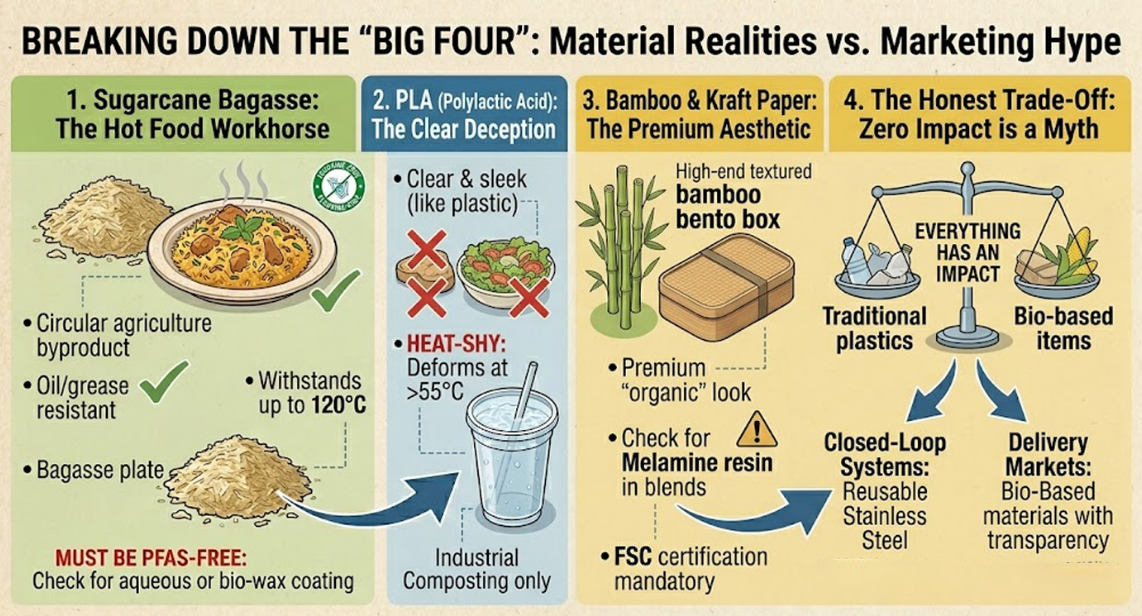
To navigate the procurement process, you need to understand the physical and chemical limits of the materials you are sourcing. There is no “one-size-fits-all” bio-material; there is only the right material for the right menu.
1. Sugarcane Bagasse: The Hot Food Workhorse
Bagasse is essentially the fibrous residue left over after sugarcane is crushed for juice. Because it utilizes an agricultural byproduct, it’s one of the most circular options available. In terms of performance, it is incredibly resilient. It handles grease well and can withstand temperatures up to 120°C. If your menu features hot, oily items like biryani or pasta, finding a reliable bagasse custom lunch box manufacturer for catering brands is usually the most logical step.
However, there is a hidden danger here: PFAS. For years, “forever chemicals” were the industry’s secret weapon to make bagasse waterproof and oil-resistant. With new bans sweeping across the US and Europe, you must ensure your sustainable custom lunch box supplier for eco-conscious businesses is utilizing a PFAS-free additive, such as an aqueous coating or a certified safe bio-wax. If they can’t show you a “Fluorine-Free” test report, your custom order could be rejected at customs.
2. PLA (Polylactic Acid): The Clear Deception
PLA looks and feels exactly like traditional plastic (PET). It’s clear, sleek, and perfect for cold displays. But here’s the catch: PLA is “heat-shy.” If you put a hot burger in a PLA-lined box, the lining will likely melt or deform at temperatures as low as 55°C. Moreover, PLA’s biggest “greenwashing” trap is its end-of-life requirement. It is only compostable in industrial facilities. If your target market doesn’t have industrial composting infrastructure, a PLA container is effectively just another piece of plastic in the landfill.
3. Bamboo and Kraft Paper: The Premium Aesthetic
Bamboo is often lauded for its rapid growth and antibacterial properties, making it a favorite for high-end “organic” brands. However, you must be wary of “Bamboo-Fiber” blends that are actually mixed with melamine resin—these are essentially unrecyclable plastics. If you are vetting a premium bamboo custom lunch box producer for high-end restaurants, you must demand FSC (Forest Stewardship Council) certification to ensure the bamboo wasn’t harvested in a way that destroys natural habitats.
Similarly, Kraft paper is beloved for its rustic, artisanal look. While it’s highly recyclable, its performance often depends on the lining. Traditional PE (Polyethylene) linings make the paper box difficult to recycle. Modern procurement focuses on “aqueous-coated” paper, which allows the box to be repulped easily. A knowledgeable kraft paper custom lunch box manufacturer for B2B procurement will be able to explain the difference between a traditional plastic film and a water-based barrier.
Greenwashing Red Flags: How to Spot a Deceptive Supplier
Deceptive suppliers rely on a lack of technical knowledge among buyers. They use “soft” language—words like “nature-friendly,” “100% botanical,” or “safe for the earth.” These are red flags. Legally, these terms carry no weight. A real OEM custom lunch box manufacturer for professional buyers will never use vague descriptors; they will lead with specific certifications like BPI (USA) or TÜV OK Compost (Europe).
Another red flag is “certification borrowing.” This happens when a factory shows you a certificate for the raw material (the resin) but doesn’t have one for the finished product. Why does this matter? Because the process of molding, printing with certain inks, and adding adhesives can change the compostability of the final item. If you are dealing with a PLA custom lunch box wholesaler for international trade, ensure that the certificate matches the specific SKU you are buying, not just the raw plastic pellets they used.
The Sourcing Audit: A Systematic Approach to Integrity

As a B2B buyer, your reputation is on the line with every shipment. A systematic audit is your only protection. When interviewing a potential wholesale eco-friendly custom lunch box supplier for fast food chains, you need to implement a “show, don’t tell” policy.
-
Request the original certificates: Don’t accept a low-resolution screenshot. Verify the certificate number on the BPI or TÜV database.
-
Ask for the “End-of-Life” recommendation: If a supplier claims their box is “home compostable” but it’s 2mm thick bagasse, they are likely lying. Home composting requires much faster degradation than industrial standards.
-
Inquire about the Ink: Is it soy-based? Water-based? If you use a bio-material but print on it with heavy-metal petroleum inks, you’ve just contaminated the composting stream.
Conclusion: The Honest Trade-Off
Let’s be honest: there is no such thing as “zero impact” packaging. Every custom lunch box produced requires energy, water, and logistics. The goal isn’t to find a “perfect” material, but to find the “most honest” one. In some closed-loop environments—like a corporate headquarters or a university—the most eco-friendly choice might actually be reusable stainless steel.
However, for the vast delivery and takeout market, bio-based materials are the bridge to a plastic-free future. The key is transparency. By choosing the right material—whether it’s the thermal strength of bagasse or the clarity of PLA—and verifying every claim with rigorous auditing, you can build a brand narrative that is rooted in facts rather than fluff. In 2026, the brands that win will be the ones that can prove their “green” claims with data, not just a brown cardboard box.