
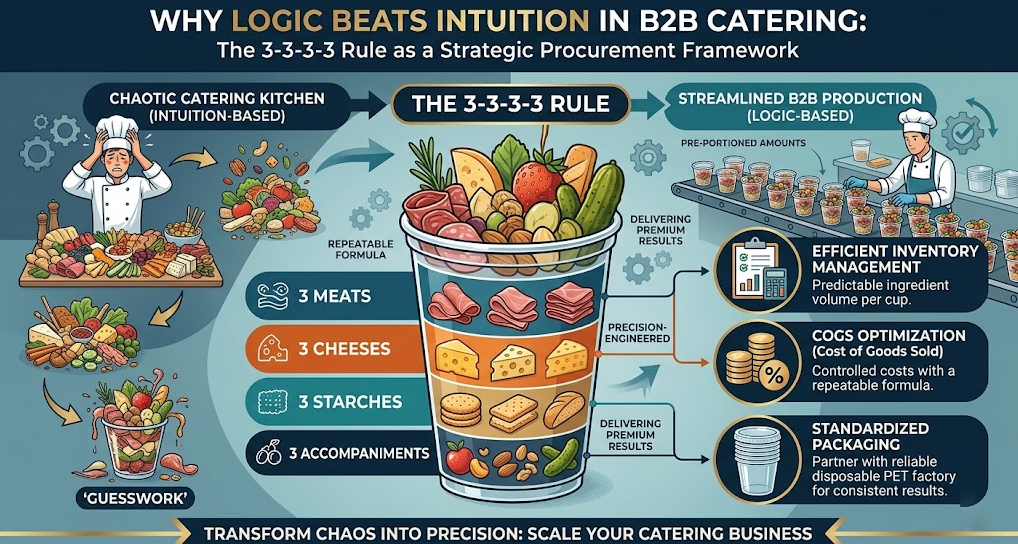
In the high-stakes world of professional catering and event planning, efficiency isn’t just a buzzword—it is the baseline for survival. If you’ve spent any time on social media lately, you’ve seen the explosion of the “Jarcuterie” trend. They are elegant, hygienic, and perfectly portioned for a crowd. But here’s the reality for business owners: if your prep team is spending twenty minutes over-thinking the placement of a single grape, you’re losing money. To scale, you need a repeatable formula. Enter the 3-3-3-3 rule. This isn’t just a list for your weekend party; it is a strategic procurement framework. By pairing this rule with a reliable disposable PET charcuterie cups factory, you can transform a chaotic kitchen into a precision-engineered production line that delivers premium results every single time.
Why Logic Beats Intuition in B2B Catering

The 3-3-3-3 rule breaks down the complexity of a grazing board into a vertical, manageable science: three meats, three cheeses, three starches, and three accompaniments. Why three? Because it offers enough variety to feel “custom” without skyrocketing your COGS (Cost of Goods Sold). For a customized PP charcuterie cups supplier, the physical constraints of the vessel are actually a gift. They force you to prioritize. When you’re sourcing from a professional plastic food packaging manufacturer, you need to know exactly how much volume those twelve items will occupy. If you guess, you end up with “sunken” ingredients or, worse, a top-heavy cup that tips over during delivery. This rule ensures that your inventory management is as crisp as the crackers you’re serving.
The Meat Trio: Beyond the Basic Salami

The first pillar of our rule is the protein. For a professional B2B presentation, you cannot just throw in three types of ham and call it a day. You need a structural variety. I usually recommend a “folding” meat like a high-grade Genoa salami, a “ribbon” meat like a thin-sliced Prosciutto, and a “solid” element like a spicy chorizo coin or a rolled Bresaola. This creates a 3D landscape inside the cup. When you are looking for a plastic charcuterie cups manufacturer for global distributors, you’re looking for a partner who understands that height is your best friend. A taller cup allows these meats to stand upright on skewers, creating that “fanning” effect that makes a $15 cup look like a $25 luxury item.
Selecting Cheeses That Can Stand the Heat
Next up: the cheese. This is where many amateurs fail by choosing cheeses that are too soft or too temperature-sensitive. For a commercial-scale operation, you need one hard cheese (think an aged Gouda or Manchego), one semi-firm cube (like a sharp white Cheddar), and one visual “anchor” (marinated Mozzarella pearls or a small wedge of Brie). Because these cups often sit out during cocktail hours, the integrity of the packaging is vital. Working with a recyclable plastic charcuterie cups factory for bulk orders, you ensure that your vessel doesn’t just look good, but stays rigid under the weight of these dense proteins and fats. A flimsy cup is the fastest way to ruin a corporate brand’s reputation.
The Starch Strategy: Defeating the Humidity Monster
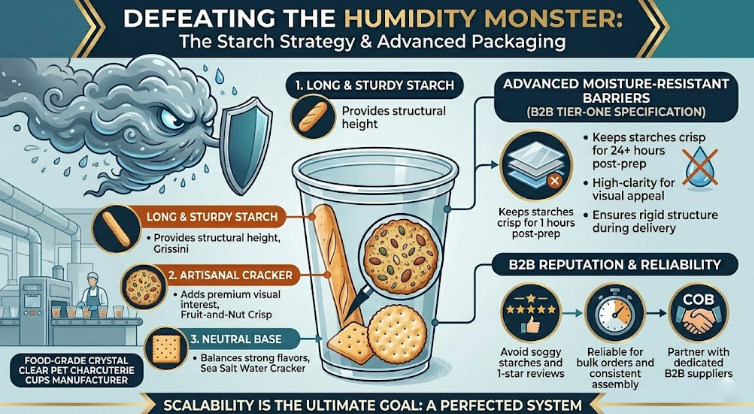
If there is one thing that will get you a 1-star review, it’s soggy crackers. The “three starches” in your list should include something long and sturdy (like a grissini breadstick), something artisanal (a fruit-and-nut crisp), and something neutral (a sea salt water cracker). In the B2B world, timing is everything. You might prep 500 cups on a Tuesday for a Wednesday event. To keep those starches crisp, you need a food-grade crystal clear PET charcuterie cups manufacturer that provides high-clarity, moisture-resistant barriers. This technical specification is often overlooked by small-time players, but it’s the difference between a “home cook” and a “tier-one supplier.”
Fillers and Accoutrements: The Profit Margin Heroes
The final three ingredients are your “fillers”—the items that bridge the gaps and add that pop of color. I’m talking about fruits (grapes or dried apricots), nuts (marinated Marcona almonds), and something pickled (Cornichons or olives). These are your lowest-cost items, but they provide the highest visual ROI. They act as the “gravel” in the jar, stabilizing the taller skewers. Many of my clients who run high-end catering brands find that a reusable plastic charcuterie cups supplier for catering brands is the best way to market these to eco-conscious corporate offices. It allows the client to feel like they are receiving a premium gift rather than a throwaway snack.
Streamlining the Assembly Line for Maximum Throughput
Once you have your 3-3-3-3 list, the “how” becomes just as important as the “what.” In a professional kitchen, you don’t build one cup at a time. You line up fifty. You drop the fillers, then the cheeses, then the meats. This modular approach is only possible if your packaging is consistent. If you are buying from a different wholesale clear plastic charcuterie cups factory every month, your skewers will fit differently every time, and your labor costs will spike as your team fumbles with the lids. Standardization is the silent partner of profitability.
Conclusion: Scalability is the Ultimate Goal
The 3-3-3-3 rule isn’t just about making a pretty snack; it’s about creating a scalable B2B product that you can sell to hotels, airlines, and corporate event planners with confidence. It removes the “guesswork” that slows down production and eats into your margins. When you combine this rigid culinary logic with the high-quality output of a dedicated B2B plastic charcuterie cups supplier, you aren’t just selling a cup of meat and cheese—you’re selling a perfected system. So, stop wandering the grocery aisles hoping for inspiration. Stick to the rule, secure your supply chain, and watch your catering business finally reach the scale it deserves.