
If you’ve ever sent out a perfectly layered biryani bowl only to see it come back as a soggy, compressed mess, you already know this isn’t a simple packaging question. It’s not about choosing “sealed” or “ventilated” as a static option. It’s about understanding why the same packaging performs beautifully one day and fails the next.
For most food brands working with a custom biryani bowl manufacturer, the real frustration is inconsistency. You tweak lids, upgrade materials, even pay more for “premium” containers, yet the outcome still varies. That’s because the core issue isn’t the box—it’s how heat, moisture, and time interact inside it.
The Real Problem Isn’t Packaging—It’s Steam Behavior

Biryani is inherently a high-risk product for delivery. It’s hot, layered, aromatic, and carries both oil and moisture. The moment it’s packed, it starts releasing steam. That steam doesn’t disappear—it either escapes or condenses and falls back.
When working with a biryani bowl supplier for bulk orders, many operators focus on durability, leak resistance, or branding. But what actually determines customer satisfaction is how the packaging handles that invisible cycle of evaporation and condensation.
If steam gets trapped, it turns your bowl into a mini pressure chamber. If it escapes too quickly, you lose heat and aroma. Most packaging failures sit somewhere in between—where neither is properly controlled.
Why Fully Sealed Packaging Fails More Often Than You Expect

Sealed packaging feels like the safe option. It locks in heat, prevents spills, and gives a clean, professional look. That’s why many brands default to it, especially when sourcing from an oem biryani bowl factory focused on tight-fitting lids.
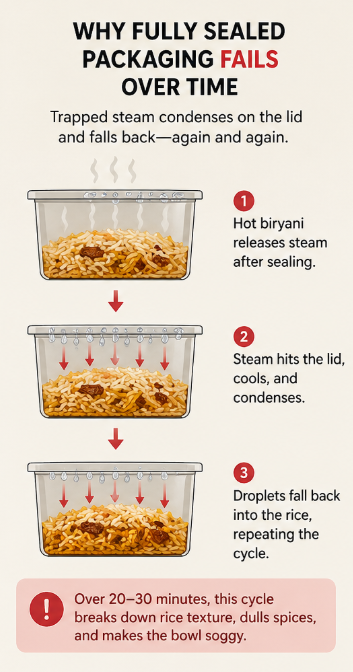
But here’s what actually happens after sealing a hot biryani bowl. The trapped steam rises, hits the lid, cools, and condenses into water droplets. Those droplets don’t stay there—they fall back into the rice. Over a 20–30 minute delivery window, this cycle repeats continuously.
The result isn’t subtle. Rice grains lose structure, spices dull, and the entire bowl feels heavier and wetter. What looked premium at dispatch arrives looking overcooked.
This is why sealed packaging only works reliably in short delivery scenarios. Beyond that, it becomes a liability.
Why Fully Ventilated Packaging Isn’t the Fix Either
On the other side, some brands swing too far toward ventilation. They assume that letting steam escape solves everything. And yes, it does prevent condensation buildup—but it introduces a different set of problems.
When working with an odm biryani bowl supplier for restaurant chains, ventilation-heavy designs often lead to rapid heat loss. The rice dries out on the surface while the deeper layers remain unevenly moist. Aromatics, which are critical for biryani, dissipate quickly when exposed to airflow.
Instead of soggy, you get dry and flat. Customers may not complain about texture collapse, but they’ll notice the lack of richness and warmth.
So again, the issue isn’t choosing one extreme over the other.
Delivery Time Changes Everything
One of the most overlooked variables is delivery duration. A packaging setup that works perfectly for a 10-minute trip can fail completely at 30 minutes.
If you’re sourcing from a custom biryani bowl supplier for food delivery brands, this is where many decisions go wrong. The packaging is tested under ideal conditions, not real delivery timelines.
Short-distance deliveries benefit from heat retention. In those cases, a more sealed structure can actually enhance the experience. But as time increases, steam accumulation becomes the dominant factor.
By the 20-minute mark, uncontrolled steam is already altering texture. By 30 minutes, it defines it.
This is why packaging decisions must be tied to operational reality, not just product design.
Temperature at Packing Is the Hidden Trigger
Another factor that quietly undermines packaging performance is the temperature at the moment of sealing.
Many kitchens pack biryani immediately after cooking, when it’s still releasing intense heat. This creates a surge of steam right at the start of the delivery cycle.
Even the best-designed container from a biryani bowl factory for large-scale catering can’t compensate for that initial burst if it’s not managed. The first minute after packing often determines the next thirty.
Allowing even a brief pause before sealing—just enough for the most aggressive steam to dissipate—can dramatically reduce condensation later. It’s a small operational shift with outsized impact.
Structure Matters More Than Material
It’s easy to assume that better materials solve the problem. Thicker plastic, coated paper, or premium composites are often marketed as solutions. But structure plays a more decisive role.
When working with a biryani bowl manufacturer for private label packaging, you’ll notice that bowls filled to the brim perform worse. There’s no space for steam to circulate or escape. Everything condenses directly back onto the food.
A slightly lower fill level, or a design that creates separation between layers, changes how moisture behaves. Instead of immediately falling back, steam has room to disperse or exit.
This is why two identical materials can deliver completely different results depending on how they’re used.
The Most Reliable Approach: Controlled Venting
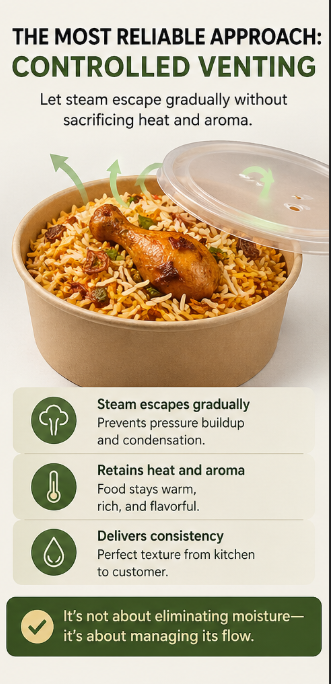
The most effective packaging strategies don’t rely on full sealing or full ventilation. They use controlled venting—allowing steam to escape gradually without sacrificing heat retention.
This is increasingly common among brands partnering with a custom printed biryani bowl manufacturer for branded packaging solutions. Small, strategically placed vents or breathable membranes create a balance.
Steam pressure is reduced before it becomes condensation, but the internal environment remains warm and aromatic. It’s not about eliminating moisture—it’s about managing its flow.
This approach requires more precision in design, but it consistently delivers better outcomes across varying delivery times.
Why Most “Upgrades” Don’t Work
A common reaction to packaging issues is to upgrade—switch to a more expensive supplier, thicker materials, or more complex lids. But without addressing steam dynamics, these changes often disappoint.
Even a premium solution from an odm biryani bowl manufacturer for cloud kitchens can fail if the core conditions remain the same. The bowl isn’t the problem in isolation.
Transport conditions, stacking, ambient temperature, and rider handling all influence how moisture behaves. Packaging is just one part of a larger system.
This is why some brands see no improvement despite higher costs—they’ve optimized the wrong variable.
Matching Packaging to Real Use, Not Ideal Scenarios
The most successful operators don’t ask, “What’s the best packaging?” They ask, “What happens to my product between kitchen and customer?”
When sourcing from a biryani bowl supplier for international distributors, this mindset shift becomes critical. Different markets, climates, and delivery infrastructures change the equation.
A solution that works in a cool, short-distance urban environment may fail in a hotter, longer-distance setup. Packaging must adapt to context.
That’s why testing under real delivery conditions—not just in-store simulations—is essential before scaling any packaging decision.
The Practical Takeaway
So, should biryani bowl packaging be sealed or ventilated?
Neither—at least not in absolute terms.
The goal isn’t to choose between two static options. It’s to control how steam behaves over time. That means considering temperature at packing, delivery duration, product structure, and venting design as a connected system.
Brands that get this right don’t just avoid soggy rice or dry textures. They deliver consistency. And in food delivery, consistency is what customers remember.
If your current setup feels unpredictable, the answer probably isn’t a new box. It’s a better understanding of what’s happening inside it.