
Most operators don’t lose customers because toppings “slightly shift.” They lose them when a carefully arranged sushi bowl arrives looking like it’s already been stirred. At that point, it’s not just a visual issue—it signals poor quality, even if the ingredients are fine.
The frustrating part is that many fixes sound right but fail in practice. Dividers, tighter lids, better stacking—these help, but they don’t solve the core problem. Mixing happens when movement, moisture, and structure interact. If one of these is ignored, the bowl still collapses during delivery.
The Problem Usually Starts Before Delivery

A lot of mixing issues are already “locked in” before the rider even picks up the order.
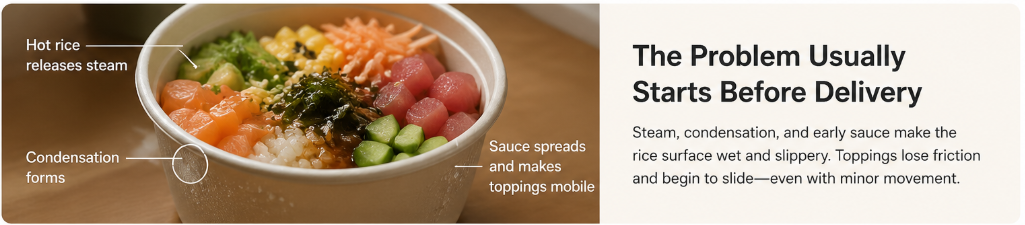
Hot rice releases steam. Cold toppings trap it. Within minutes, condensation forms and turns the rice surface slightly wet. That thin layer is enough to reduce friction, so toppings begin to slide even with minor movement.
Now add sauce. Once it’s poured early, it spreads across the base and makes everything more mobile. Even if you’re using segmented containers, liquid will eventually bypass those boundaries.
This is why many brands working with a custom sushi bowl manufacturer for restaurant chains don’t just redesign the bowl—they adjust packing timing, especially when sauce and temperature are involved.
Why Dividers Alone Don’t Solve It
Compartment designs are often treated as the “final answer,” but in real delivery conditions, they’re just one piece.
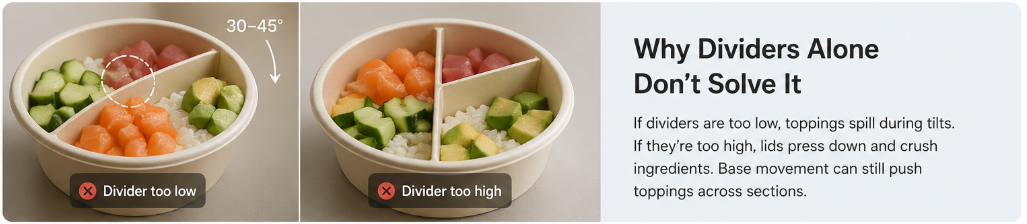
If divider walls are too low, toppings spill over during a 30–45° tilt, which is common during transport. If they’re too high, lids press down on ingredients, especially softer items like fish or avocado, destroying the presentation anyway.
There’s also base movement. Rice shifts when the container tilts, and that movement can push toppings across sections.
Operators sourcing from a sushi bowl packaging supplier for ghost kitchens often find that divider effectiveness depends on proportion, not just presence. Height, spacing, and how tightly ingredients are packed all matter.
Reducing Movement Works Better Than Blocking It
Instead of trying to “trap” toppings, a more reliable approach is to make them less likely to move.
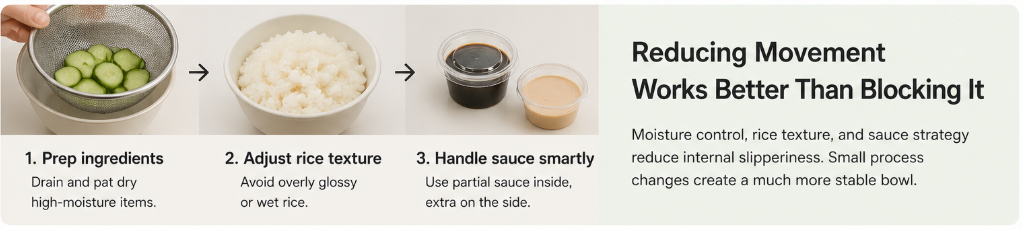
Moisture control is key. Ingredients like cucumber or marinated proteins release water over time. If they’re packed without preparation, they create a slippery environment inside the bowl.
Some kitchens lightly drain or pat dry high-moisture toppings. Others adjust rice texture so it isn’t overly glossy. Small changes here significantly reduce internal movement.
Sauce handling is another major lever. Fully pre-sauced bowls are the least stable. Fully separated sauces slow down operations. A balanced approach—partial sauce inside, extra on the side—often performs best.
Brands working with a oem sushi bowl container factory for food delivery brands typically test these variables together instead of treating packaging as a standalone fix.
When “Controlled Mixing” Is Actually the Smarter Move
Trying to keep everything perfectly separated isn’t always necessary—or efficient.
In high-volume delivery, some brands design bowls that still taste right even if partial mixing happens. This is common in poke-style menus, where ingredients and sauces are chosen to blend naturally.
Instead of rigid separation, the bowl is built to tolerate movement. That way, even after transport, the product still feels intentional.
Teams collaborating with a sushi bowl container manufacturer for fast casual chains often shift to this approach when scaling, especially when delivery times are inconsistent.
Container Shape Quietly Impacts Everything
Shape is often overlooked, but it directly affects how ingredients behave.
Shallow, wide bowls make toppings easier to spread—but also easier to shift. A slight tilt sends everything across the surface.
Deeper bowls contain movement better but can create pressure if the lid sits too close to the food. That leads to compression instead of mixing, which is a different kind of failure.
Round containers distribute movement more evenly. Square ones create corners where ingredients accumulate and then spill unevenly.
Brands working with a custom printed sushi bowl supplier for branded packaging often realize that visual design needs to follow functional behavior, not the other way around.
Lids Are Part of the Stability System
A lid isn’t just for sealing—it directly affects how stable the contents remain.
Loose lids allow internal shifting to increase. Overly tight lids press down on toppings. Slight variations in portion size can make this worse during busy service.
Some designs use domed lids to create space. Others rely on locking edges to reduce vibration impact.
Those partnering with a odm sushi bowl packaging manufacturer for takeaway solutions usually test lid performance under movement, not just leak resistance.
Where Things Commonly Go Wrong
Most failures come from treating the issue too simply.
Relying only on compartments is one of the biggest mistakes. Ignoring moisture control is another. Pre-pouring sauce too early is a frequent cause of collapse.
There’s also a tendency to optimize cost per unit without considering customer experience. A cheaper bowl that leads to complaints or refunds ends up costing more.
Buyers sourcing from a sushi bowl container supplier for bulk packaging buyers often reassess priorities after seeing how packaging impacts repeat orders.
A Practical Way to Test Your Setup
You don’t need complex tools to evaluate performance.
Pack a bowl exactly as you would during service. Close it, then simulate movement—tilt it, shake it lightly, and leave it for 15–20 minutes.
Open it and check three things: have toppings crossed sections, has moisture spread, and does the bowl still look intentional?
Teams working with a eco-friendly sushi bowl factory for sustainable packaging solutions often rely on this kind of testing when switching materials, since sustainability changes can affect structure and moisture behavior.
Choosing What Actually Fits Your Operation
There’s no single “best” solution. What works depends on how your business runs.
If your brand relies on presentation, stronger structural separation and tighter process control are necessary. If you prioritize speed and volume, designing for acceptable mixing may be more practical.
Operators working with a sushi bowl packaging factory for international distributors often test multiple configurations before committing, especially when serving different delivery environments.
What Makes the Real Difference
Preventing toppings from mixing isn’t about one feature. It’s about how structure, moisture, and movement interact in real conditions.
When those are aligned, even long deliveries hold up well. When they’re not, no amount of packaging tweaks will fully solve the issue.
The difference comes from treating the bowl as a system—not just a container.