
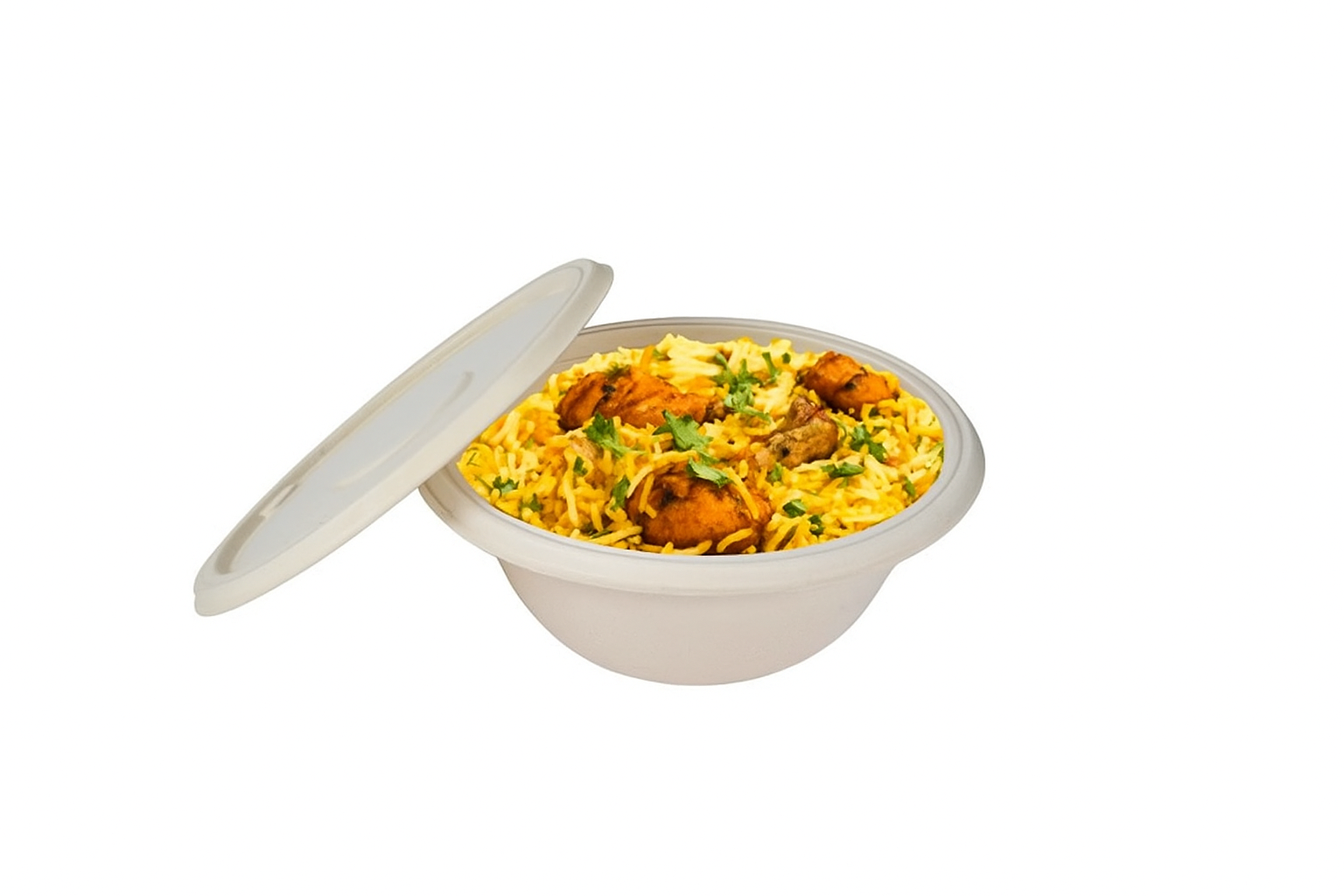
Packaging rarely becomes a strategic issue until it fails. For many U.S. foodservice operators working with Indian and South Asian menus, that failure tends to happen publicly and repeatedly. Biryani exposes weak packaging in a way few dishes do. Steam builds, oil migrates, weight settles, and the container is tested long after the food leaves the kitchen. When the bowl underperforms, the result is not subtle.
This is why sugarcane bagasse biryani bowls are now being specified intentionally rather than adopted incidentally. They solve practical problems first. Sustainability comes later.
Why Biryani Forces Operators to Rethink Bowl Design

Biryani behaves differently from most rice-based meals once it enters a delivery environment. The rice continues to expand. Gravy stays fluid longer. Protein adds concentrated weight to the center of the bowl. Shallow containers exaggerate these forces, causing separation and leakage even when lids remain intact.
Operators learned quickly that increasing bowl size alone does not fix the issue. Depth, wall density, and base rigidity matter more than diameter. This is where molded fiber formats begin to outperform thin plastic or coated paperboard. A properly engineered bagasse bowl absorbs stress instead of deforming under it.
As a result, buyers increasingly search for a biryani bowl manufacturer with operational-grade performance, rather than relying on generic compostable packaging that was never designed for this cuisine.
What Sugarcane Bagasse Actually Delivers in Daily Service
Bagasse is often framed as an eco-friendly material, but its real value shows up during service hours. When compressed under heat and pressure, bagasse fibers create a dense structure that resists oil penetration without requiring plastic liners. This matters when hot curry sits in contact with the bowl for thirty minutes or more.
Unlike paperboard, bagasse does not lose stiffness quickly when moisture accumulates. Unlike foam, it remains dimensionally stable at temperatures above 220°F. These properties explain why many procurement teams now specify bagasse by name when sourcing from a compostable packaging supplier serving hot-food menus.
In practice, the material choice reduces complaints, stabilizes presentation, and lowers the frequency of packaging-related refunds.
Regulation Accelerates Change, but Operations Force It
State-level restrictions on single-use plastics have certainly accelerated the transition toward compostable packaging. California and New York are often cited, but regulation alone rarely explains the speed of adoption. Operators move faster when delivery photos circulate online showing collapsed bowls or stained bags.
Delivery platforms amplify packaging failures. One leaking order can undo dozens of positive reviews. This dynamic has pushed packaging into the same decision category as ingredients and equipment. Certifications such as BPI and ASTM D6400 now function as baseline requirements rather than marketing advantages, especially when working with a foodservice packaging supplier aligned with U.S. compliance norms.
How the Five Suppliers in This Article Were Filtered

The suppliers discussed here were selected based on performance relevance rather than product breadth. Each one offers genuine bagasse bowls in formats appropriate for biryani, typically 32oz or larger, and maintains a viable supply path to U.S. buyers. Companies focused on shallow bowls or retail-only packs were excluded regardless of brand visibility.
AMS Compostable and the Economics of Volume
AMS Compostable operates on a scale-driven model. Headquartered in Florida, the company supplies compostable packaging to buyers who prioritize consistency across locations. Its bagasse bowls are standardized, designed to integrate smoothly into national foodservice programs.
For large operators, AMS Compostable functions as a foodservice packaging supplier for multi-location distribution, minimizing logistics complexity and inventory variability. The model is efficient, though not flexible. Smaller buyers often find minimum order thresholds prohibitive, but for chains, predictability outweighs customization.
Bioleader and Direct Manufacturing Control
Bioleader represents a factory-direct sourcing approach. The company produces molded fiber tableware in a wide range of sizes, including deep bowls suitable for biryani and curry dishes. Certification support typically aligns with U.S. import requirements, reducing compliance friction.
Bioleader is often selected by buyers seeking OEM bagasse bowl production for private-label foodservice programs. While overseas sourcing requires longer planning cycles, it provides control over specifications, branding, and cost structure that domestic distributors rarely offer.
Vegnar Greens and Cuisine-First Manufacturing
Vegnar Greens designs packaging from a culinary perspective rather than a Western template. Based in India, the company develops bagasse bowls specifically for traditional meal formats. Deeper profiles and reinforced bases reflect practical service realities rather than marketing trends.
This approach resonates with buyers looking for a biryani-focused packaging factory with ODM capability, particularly brands serving South Asian communities across multiple U.S. regions. Longer transit times are offset by reduced testing cycles and better functional fit.
AGH Supply and the Role of Accessibility
AGH Supply occupies a different position in the supply chain. As a domestic distributor, it provides bagasse bowls through U.S.-based fulfillment, allowing independent restaurants and food trucks to transition away from plastic without committing to large volumes.
Customization is limited, but speed matters. AGH Supply serves as a bagasse bowl supplier for independent foodservice operators who need compliance and reliability more than branding control.
Eco-Pulp Pack and Long-Term Custom Strategy
![SIMOND STORE - 6Oz Paper Bowls - [Pack of 100] Disposable 100% Compostable Paper Bowls - Heavy Duty Eco-Friendly - Sugarcane Bagasse Fiber Biodegradable Bowls for Party, BBQ, Wedding - Walmart.com](https://i5.walmartimages.com/seo/SIMOND-STORE-6Oz-Paper-Bowls-Pack-100-Disposable-100-Compostable-Heavy-Duty-Eco-Friendly-Sugarcane-Bagasse-Fiber-Biodegradable-Party-BBQ-Wedding_4b323fb6-0534-46c6-a358-8e7e17f82505.9b70e583089c5b5ac12770d19749c77b.jpeg)
Eco-Pulp Pack focuses on engineered solutions rather than catalog items. Buyers can adjust dimensions, wall thickness, and structural details to match specific menu requirements. This makes the company appealing to brands building proprietary packaging systems.
Eco-Pulp Pack is commonly chosen as a custom molded fiber bowl factory for scalable restaurant concepts, where upfront planning leads to consistency across markets. The overseas model demands forecasting, but rewards buyers who commit to long-term programs.
Comparing Supply Models Instead of Chasing Lowest Price
Looking across these suppliers, the key distinction is not product quality but sourcing philosophy. Domestic distributors emphasize speed and simplicity. Overseas manufacturers emphasize control and efficiency. Neither model fits every buyer.
For procurement teams sourcing from a sugarcane bagasse bowl supplier for commercial kitchens, aligning supply structure with operational reality matters more than marginal price differences.
How Buyers Should Test Before Scaling Orders
Certifications alone do not reveal performance limits. Real-use testing remains essential. Bowls should be filled with hot gravy, stacked, transported, and reheated to expose weaknesses. These tests often surface issues that specifications overlook.
Negotiations are more productive when framed around annual volume and partnership potential. Suppliers respond differently when discussions move beyond spot pricing, particularly in ODM biryani bowl manufacturing for growing restaurant groups.
Where U.S. Buyers Source Bagasse Biryani Bowls at Scale
Bulk sourcing spans domestic distributors, direct imports, and hybrid models. Each path balances speed, cost, and control differently. Seasonal fluctuations in sugarcane supply can also affect pricing, reinforcing the value of forward planning.
Whether sourcing through a biryani bowl factory for private-label initiatives or relying on U.S. inventory for rapid replenishment, informed sourcing decisions reduce both operational and reputational risk.
Sugarcane bagasse biryani bowls have moved beyond experimentation. They now function as a practical standard for a cuisine that leaves little room for packaging failure. Buyers who treat packaging as part of the food system, rather than an afterthought, are better positioned to scale consistently in the evolving U.S. foodservice market.