
It is one of those low-stakes dinner table debates that somehow manages to get everyone surprisingly heated: do you crunch through your bowl of greens before the main course arrives, or do you save that salad as a refreshing, palate-cleansing finale? Depending on where you grew up, you might have very strong feelings about this. Americans generally treat the salad as a “starter,” while many Europeans wouldn’t dream of touching a leaf until the roast is finished.
But if we strip away the cultural traditions and look strictly at the biology of how our bodies process food, there is a clear winner. If you’re looking for the short answer: the “Before” camp takes the trophy. However, as any nutritionist (or savvy diner) will tell you, the timing is only half the battle. To really make this habit work for your waistline and your energy levels, you need to understand the “why” behind the crunch.
The Verdict: Why Starting with Greens is a Metabolic “Cheat Code”
Let’s get the big numbers out of the way first. When you eat a salad before your main meal, you aren’t just adding vitamins to your day; you are fundamentally changing how you interact with the rest of your dinner. Scientists have crunched the numbers, and the results are pretty staggering: eating a pre-meal salad can reduce your total calorie intake by roughly 11%. On top of that, it usually bumps up your total vegetable consumption by about 23%.
In the world of health, that is a massive return on investment for simply changing the order of your fork hits. But here is the nuance that people often miss: the real variable isn’t just the clock—it’s the volume. You can’t eat three tiny leaves of spinach and expect your brain to shut off your hunger. The goal is to create a physical “buffer” in your stomach. To help restaurants and meal-prep services facilitate this, a Custom PET Salad Bowl Manufacturer focuses on creating containers that are deep enough to hold a “functional” portion of greens, ensuring the consumer actually gets enough fiber to make a difference.
The Fiber-Fill Mechanism: Letting Physics Do the Heavy Lifting
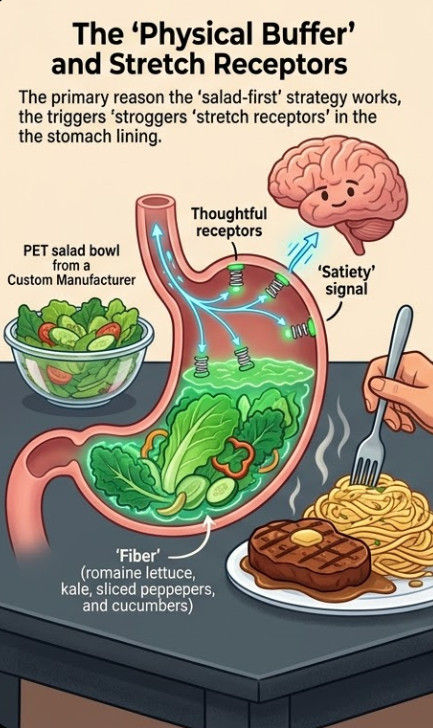
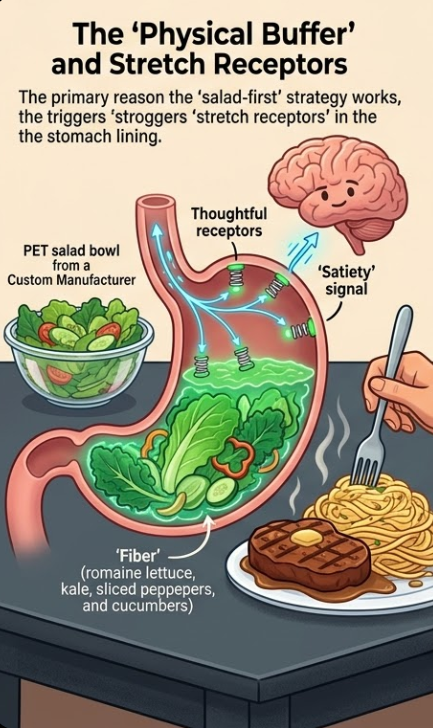
The primary reason the “salad-first” strategy works isn’t some mysterious chemical reaction; it is mostly about basic physics. High-fiber vegetables—think romaine, kale, bell peppers, and cucumbers—are incredibly “bulky” but very low in calories. When these hit your stomach first, they trigger “stretch receptors” in the stomach lining. These receptors send a direct message to your brain saying, “Heads up, we’re filling up,” long before the calorie-dense steak or pasta makes its entrance.
Think of it as a “pre-load.” By the time you start on the main course, you’ve already dampened your appetite. Research suggests this habit can cut about 57 calories from a single meal. That sounds small, but if you do it once a day for a month, you’ve created a 1,700-calorie deficit without ever feeling like you were on a restrictive diet. For large-scale catering, a Salad Bowl Factory for Wholesale Buyers ensures these portions are easy to distribute, keeping the “pre-load” fresh and crisp for office workers and students alike.
Blood Sugar Control: Flattening the “Glucose Rollercoaster”

If you’ve ever felt like you needed a nap at 2 PM after a big lunch, you’ve experienced a blood sugar crash. When you eat a meal high in refined carbohydrates or sugars on an empty stomach, your glucose levels spike, followed by a massive insulin dump. This is the biological root of that afternoon brain fog.
Fiber is the ultimate “glucose shield.” When you eat your salad first, the fiber creates a viscous “mesh” or net in your small intestine. This net acts like a speed bump, slowing down the rate at which sugars from your main meal enter your bloodstream. This is known as “flattening the glucose curve.” For anyone managing insulin resistance or Type 2 diabetes, this simple change in food order can be revolutionary. To make this accessible for the modern, busy professional, an OEM Disposable Salad Bowl Supplier must prioritize leak-proof, durable designs so that high-fiber lunches can be eaten anywhere, from the breakroom to the park bench, without a mess.
Is the “After-Meal” Salad Totally Useless?
If you were raised in a household where the salad followed the roast, don’t feel like you’ve been sabotaged. While the “digestive enzyme” argument—the idea that raw greens after a meal somehow “spark” digestion—is more folk wisdom than hard science, the habit still has merit.
The biggest benefit of the post-meal salad is that it still provides those essential micronutrients and long-term gut health benefits. Research comparing “before-meal” and “with-meal” consumption shows that the satiety (fullness) levels stay relatively similar. The only real downside to the European style is that it doesn’t help with “passive calorie reduction.” If you’ve already polished off a mountain of potatoes, the salad won’t magically undo those calories. However, it’s still infinitely better than skipping the greens entirely. To cater to these different dining styles, a Bulk Salad Container Manufacturer for Food Chains produces a wide range of sizes, from small “side” vessels to massive “meal” tubs, ensuring every cultural preference is covered.
The “Token Salad” Mistake: Why Volume is King
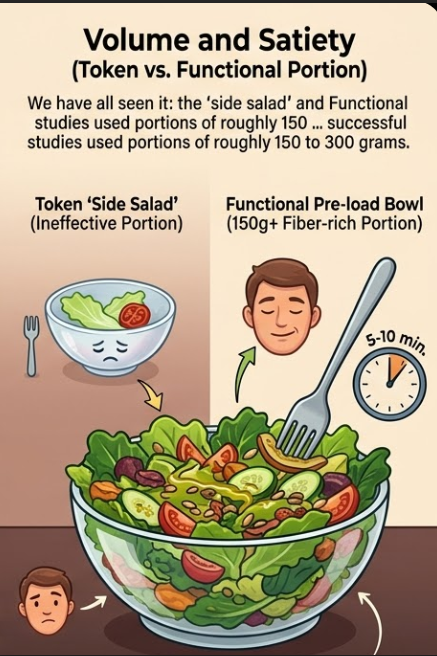
We have all seen it: the “side salad” that consists of two translucent leaves of iceberg lettuce and one sad cherry tomato. If you are expecting that to change your metabolic health, I have some bad news. To trigger the satiety signals your brain needs, you need volume.
The most successful studies on this topic used portions of roughly 150 to 300 grams. A good rule of thumb? If the salad doesn’t take you at least five or ten minutes to chew through, it probably isn’t big enough to make a dent in your appetite. This is why an ODM Eco-friendly Salad Bowl Factory will often focus on wide-base designs; they know that for a salad to be functional, it needs to look (and be) substantial. A tiny bowl might look cute, but it doesn’t leave room for the amount of roughage required to actually influence your hormones.
Building the Right Foundation: Ingredients That Maximize Benefits
Not all salads are created equal. If your “healthy” starter is a pile of greens drowned in 500 calories of creamy ranch, bacon bits, and oily croutons, you’ve just added more calories to your day than you’re saving.
To win at the “before-meal” game, you need high-fiber, high-water ingredients. Dark leafy greens like arugula or spinach are the gold standard. Add cucumbers, celery, or radishes for crunch and hydration. And don’t be afraid of a little fat—just keep it healthy. Vitamins A, D, E, and K are fat-soluble, meaning your body literally cannot absorb them without a source of fat like olive oil or avocado. To keep these ingredients from getting soggy, a Clear Plastic Salad Bowl Supplier for Global Markets often develops multi-compartment containers that keep the dressing and the crunch separate until the very last second.
Practical Scenarios: When “Before” Isn’t Easy
Let’s be realistic: life isn’t always a controlled experiment. You are at a busy restaurant with friends, or you’re rushing through a 15-minute lunch break. It isn’t always easy to wait for a salad before touching your fries.
In a restaurant, the trick is simple: ask the server to bring the salad as soon as it’s ready, regardless of when the appetizers come out. At home, the biggest hurdle is the cooking workflow. Most people are busy right up until the moment dinner is served. The solution? Have your salad pre-prepped in the fridge. Munch on it while you’re plating the rest of the meal or waiting for the oven timer to ding. To make this “grab-and-go” lifestyle possible, a Takeaway Salad Bowl Manufacturer for Bulk Purchase focuses on stackability and durability, allowing you to prep five days of “metabolic primers” on a Sunday afternoon.
The Verdict: A Simple Rule to Live By
At the end of the day, you don’t need to be a scientist to eat better. Just follow one simple, actionable rule: Eat a substantial, fixed-size bowl of greens before you touch your main course. Don’t worry about being perfect. If the salad comes out at the same time as your pizza, just eat a few big bites of the greens first. If you’re at a fancy dinner and the salad comes last, enjoy the tradition. The goal is to build a sustainable habit that prioritizes fiber and slows down your eating pace. For the professional world, providing the right tools—like high-quality packaging from a Premium Grade Salad Bowl Supplier for Commercial Use—is what makes these healthy habits actually stick in the wild. When we make the healthy choice the most convenient choice, everyone wins.