
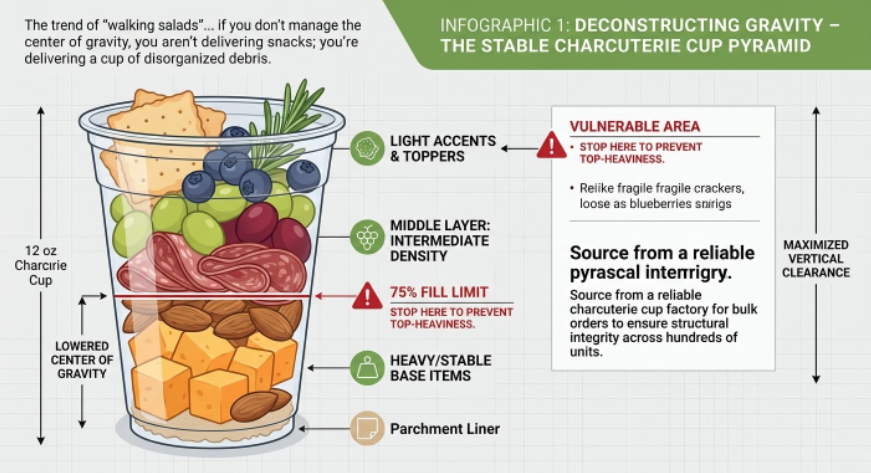
The trend of “walking salads” and grazing cups has solved the hygiene hurdle for modern events, but it has created a massive logistical headache. Unlike a traditional flat board, these vertical appetizers are a physics nightmare. They are top-heavy, prone to sliding, and sensitive to every micro-vibration of a car engine. If you don’t manage the center of gravity, you aren’t delivering snacks; you’re delivering a cup of disorganized debris.
Why Charcuterie Cups Are Tricky to Transport (And What Goes Wrong)
Understanding the “why” behind the mess is the first step to stopping it. In a real-world drive—like a quick turn to avoid a cyclist or a sudden stop at a red light—the primary failure is “tipping.” The narrow base of a 12 oz cup simply cannot fight centrifugal force. Once one cup leans, it creates a domino effect across the tray.
Beyond the tipping, you have “ingredient migration.” A heavy grape or a rolling piece of boccincini can easily crush a delicate prosciutto rose. Then there’s the oil. High-quality salami sweats, and that oil pools at the bottom, potentially turning a paper base into a soggy mess. This is why professional planners often source their hardware from a reliable charcuterie cup factory for bulk orders, ensuring the sidewalls are thick enough to resist collapsing under the weight of the contents.
The Art of Pre-Transport Prep: Building a Stable Foundation
Stability starts in the kitchen, not the car. Think of your cup like a high-rise building: the “foundation” must be heavy. Use dense items like Manchego wedges or cubes of aged cheddar to create a weighted anchor at the bottom. This lowers the center of gravity significantly.
Keep your fill levels in check. A common amateur mistake is piling food three inches above the rim. For safe movement, stick to the 75% fill rule. This lets the cup’s own walls act as a structural cage. To handle the moisture issue, tuck a small circle of greaseproof paper at the very bottom. If you are scaling a business, consulting a professional snack cup supplier for catering businesses can help you find containers with reinforced, flared bases designed specifically for multi-layered stability.
Chilling and Firming: The Hidden Step to Success
Temperature isn’t just about food safety; it’s a mechanical tool. When fats in cured meats and cheeses get cold, they firm up and act like a mild adhesive, “locking” the ingredients into place. A room-temperature cup is a slippery cup.
Try refrigerating the fully assembled cups for at least 45 minutes before they hit the road. This cooling period turns soft fats into rigid anchors. For distributors moving thousands of units, material resilience is key; sourcing from a premium PET charcuterie cup manufacturer for global distributors ensures your cups won’t crack or fog up when moving from a cold fridge to a warm delivery van.
Choosing the Right Lid and Sealing Method
Lids are your primary insurance policy. For plastic versions, a tight-fitting dome lid is best because it provides the vertical “headroom” needed for tall skewers. If you use paper cones, high-tension plastic wrap with a decorative elastic band can provide a decent temporary seal.
For long-haul trips, I always suggest a “double-containment” strategy. Put the sealed cup inside a secondary carrier—like a snug box or even a zip-lock bag for solo deliveries. This keeps any rogue oil or stray berries from ruining the presentation. To add a layer of brand authority, many event leads work with a custom printed appetizer cup supplier for event planners to create secure, branded sleeves that double as structural stabilizers.
Best Carriers and Holders to Keep Cups Upright

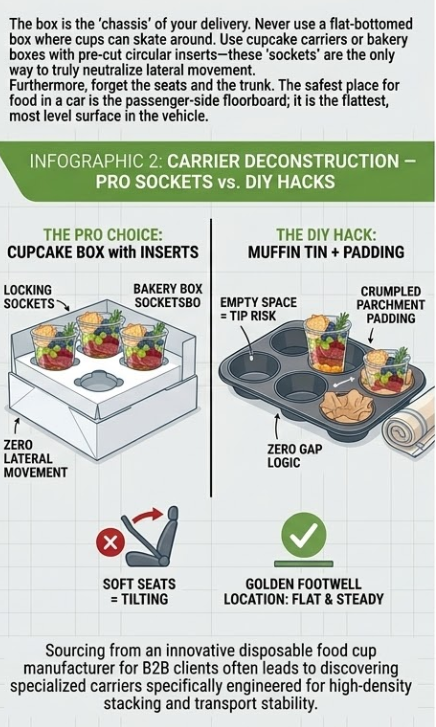
The box is the “chassis” of your delivery. Never use a flat-bottomed box where cups can skate around. Use cupcake carriers or bakery boxes with pre-cut circular inserts. These “sockets” are the only way to truly neutralize lateral movement.
If you’re caught without professional gear, a muffin tin is a legendary DIY hack. The wells are usually the perfect diameter for 5 oz or 8 oz cups. For larger crates, follow the “zero-gap” logic: fill every bit of empty space with crumpled parchment or towels. If the cups can’t wiggle, they can’t tip. In the procurement phase, it’s worth finding an innovative disposable food cup manufacturer for B2B clients who offers specialized inserts designed for high-density transport.
How to Transport Charcuterie Cups Safely in a Car
Forget the seats and forget the trunk. The safest place for food in a car is the passenger-side floorboard. It is the flattest, most level surface in the vehicle. Seats are angled and soft, which encourages tilting, and the trunk is where the car’s “bounce” is most violent.
Drive like you have a sleeping toddler in the back. Smooth brakes and wide, lazy turns are the goal. Use a non-slip silicone mat under your carriers to stop the whole box from sliding. If you’re managing national-scale retail logistics, you might consult a wholesale charcuterie container factory for large-scale retail to source shipping-grade outer cartons that can handle the vibration of long-distance freight.
Transporting on Foot, Bus, or Rideshare
Urban transit adds the variable of human swing. If you’re walking, use a rigid-sided tote bag rather than a soft one. A soft bag will cave in and crush your garnishes. Keep your arm steady and avoid the natural pendulum motion of your stride.
For rideshare trips, keep the carrier on your lap or at your feet—never on the seat. If your business model focuses on “grab-and-go” in city centers, consider shorter, wider cup profiles. Sourcing these from a versatile paper food cup supplier for boutique cafes ensures your product can survive the bumps of a subway ride or a busy sidewalk without a total collapse.
Keeping the Temperature Right During Transit
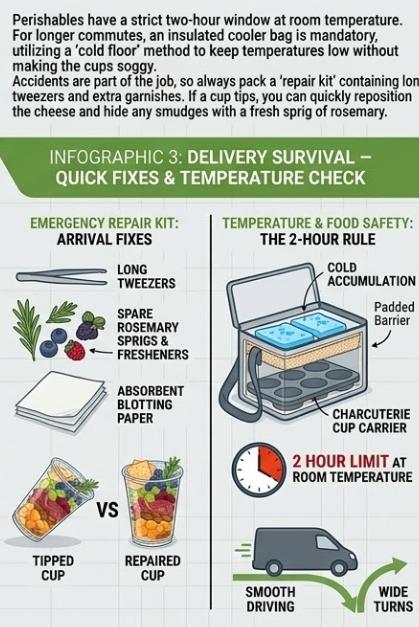
Perishables have a strict two-hour window at room temperature. For longer commutes, an insulated cooler bag is mandatory. But don’t just toss in ice packs; the condensation will melt your packaging.
Place ice packs at the very bottom of the cooler, cover them with a towel, and set your carriers on top. This “cold floor” method keeps the temperature low without making the cups soggy. High-volume operations often use a high-volume snack packaging manufacturer for food distributors to find materials that won’t degrade or lose their “snap” in high-humidity cooler environments.
Quick Fixes for Last-Minute Transport Problems
Accidents are part of the job. Always pack a “repair kit”: long tweezers, extra rosemary sprigs, and a few backup crackers. If a cup tips, use the tweezers to reposition the cheese and hide any smudges with a fresh garnish.
If a cup leaks oil, blot the base quickly and swap the insert if you have spares. Staying connected with a premium eco-friendly cup factory for sustainable brands ensures your backup inventory is always made of resilient, high-quality materials that make on-site fixes look intentional.
In short, successful charcuterie transport is just a game of gravity management. If you build a heavy base, lock the cups into a socket, and stay off the car seats, your appetizers will arrive looking as sharp as they did in the kitchen.