
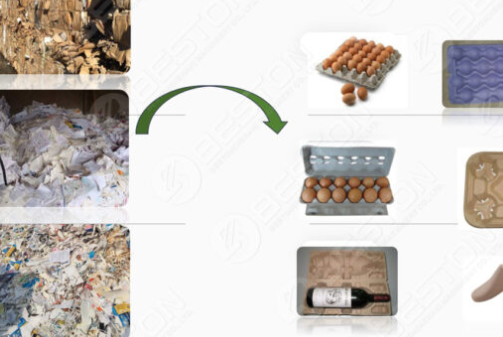
Using waste paper to make egg trays sounds like a simple recycling idea, but once you start doing it, you quickly realize it is more about process control than improvisation. What looks like a low-tech product is actually the result of very specific material behavior. Fiber length, water content, forming pressure, and drying conditions all determine whether the final tray is usable or not.
This guide focuses on how egg trays are actually made from waste paper in real situations. It covers home experiments, small workshops, and entry-level production without turning the process into abstract theory. The goal is to explain what matters, what does not, and where most mistakes happen.
Understanding the Core Principle Behind Paper Egg Trays
Paper egg trays are not glued together, pressed flat, or chemically bonded. Their strength comes almost entirely from how paper fibers reconnect after being separated in water. Once paper is pulped, the fibers float freely. When shaped and dried, those fibers lock back together through natural bonding.
The tray’s structure does most of the work. Each egg cavity spreads pressure and absorbs shock, which is why recycled paper performs surprisingly well even without additives. Whether you use a household blender or a factory pulper, the basic principle does not change. Only speed, consistency, and output volume do.
Choosing the Right Waste Paper for Egg Tray Production

Not every type of waste paper behaves well during pulping. Cardboard, newspapers, and office paper differ significantly once broken down. Cardboard generally produces stronger trays because it contains longer fibers that hold together better during drying. This is why it is widely used in commercial production.
Newspaper pulp is easier to process but tends to produce softer trays unless thickness is increased. Office paper, especially heavily processed white paper, often creates weaker bonding and is less forgiving during forming.
Clean input material matters more than beginners expect. Tape, plastic coatings, staples, and glossy layers interrupt fiber bonding and cause defects. The cleaner the paper, the fewer problems appear later in forming and drying.
Materials and Equipment: What Changes With Scale
The raw materials remain simple: waste paper and water. What changes with scale is how precisely they are controlled. Small batches rely on visual judgment and texture, while larger operations rely on repeatable ratios and mechanical settings.
At the DIY level, buckets, blenders, and homemade molds are enough to demonstrate the process. These setups are slow but flexible. Small workshops typically introduce pulping machines and vacuum molds to improve consistency. Industrial lines add automation, pressure control, and water recycling systems.
Some producers add strengthening agents or water-resistant treatments, but these are optional. The core structure of an egg tray does not depend on chemicals—it depends on fiber behavior.
Collecting and Preparing Waste Paper

Sourcing waste paper is not just about volume. Quality consistency matters. Free sources often require extra sorting, while paid suppliers usually offer cleaner material. Both approaches work, but preparation time varies.
Before pulping, non-paper elements must be removed. Even small amounts of plastic or adhesive can weaken trays or damage equipment. Shredding speeds up soaking and creates more uniform pulp. Hand tearing works for small batches, but machine shredding produces more predictable results.
Soaking softens fibers and reduces pulping energy. Thick cardboard needs more time than thin paper. Skipping or rushing this step often leads to uneven pulp and weak tray walls.
Turning Paper Into Pulp
Pulping separates paper into usable fibers. In home setups, blending time is critical. Too little blending leaves clumps; too much breaks fibers down too far. The goal is separation, not pulverization.
Good pulp feels dense but fluid. It should flow easily while still holding fiber together. Adjusting water content is a gradual process rather than a fixed formula.
Filtering removes leftover contaminants. If pulp is stored, it should be used soon. Settling and microbial growth become problems if pulp sits too long without agitation.
Forming the Egg Tray Shape

Forming gives the tray its function. DIY molds often rely on basic materials arranged into egg-shaped cavities. Precision is less important than uniformity, especially at small scale.
Commercial molds follow standardized dimensions to ensure stacking and compatibility. Vacuum forming distributes pulp more evenly and removes excess water faster. Manual forming works but introduces more variation.
Thickness control matters. Areas that trap water take longer to dry and are more likely to crack or warp later. Proper drainage during forming prevents many downstream issues.
Drying: Where Most Failures Happen
Drying determines whether a tray succeeds or fails. Natural air drying works, but only under the right conditions. Humidity, airflow, and temperature all influence results.
Sun drying can speed things up, but uneven exposure causes distortion. Small producers often use fans or low-temperature ovens to improve consistency. Heat alone is rarely the solution; airflow is just as important.
Industrial drying systems focus on uniformity and speed. Regardless of method, trays that are not fully dried will absorb moisture later and lose strength.
Finishing and Quality Checks
A finished egg tray should feel rigid, not spongy. Moisture trapped inside is a common cause of storage problems. Trimming improves appearance and stacking efficiency.
Strength testing can be simple. A tray that collapses under normal egg weight will not survive transport. Storage should protect trays from humidity to maintain quality.
Solving Common Production Problems
Weak trays often result from poor pulp consistency or contaminated input material. Uneven thickness usually traces back to forming issues. Mold sticking can often be fixed by adjusting pulp density rather than changing molds.
Slow drying is usually a system problem, not a single mistake. Improving airflow and reducing water retention often works better than increasing heat.
Scaling From DIY to Small Production
Once output increases, manual methods become limiting. Semi-automatic systems balance cost and efficiency and are common in small businesses. Consistent raw material supply becomes critical at this stage.
Basic quality control reduces waste and customer complaints. Scaling is less about equipment and more about process discipline.
Cost and Profit Reality
Raw material costs are low, but labor and drying time add up. Equipment investment determines how quickly production becomes profitable. Market prices vary by region and tray specification.
Some producers improve margins by offering custom sizes or expanding into other molded pulp products. Understanding cost structure helps decide whether the project stays experimental or becomes commercial.
Environmental Impact and Sustainability
Paper egg trays divert waste from landfills and break down naturally after use. Compared with plastic or foam packaging, molded pulp generally has a lower environmental footprint.
Water use can be reduced through recycling systems, making production more sustainable over time. From an environmental standpoint, waste-paper egg trays balance performance with responsibility.