
Most people don’t remember when they bought their baking tray. It’s usually added to the cart with little thought, chosen by size or price, and expected to behave like every other tray that came before it. Only later—after a few uneven bakes or oddly browned cookies—does it start to feel like something is off.
What often gets blamed on oven temperature or recipe accuracy is actually a material issue. Baking trays don’t just hold food in place. They control how heat enters the bake, how quickly it builds, and how evenly it spreads. Once you notice that, a lot of small baking frustrations suddenly make sense.
Why tray material quietly controls the outcome
An oven heats air. A tray decides what happens next.
Some materials absorb heat almost immediately and pass it on with very little delay. Others resist that initial surge and release heat more gradually. The food sitting on top reacts to those differences long before the oven thermometer has a chance to matter.
Fast-heating trays push color and structure early. That can be useful, but it also creates sharper contrasts across the surface of the bake. Slower materials soften those extremes. They don’t rush the bottom to set, and that restraint shows up in the final texture.
This is why two trays can turn the same dough into noticeably different results. One produces crisp edges and strong browning, the other looks paler but bakes more evenly. Neither is “wrong.” They are simply doing different jobs.
Heat behavior matters more than the material name

People often ask whether aluminum, stainless steel, or silicone is “better.” The question itself is slightly off. What matters is not the label, but how the tray behaves once it starts heating.
Recipes that depend on quick structure benefit from speed. Thin cookies, crackers, and flat bakes need the base to firm up before moisture escapes. When the tray delivers heat quickly, the result is cleaner edges and a more defined bite.
Other recipes need patience instead. Cakes, sponges, and layered pastries rely on gradual expansion. If heat arrives too fast, the outside locks in place while the inside is still catching up. The bake might finish on time, but the structure never quite settles the way it should.
Once you look at baking this way, the idea of a single “all-purpose” tray stops being appealing. A tray that excels at one category will almost always be working against you in another.
The temperatures that actually test your tray
Most everyday baking lives in a comfortable middle zone where many trays perform well enough. Problems usually show up at the edges of that range.
Higher temperatures expose weaknesses quickly. Some trays warp after a few intense pizza bakes. Others hold their shape but develop surface issues that weren’t obvious at lower heat. Nonstick coatings are especially sensitive here. They rarely fail all at once; they just become less reliable with each high-temperature cycle.
The difference between a tray that tolerates occasional heat and one that is built for it becomes obvious over time. If high-heat baking is part of your routine, material limits stop being theoretical and start showing up as real wear.
Why warping is more than an inconvenience
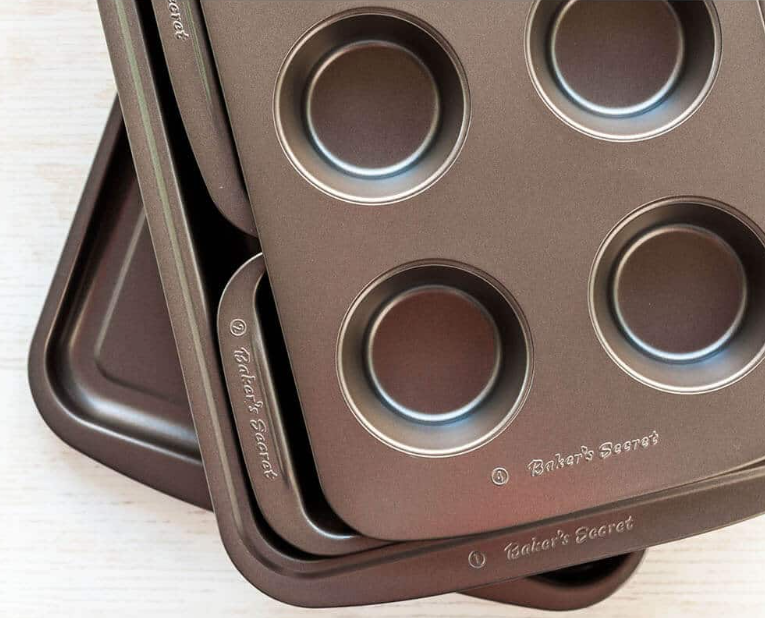
A warped tray doesn’t just look bad. It changes how heat travels across the surface.
Warping usually comes down to thickness. Thin metal responds quickly to heat but lacks the mass to distribute it evenly. As different areas expand at different speeds, the tray twists. Once that happens, heat concentrates in unpredictable places, and consistency disappears.
Thicker trays take longer to warm up, but they stay stable. Over repeated use, that stability matters more than the initial speed. A tray that stays flat year after year will almost always outperform a thinner one that started out responsive but couldn’t hold its shape.
Durability also includes upkeep. Some materials demand attention to prevent rust or surface damage. Others are content to be washed and reused. Over time, those small differences shape whether a tray becomes a long-term tool or a short-term replacement.
Food interaction is about context, not fear
Concerns about food safety often get flattened into blanket rules, but material interaction is more nuanced than that.
Certain metals don’t love acidic environments, especially when exposure is long. That doesn’t mean they’re unsafe for all uses. It means they have boundaries. Short bakes with neutral ingredients rarely cause issues. Long, acidic cooks deserve a different surface.
Silicone introduces a separate question of quality. Well-made silicone stays stable under heat and remains neutral in contact with food. Lower-grade versions may not. The difference isn’t always visible, but it shows up over time in smell, texture, and performance.
Non-reactive surfaces simplify these decisions. They remove one variable, which is often worth it when cooking times stretch or recipes lean acidic.
Living with a tray matters as much as baking on it

A tray can perform beautifully and still end up unused if it’s awkward to handle.
Weight plays into this more than people expect. Heavier trays feel solid and dependable, but lifting them in and out of a hot oven takes effort. Lighter trays are easier to manage but may feel less stable under heat. Most people naturally gravitate toward the option that fits their comfort level, not the one with the best technical profile.
Release and cleanup shape habits too. Trays that fight you during unmolding or demand heavy scrubbing slowly get avoided. Flexible surfaces and liners aren’t just conveniences; they influence how often you bake certain recipes at all.
Even storage matters. A tray that fits easily into your space is more likely to be used than one that requires rearranging a cabinet every time.
Choosing less, but choosing better
Most kitchens don’t need a collection of specialized trays. They need a small number of tools that match real cooking habits.
When you look at what actually comes out of your oven week after week, patterns appear quickly. Those patterns should drive material choices, not trends or claims of versatility. A tray that aligns with how you bake will quietly improve results without demanding extra attention.
The goal isn’t to optimize every possible recipe. It’s to reduce friction in the ones you make most often. When the tray stops being something you think about, and starts behaving predictably every time you use it, you’ve chosen well.