
Last week a friend who runs a meal-prep delivery service called me in frustration. She had just unboxed 500 ceramic bowls for her new “Mediterranean Bowl” line, only to discover that after two hours in the fridge, every single bowl had a pool of cucumber-tomato water sloshing at the bottom. The greens were limp. The dressing was diluted. Customers complained. The bowls weren’t defective — they were just wrong for the job.
This is the gap nobody talks about when sourcing salad bowls. The conversation usually stops at “which material?” — but high-moisture ingredients break that conversation wide open. If you’re stocking a restaurant, building a private-label tableware line, or sourcing for a meal-kit brand, here’s what actually matters.
Where the Water Really Comes From (And Why It Changes Everything)
Before picking a bowl, you have to know which kind of “wet” you’re dealing with. There are three, and they behave completely differently.
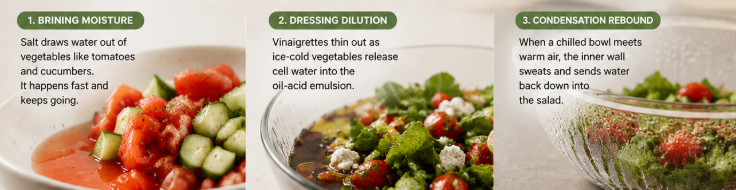
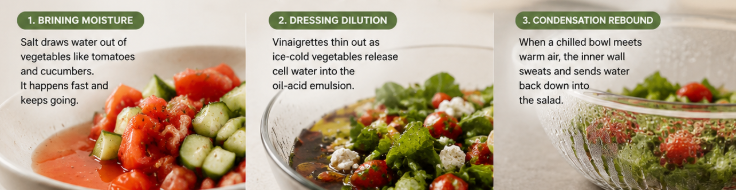
The first is brining moisture — salt drawing water out of tomatoes, cucumbers, watermelon, or salted onions. This happens fast and keeps going. The second is dressing dilution — vinaigrettes thinning out as ice-cold vegetables release their cell water into the oil-acid emulsion. The third, and the one most overlooked, is condensation rebound — when a chilled bowl meets warm air and the inner wall sweats, sending water back down into the salad from above.
A bowl that handles brining beautifully may fail completely at condensation because of its thermal mass. Once you separate these three problems, the material conversation gets much sharper.
Material Reality Check — What Survives, What Doesn’t
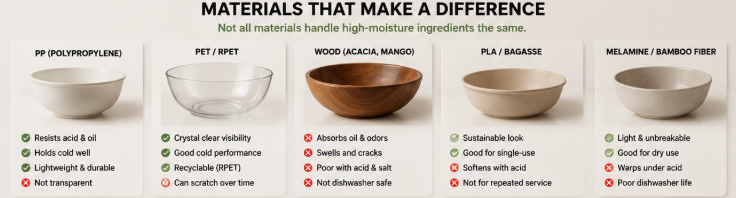
Let’s be blunt about what most blogs get wrong. Wooden bowls are the Instagram darling of the salad world, but for any ingredient sitting in acid or salt longer than ten minutes, wood is the worst choice on the shelf. It absorbs oil, holds onion smell, swells, and eventually cracks along the grain. If you’re a hospitality buyer working with a custom PP salad bowl manufacturer, push back hard if they’re recommending raw acacia or mango wood for anything beyond dry plating.
PP and high-grade polypropylene blends are the workhorse choice for modern service. They hold cold well, don’t react with citrus, and won’t transfer flavor between shifts. The bonus is weight — staff actually love them on long buffet lines because they don’t fatigue wrists during a four-hour event.
Clear PET and food-grade RPET are underrated. They let the kitchen see exactly how much liquid is pooling, which matters enormously for QC in meal-prep operations. A reliable PET salad bowl supplier for hospitality brands can also offer crystal-clear variants that survive the freezer-to-table swing without crazing or fogging.
PLA and bagasse-based compostables cool fast and look great on a sustainability report, but they soften with acid contact over time, especially with vinaigrettes left sitting. Use them for single-use grab-and-go, not for repeated service. Melamine and bamboo fiber? Light and unbreakable, sure, but neither holds up to repeated acid contact over a commercial dishwasher cycle. Most disposable bowl factories won’t admit this in their spec sheets, but the warpage rate after 200 wash cycles is brutal.
The Structural Details That Decide Whether the Salad Survives
Here’s where 90% of sourcing decisions go wrong: buyers obsess over material and ignore geometry. The shape of the bowl matters as much as what it’s made of.
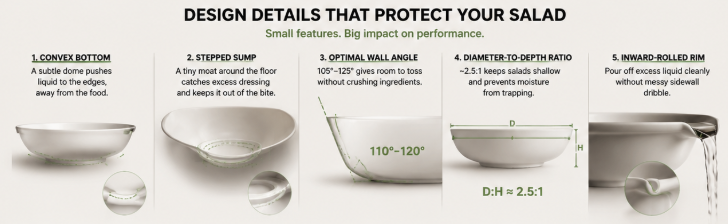
Start with the bottom profile. A perfectly flat interior bottom guarantees pooled liquid contacts every leaf at the base. A subtle convex dome in the center — even three millimeters — pushes liquid to the perimeter, away from the food. Some premium OEM RPET salad bowl factories now offer a stepped sump design, essentially a tiny moat around the rim of the floor, where excess dressing drains and stays out of the bite.
Wall angle is next. A bowl with walls that flare outward at roughly 110 to 120 degrees gives a server enough room to toss without crushing ingredients against the side — and crushed ingredients release more water. Bowls that are too vertical look generous but turn into compression chambers.
The diameter-to-depth ratio should sit around 2.5 to 1 for tossed salads with wet ingredients. Anything deeper traps moisture in the middle column and accelerates wilting. And finally, check the rim. An inward-rolled lip lets you pour off excess liquid cleanly without the dreaded sidewall dribble that ends up on the customer’s lap.
Matching Bowl Strategy to Real Use Cases
Don’t ask “what is the best salad bowl.” Ask “best for which operation.” A grab-and-go café needs something completely different from a fine-dining tasting room.
For single-serve meal-prep brands, the answer is almost always a double-wall PET bowl with a removable inner strainer insert. The insert lets cucumber and tomato sit slightly above any released liquid, preserving texture for 24 to 36 hours. Several private label PP salad bowl manufacturers in Asia now mold these inserts to match standard 750 ml and 1 liter cavity sizes — worth specifying in your tech pack.
For full-service restaurants, the smart play is a two-bowl system: a large food-grade polypropylene mixing bowl in the back-of-house for the actual toss, and a service-weight presentation bowl at the pass. Trying to do both jobs with one bowl is where consistency dies.
For large-format catering and family-style banquets, source a wide, shallow PET platter-bowl — the kind with a slight gravity well in the center. When negotiating with a clear PET salad bowl supplier for catering distributors, ask specifically about surface acid resistance after 500 dishwasher cycles. Cheaper finishes start pitting around cycle 300, and pitted surfaces hold onion oil forever.
For corporate gifting and retail private label, the conversation shifts to presentation. Here a matte-exterior, glossy-interior PP bowl with a contrast rim photographs beautifully and still functions. Any ODM recycled PET salad bowl producer worth working with should offer at least three finish options and a sample turnaround under three weeks.
The Sourcing Conversation Most Buyers Skip
When you’re talking to a factory, the questions that actually matter are not “what’s your MOQ.” They are: What is the resin grade and food-contact certification? What is the thermal shock tolerance? What’s the migration test result — Prop 65, LFGB, FDA? How does the bottom profile hold up after a 1-meter drop test? Can you tool a custom interior sump if I provide a 3D file?
Any reputable RPET salad bowl wholesaler servicing global distributors will have these answers ready in a spec PDF. If they hedge or send you a generic catalog, walk away. The good vendors know that high-moisture performance is a measurable property, not a marketing claim.
One more thing: ask for a sample with your actual menu in it. Ship them a kilo of cherry tomatoes and a bottle of your house vinaigrette if you have to. A bowl that performs in a showroom can still fail with your specific food. I’ve watched buyers approve gorgeous samples that turned into soup bowls the moment real salad hit them.
A Quick Checklist Before You Place the PO
Before signing off on an order, run through these: Does the interior bottom have positive drainage geometry? Is the wall angle between 105 and 125 degrees? Is the diameter-to-depth ratio above 2:1 for wet salads? Does the material resist citric and acetic acid over 1000 contact hours? Is the rim rolled inward for clean pour-off? Has the resin passed at least one major food-contact certification? Has a real-food sample test been completed with your menu?
If you can check all seven, the bowls won’t betray you on a Saturday lunch rush. If you can’t, no amount of beautiful photography will save the customer experience.
The right salad bowl isn’t the prettiest one in the catalog. It’s the one engineered around the specific way your food fails — and the supplier who understands that distinction is the one worth a long-term contract.