
Keeping a salad truly vibrant isn’t just about the recipe; it’s a calculated win against moisture migration and cellular breakdown. For anyone in the high-end catering world or the fast-paced meal-prep industry, the “soggy salad” is the ultimate enemy. We’ve all seen it: a beautiful mix of kale, roasted protein, and crisp seeds turning into a limp, unappetizing mess by lunchtime. The root cause is simple physics—a salad is a collection of living tissues with different water activities, and left alone, they will always move toward a state of mushy equilibrium.
The Science of Moisture and Osmotic Stress
If you want to understand why greens die, look at the water. Ingredients like cucumbers and tomatoes are essentially water-rich cells held together by fragile walls. When these sit next to dry components like croutons or quinoa, the moisture naturally travels to the drier area. This is made worse the second you add dressing. Salt and acid trigger osmosis, literally sucking the hydration out of your spinach leaves until they turn translucent and flat.
One pro tip to stall this is the “Oil-Buffer” technique. By tossing your greens in a light coating of oil before adding anything else, you’re creating a microscopic waterproof barrier. This keeps the acidic dressing from penetrating the leaf instantly. For brands looking to scale this quality, partnering with a reliable salad bowl manufacturer for food service brands is essential, as the physical seal and material density play a massive role in maintaining that internal atmosphere.
Vertical Architecture: The Gravity Strategy

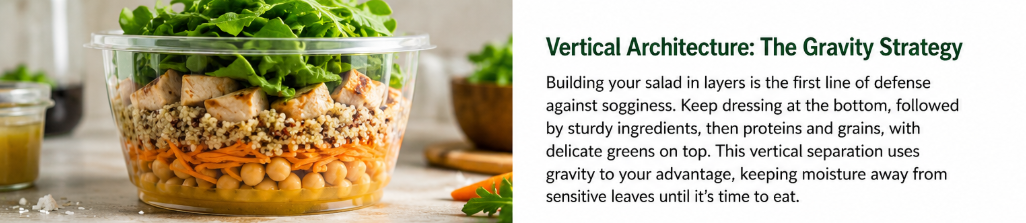
In a deep container, the order of assembly is your best defense. You have to build it like a house, where the foundation handles the “wet” work. The “Heavy-Bottom” logic means your dressing stays at the very base. Immediately on top of the liquid, you place resilient ingredients that don’t mind a soak—think chickpeas, pickled onions, or sliced carrots. These act as a structural dam.
Your proteins and grains come next, providing a buffer zone. Finally, the delicate leafy greens and fresh herbs sit at the very top, as far from the moisture as possible. This vertical separation is exactly why many sourcing managers look for a professional salad bowl factory for eco-friendly cafes; the taper and depth of the bowl are specifically designed to keep these layers from collapsing into each other during transport.
The Rise of Physical Compartmentalization
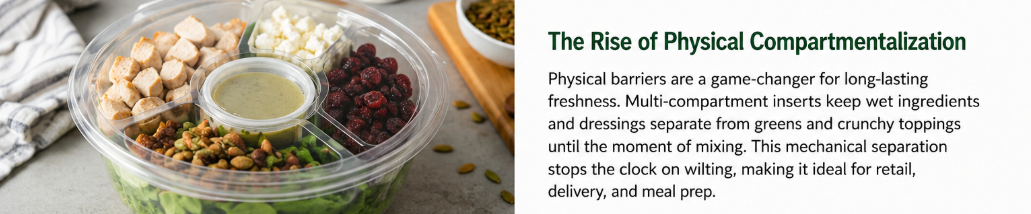
Layering is great for a few hours, but for retail shelf-life or long commutes, you need a physical wall. The industry has evolved past the “one-size-fits-all” bowl. We are now seeing the dominance of multi-insert systems—trays that sit nested inside the main bowl to hold wet toppings or heavy proteins until the diner is ready to mix them.
This mechanical separation is a game-changer. It’s why so many regional distributors now prioritize a reputable disposable salad bowl exporter that offers integrated dressing cups. When the sauce is snapped into the lid rather than sitting in the greens, you effectively stop the clock on wilting. The salad doesn’t officially “start” until the consumer pops the seal and shakes it.
Material Engineering: Managing the Micro-Climate
Inside a sealed container, you’ve created a high-humidity greenhouse. If the material doesn’t handle thermal changes well, condensation will form on the lid and drip back onto your croutons. This is where material science meets culinary art. While PET is great for clarity, modern bio-polymers are being refined to handle “respiration” better. A bespoke plastic salad bowl manufacturer can actually fine-tune the gauge of the material to help maintain a stable internal temperature.
For those pushing the sustainability angle, sugarcane bagasse and MFPP (Mineral-Filled Polypropylene) are the new gold standards. They offer a slight breathability that prevents the “sweat” effect while keeping the dressing contained. Sourcing these from a wholesale salad bowl factory for bulk distributors allows a brand to maintain “fresh-all-day” claims while meeting strict plastic-reduction targets.
The “Dry-Prep” Protocol: No Room for Error
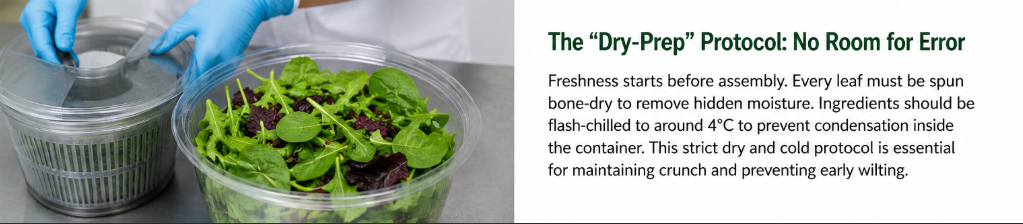
No bowl, no matter how advanced, can save wet lettuce. The “Dry-Prep” protocol is the backbone of professional freshness. Every leaf must be spun in a high-capacity centrifugal dryer until bone-dry. Any wash-water left behind acts as a carrier for the dressing, allowing it to slide into the leaf’s pores even faster.
Temperature is the other silent killer. Packing warm grilled chicken onto cold arugula creates immediate steam, which is basically a death sentence for crispness. Ingredients must be flash-chilled to around 4°C before they ever see the inside of the container. This level of thermal discipline is common among users of a trusted salad bowl factory for healthy meal prep kits, as these containers are built to handle rapid cooling without the lid seal failing or warping.
Final Assembly: The Tumble Space
The last secret to a great salad is actually the empty space. If a bowl is packed to the brim, the dressing can’t move. You need “tumble space.” This is why savvy buyers often select a customizable salad bowl supplier for restaurant chains that provides domed lids. That extra half-inch of headspace allows the user to give the bowl a vigorous shake, ensuring the dressing coats everything evenly without bruising the greens. By combining smart prep, vertical logic, and the right hardware, you turn a simple salad into a high-performance meal that stays crunchy until the very last bite.