
In real procurement scenarios, logo failure is rarely a “design issue.” It’s almost always a mismatch between packaging decisions and actual usage conditions. Many food brands focus heavily on how the logo looks during sampling—sharp print, strong contrast, premium feel—but overlook what happens after sealing, refrigeration, transport, and display.
By the time condensation appears and the logo turns hazy, smears, or even peels off, the problem is no longer technical—it’s financial.
For buyers working with a custom sushi bowl manufacturer, the real value lies not just in production capability, but in whether the supplier understands how packaging performs under cold-chain and high-humidity conditions.
Where Things Start Going Wrong in Real Use
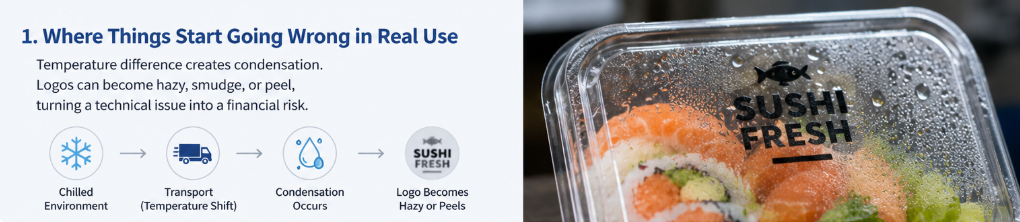
The issue usually begins the moment temperature difference is introduced.
A sushi bowl packed in a chilled environment enters ambient conditions during delivery or retail display. That temperature shift creates condensation—tiny water droplets forming either inside the lid or across the container surface. This is where many logo applications begin to fail.
In several sourcing cases, buyers reported that samples looked perfect, but mass production failed after just one delivery cycle. In most of these situations, the logo method itself wasn’t wrong—it was simply not compatible with condensation exposure.
An experienced oem sushi bowl supplier would typically ask about storage temperature, delivery time, and whether the product is displayed in open or closed refrigeration. Without that information, even high-end printing can underperform.
Choosing the Right Logo Application Method for Cold Environments

Not all logo techniques behave the same when exposed to moisture. The difference becomes obvious only after real-world testing.
Direct printing, such as silk screen or UV printing, can provide strong visual consistency, but on smooth PET surfaces, adhesion can become an issue if no surface treatment is applied. Under condensation, this weakness becomes visible quickly.
In-mold labeling, on the other hand, integrates the logo into the container structure itself. This method performs well under moisture stress because the label is not exposed. However, it comes with higher tooling requirements, making it more suitable for brands working with an odm sushi bowl factory on long-term volume programs.
External sticker labels are often chosen for flexibility, especially during early-stage branding. But in cold-chain sushi applications, they are also the most vulnerable. Adhesive performance drops significantly in humid and low-temperature transitions.
A professional sushi bowl manufacturer for bulk orders will usually recommend limiting sticker usage unless the product is strictly for ambient display.
Material Selection Is Not Just About Appearance
Many buyers choose PET for its clarity, especially for sushi where presentation matters. However, PET’s surface characteristics make it less forgiving when it comes to print adhesion.
Without proper treatment, even well-executed printing can become unstable under condensation. This is especially true when combined with anti-fog coatings, which may further reduce surface energy.
PP, while less transparent, often provides more stable printing results. Some buyers working with a printed sushi bowl supplier for food brands choose PP for logo reliability, especially when branding consistency is more important than full visibility.
For recycled PET (rPET), the challenge becomes consistency. Slight variations between batches can affect how ink or coatings behave, which is why experienced buyers usually require pre-production testing before scaling.
Structure Design Quietly Affects Logo Performance
One of the most overlooked factors in logo durability is the container structure itself.
Condensation does not form evenly. It tends to accumulate in specific zones—usually the inner side of lids or near sealing edges. Placing logos in these high-moisture zones increases the risk of visual distortion.
A well-informed clear sushi bowl manufacturer for retail packaging will often suggest repositioning the logo slightly away from condensation-prone areas rather than changing the entire printing method.
Ventilation design also plays a role. Completely sealed containers trap moisture inside, accelerating condensation buildup. Slight structural adjustments can reduce internal humidity, indirectly protecting the logo.
Anti-Fog Treatments: Helpful but Not Always Neutral
Anti-fog technology is commonly used in sushi packaging to maintain visibility, but it introduces another layer of complexity.
Some coatings interact poorly with inks or adhesives, especially if compatibility is not tested beforehand. This can result in partial fading or uneven logo surfaces after exposure to moisture.
Buyers sourcing from a pet sushi bowl manufacturer with logo printing often assume anti-fog is purely beneficial, but in reality, it must be evaluated alongside the printing process, not separately.
How to Actually Test Before Mass Production
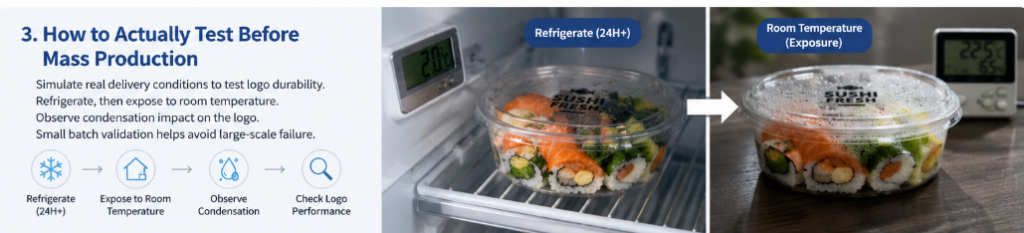
Many suppliers will say “testing is recommended,” but what matters is how the test is conducted.
A practical approach used by experienced procurement teams involves simulating real delivery conditions. The product is stored in refrigeration for at least 24 hours, then exposed to room temperature for a defined period. Observing how the logo reacts during this transition provides more insight than static inspection.
Another step involves placing actual food—high-moisture sushi or fruit—inside the container and sealing it. This helps identify whether internal humidity affects the logo differently than external condensation.
Buyers working with a disposable sushi bowl supplier for restaurant chains often run these small-batch tests before confirming large-volume orders. It is not about perfection, but about predictability.
Small Batch Validation Is Not Optional
Skipping the sampling phase is one of the most common reasons behind large-scale failures.
Even when working with a reliable plastic sushi bowl factory for exporters, variations in material, coating, or environmental factors can influence final performance. A controlled pilot batch, typically between 50 to 500 units, allows both sides to validate assumptions.
This step also helps align expectations. What looks acceptable in a factory setting may not meet brand standards under retail lighting and real humidity conditions.
Aligning Process, Material, and Usage Early
The most stable results come from aligning three factors early in the project: how the product will be used, what material is selected, and which logo method is applied.
Buyers who communicate their cold-chain requirements clearly tend to avoid most issues. Those who treat logo printing as a final step, rather than part of the packaging system, usually encounter rework.
Working with a sushi bowl supplier for private label packaging who can guide this alignment process often reduces both cost and risk over time.
Final Thoughts: Preventing Problems Instead of Fixing Them
Condensation is not an edge case in sushi packaging—it is a standard condition. The question is not whether it will happen, but whether the packaging has been designed with it in mind.
Logo durability, in this context, is not about choosing the “best” printing method, but about choosing the right combination for a specific environment.
For procurement teams, the takeaway is simple: treat logo application as part of performance design, not just branding. When the right decisions are made early, the final product does not just look good in samples—it holds up where it actually matters.