
If you run a sushi or poke-focused delivery business, you’ve likely seen it happen: a customer opens the lid and finds everything soaked, rice compressed, and presentation ruined. This isn’t just a packaging flaw—it directly leads to refunds, lower ratings, and repeat order loss.
From the perspective of a sushi bowl manufacturer for bulk buyers, most leakage issues are not caused by a single failure point. They come from a mismatch between bowl structure, sauce handling, and real delivery conditions. Fixing the problem requires aligning these three—not just upgrading to a “tighter” lid.
Leaks Start Inside the Bowl, Not at the Lid

A common misconception is that leakage is purely a sealing issue. In practice, what happens inside the bowl matters more. Once a delivery starts, the contents are constantly moving. Every turn, stop, or vibration shifts liquid across the surface.
When sauce is poured directly over rice and protein, it doesn’t stay evenly distributed. It gradually collects at the bottom, creating a liquid pool. That pool becomes a pressure point. As the bowl tilts, the liquid pushes toward the edges, eventually finding the weakest point in the seal.
An experienced oem sushi bowl factory with leak-resistant lid design will typically emphasize that leakage is a “movement problem” before it’s a “closure problem.” If the internal movement isn’t controlled, even high-quality lids will fail under pressure.
Why Stronger Sealing Alone Doesn’t Work
Many buyers try to solve leaks by choosing tighter snap lids or stronger locking edges. While this helps to some extent, it doesn’t eliminate the root cause. If liquid is constantly being forced against the rim, any seal can eventually give way.
In some cases, overly tight lids reduce internal space, increasing pressure instead of relieving it. Without room for slight movement, the contents press directly against the sealing edge during transport.
That’s why a custom sushi bowl supplier for restaurant chains will often recommend focusing on pressure distribution. The goal is not to eliminate movement entirely, but to manage it so it doesn’t concentrate at the seal.
Structural Design Makes the Biggest Difference
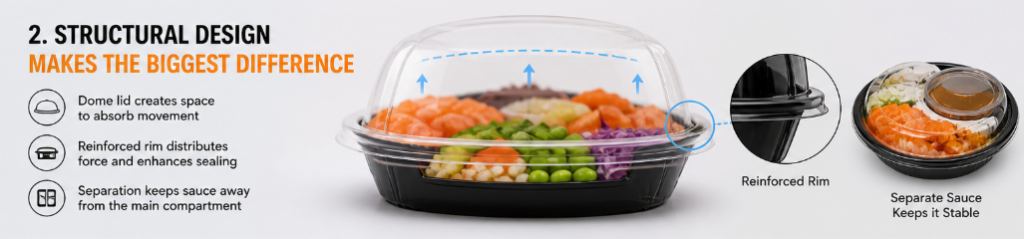
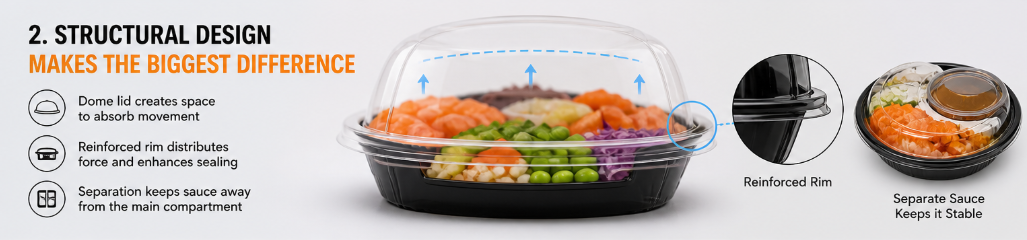
Choosing the right bowl design is the most effective way to reduce leakage. Not all sushi bowls are built for delivery. Many are optimized for display, which creates problems once they are exposed to transport conditions.
A deeper lid structure—commonly known as a dome lid—creates a buffer zone above the food. This space absorbs movement and prevents direct pressure on the seal. It’s a simple adjustment, but it significantly improves performance in real delivery scenarios.
Rim strength is equally important. Reinforced edges distribute force more evenly and reduce the chance of localized failure. This is why buyers working with an odm sushi bowl packaging manufacturer with reinforced rim often see fewer complaints without changing their overall packaging format.
Another structural solution is separation. Keeping sauce away from the main compartment—either through built-in sections or separate containers—removes the primary cause of internal pressure buildup.
Sauce Handling Is Where Most Problems Begin
In many kitchens, sauce is added right before sealing, often in generous amounts to enhance appearance. This is also where leakage starts.
Once the bowl is closed, that sauce becomes a moving element. As it shifts, it creates uneven weight distribution and accumulates in certain areas. Over time, this increases pressure against the lid edge.
Separating sauce from the main bowl is one of the most effective adjustments. Whether using a small cup or a dedicated compartment, this approach stabilizes the contents and prevents liquid pooling. Many operators notice immediate improvements after making this change.
Portion control also matters. More sauce doesn’t necessarily improve customer experience, but it does increase the risk of leakage. A controlled amount that enhances flavor without creating excess liquid is more effective in delivery scenarios.
A reliable sushi bowl supplier for foodservice distributors will often recommend testing sauce behavior under real delivery conditions rather than relying on in-store presentation.
Material Choice Should Match Usage, Not Trends
Material selection plays a role, but it should be based on how the bowl is used rather than general preferences.
Clear PET bowls are widely used for their visual appeal. They work well for cold, fresh presentations but are less forgiving when exposed to heat or heavier sauces. Under pressure, even minor deformation can affect sealing performance.
PP bowls provide better stability under temperature variation and physical stress. They are more suitable for operations that combine warm rice with sauces or require longer delivery times.
A professional custom sushi bowl factory for private label packaging will typically guide buyers toward materials that align with their menu and delivery conditions, rather than promoting a one-size-fits-all solution.
Transport Conditions Are Often Overlooked
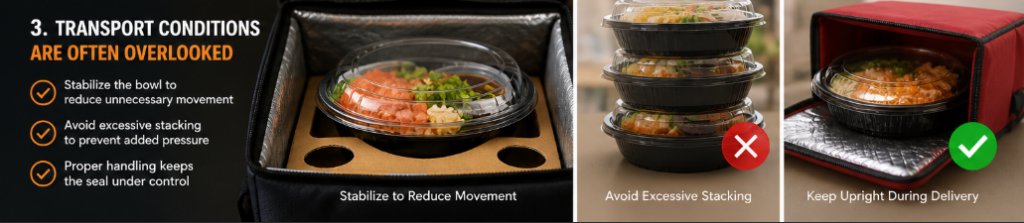
Even with proper packaging and sauce handling, transport conditions can still introduce risk. Delivery is not controlled. Bowls are tilted, stacked, and moved continuously.
Stabilizing the bowl inside the delivery bag reduces unnecessary movement. Simple adjustments, such as using inserts or ensuring upright placement, can significantly improve outcomes.
Stacking is another factor. When multiple bowls are placed directly on top of each other, the bottom container experiences additional pressure. Over time, this can weaken the seal and increase the likelihood of leakage.
From the perspective of an oem sushi bowl supplier for large volume orders, small operational changes in packing and handling often produce more consistent results than switching packaging alone.
Aligning Packaging With Business Model
Different types of operations require different solutions. High-end sushi brands that prioritize presentation often use clear bowls with separate sauce containers to maintain visual quality while preventing leaks.
Delivery-focused businesses benefit more from durable, pressure-resistant designs combined with controlled sauce application. Consistency matters more than appearance in these cases.
Chain operations typically aim for standardization. Fixed portion sizes, consistent sauce handling, and uniform packaging reduce variability across locations. This is where working with a sushi bowl factory for global wholesale partners becomes important, as consistency at scale depends on controlled specifications.
Reducing Leakage Is a Cost Decision, Not Just a Packaging Choice
Focusing only on packaging cost per unit can be misleading. Leakage introduces hidden costs—refunds, replacements, and negative reviews—that quickly outweigh small savings.
Adding a sauce cup or upgrading to a reinforced lid design may increase unit cost slightly, but it reduces failure rates. Over time, this leads to more stable operations and better customer retention.
Experienced buyers evaluate packaging based on total impact, not just initial cost. A system that reduces complaints and maintains quality during delivery provides long-term value.
What Actually Works in Practice
Preventing sauce leaks is not about a single upgrade. It requires a combination of structural design, controlled sauce handling, and realistic transport preparation.
Operations that consistently avoid leakage tend to follow a similar pattern. They select bowls designed for delivery rather than display, manage sauce placement carefully, and adjust packing methods to reduce movement during transport.
From the standpoint of a custom sushi bowl manufacturer for restaurant brands, the goal is not just to provide containers, but to support a packaging system that performs reliably in real-world conditions.
When structure, process, and handling are aligned, leakage stops being a recurring issue and becomes something you can control.