
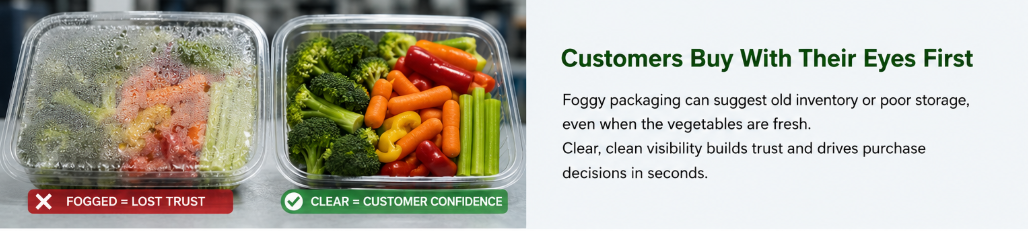
Fresh vegetables can be washed, cut perfectly, packed under strict food safety standards, and still lose customer trust in seconds if the tray looks wet, cloudy, or fogged by the time it reaches the shelf.
For produce brands, retailers, and foodservice buyers, moisture inside veggie tray packaging is rarely a minor inconvenience. It affects how fresh the product looks, how long it stays appealing, and whether shoppers feel confident enough to buy it. A tray filled with crisp carrots, celery, peppers, or broccoli may still be high quality—but visible condensation often tells a different story.
That disconnect is where many packaging decisions quietly fail.
Moisture problems are often blamed on refrigeration or produce itself, yet in commercial reality, fogging usually comes from a chain of small decisions: washing procedures, drying time, material choice, lid design, airflow, transport conditions, and tray structure. Solving it is less about one miracle material and more about understanding how the full packaging system behaves from production line to retail display.
When Fogging Starts Before The Lid Even Closes
A surprising number of moisture issues begin long before packaging materials become the focus.
Fresh-cut vegetables naturally release water, especially after slicing or peeling increases exposed surface area. Add washing to the process, and moisture load rises immediately. If produce is packed while residual water still sits on the surface, that water becomes trapped the moment sealing happens.
This is where many businesses unknowingly create their own condensation problem.
A tray can leave the facility looking acceptable, only to develop internal fog hours later as temperature changes during storage or transportation trigger condensation. Moving from prep room temperatures to refrigerated logistics, then into retail cases, creates repeated environmental shifts that encourage moisture to collect where consumers notice it most—on the inside of the lid.
Experienced custom veggie tray manufacturer partners often look beyond packaging appearance and start by evaluating processing habits, because even advanced packaging struggles when excess moisture is locked in from the start.
Customers Buy With Their Eyes First

In refrigerated merchandising, visual freshness often matters before ingredient quality ever gets judged.
Consumers rarely analyze why condensation exists. Instead, they make rapid assumptions. Foggy packaging can suggest old inventory, poor storage, or reduced hygiene, even when none of those concerns are true. That means moisture isn’t just a technical issue—it’s a perception issue.
For brands selling snack trays, party platters, or supermarket-ready vegetable assortments, perception directly impacts sell-through. Retail buyers also notice. Packaging that repeatedly appears cloudy or wet may trigger complaints, shorter display windows, or pressure to improve packaging consistency.
This is why sourcing decisions increasingly involve more than price. A dependable OEM veggie tray supplier is often evaluated by how well packaging protects shelf presentation, not just by unit cost.
Material Choice Matters — But Not In The Simplest Way
Businesses often ask which material prevents fogging best, but that question alone can be misleading.
PET and RPET are popular because they offer clarity and strong visual merchandising, making produce more attractive. However, transparency alone doesn’t stop condensation. Without airflow management or anti-fog solutions, clear plastic can actually make moisture more obvious.
PP may offer useful flexibility in some packaging environments, while compostable materials like PLA may support sustainability strategies, but no material category automatically solves moisture buildup.
The real issue is how tray material interacts with lid performance, ventilation, storage temperatures, and product type.
A reliable veggie tray factory for grocery programs understands that packaging success is rarely determined by resin choice alone. Structural engineering and product compatibility often matter more than material marketing.
The Lid Can Protect Freshness — Or Create A Humidity Trap
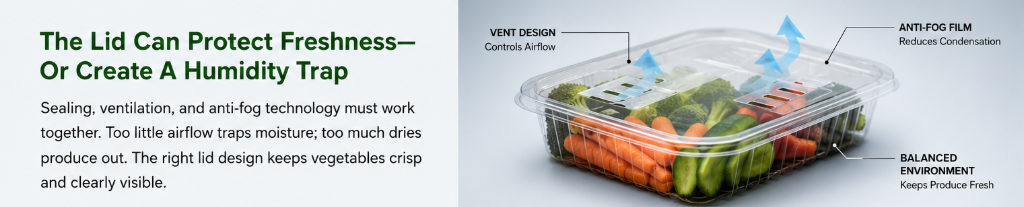
Many moisture problems become visible on the lid first, which makes lid technology one of the most commercially important but underestimated packaging variables.
A fully sealed lid may preserve moisture, but if ventilation is too limited, humidity rises quickly. Anti-fog films can improve product visibility by dispersing moisture differently, helping reduce visible clouding. Vent systems can improve internal airflow, but over-ventilation may dry vegetables faster than intended.
This balancing act becomes even more complicated in mixed vegetable trays. Cucumbers, carrots, tomatoes, and broccoli do not all behave the same way under refrigeration. One ventilation pattern may support one vegetable while accelerating visual decline in another.
That’s why brands with more specialized packaging needs often work with an ODM veggie tray supplier capable of adjusting lid systems to product mix rather than using standard one-format designs.
Moisture Management Is Often About Tray Architecture
The presence of moisture is not always the problem. Sometimes, the visible accumulation is.
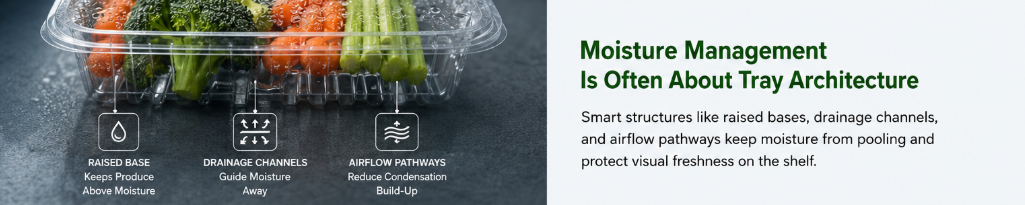
If water gathers in obvious droplets or pools beneath vegetables, customers notice immediately. Smart tray design focuses on moisture control pathways—where water settles, how airflow circulates, and whether condensation becomes visually disruptive.
Raised bases, compartment structures, absorbent inserts, and drainage channels often outperform thicker packaging walls when presentation is the goal. These features may seem secondary during purchasing, but in retail settings, they often shape consumer trust more directly than branding graphics.
An experienced food packaging veggie tray manufacturer for fresh produce brands typically treats tray structure as an active freshness management tool, not just a container.
Better Packaging Cannot Fully Compensate For Weak Prep Standards
Even premium tray systems can struggle when operational discipline is inconsistent.
Vegetables packed too quickly after washing, overloaded compartments, inconsistent drying, or sealing during unstable temperature windows can all undermine packaging performance. In these situations, brands sometimes spend more upgrading materials without addressing the real source of the problem.
That often leads to frustration because the visible issue remains.
Strong suppliers know this. A knowledgeable fresh produce veggie tray factory may provide packaging recommendations while also identifying process adjustments that improve moisture outcomes before packaging even begins.
Distribution Conditions Quietly Shape Packaging Success
A veggie tray that performs well in controlled tests may still fail if real-world logistics introduce repeated temperature fluctuations.
Cold storage interruptions, delivery transitions, retailer handling, and open refrigerated displays all influence internal humidity behavior. Every temperature shift can change how moisture behaves inside sealed packaging.
This means testing packaging only in production environments can create false confidence.
Many larger buyers now prioritize suppliers that understand full cold-chain conditions. A proven commercial veggie tray supplier for supermarket distribution usually offers more value because packaging is evaluated under realistic transport and shelf conditions, not just factory assumptions.
Customization Often Delivers Better Results Than Generic Cost Savings
Standard trays can work, but brands aiming for premium appearance, lower shrink, or category differentiation often benefit from more targeted packaging adjustments.
Custom venting, anti-fog coatings, insert systems, and produce-specific compartment sizing can significantly improve performance. For example, a tray built for celery and carrots may require different moisture strategies than one focused on cucumber slices or mixed snack vegetables.
This is where customization becomes practical rather than cosmetic.
A strategic bespoke veggie tray manufacturer for private label sourcing can help businesses align packaging with product behavior, not just product dimensions.
The Cheapest Tray Can Become The Most Expensive Mistake
Reducing upfront packaging cost may look attractive on paper, but if lower-cost trays create poor shelf appearance, increased spoilage, or retailer dissatisfaction, total business cost often rises.
In many cases, small investments in anti-fog technology, drainage structures, or airflow improvements outperform aggressive cost cutting on material thickness.
For serious buyers, the more important metric is often not “What does this tray cost?” but “What does poor presentation cost?”
That’s why long-term partnerships with a wholesale veggie tray supplier for retail-ready packaging are frequently built around performance outcomes rather than the lowest quote.
Moisture Control Is Really About Protecting Product Confidence
Vegetables naturally release moisture. That reality cannot be eliminated. What brands can control is whether that moisture damages appearance, shortens shelf confidence, or creates avoidable commercial friction.
The most effective veggie tray packaging doesn’t promise impossible dryness. Instead, it manages moisture intelligently enough that freshness still looks convincing when it matters most.
For businesses competing in refrigerated retail, that distinction can influence not only product quality perception, but repeat orders, buyer trust, and long-term brand strength.