
When buyers discuss egg tray customization, the conversation often starts with appearance—size adjustments, logo placement, or color selection. In operational reality, customization is far less flexible than it appears. What can actually be changed, scaled, or repeated consistently is dictated first by material behavior, not design intent.
For producers and distributors managing ongoing volumes, tray material defines the technical limits of customization long before branding or differentiation enter the discussion. The wrong material choice does not merely increase cost—it narrows production options, complicates compliance, and introduces instability across transport and handling stages.
Why Material Choice Comes Before Design Decisions

Customization does not begin on a drawing board. It begins at the point where raw material meets production equipment.
Each egg tray material reacts differently to moisture, pressure, temperature, and repeated handling. These physical properties determine whether a design can be produced at scale, whether tolerances can be held over time, and whether the finished tray performs consistently during transport.
Once a material is selected, many customization ideas quietly disappear. Some shapes become structurally unreliable. Others require tooling investments that cannot be amortized at realistic order volumes. In regulated markets, certain material–design combinations may never pass certification in the first place.
This is why experienced buyers treat material selection as the foundation of customization, not a secondary choice.
Pulp and Paper Trays: Flexible Enough, Within Clear Limits

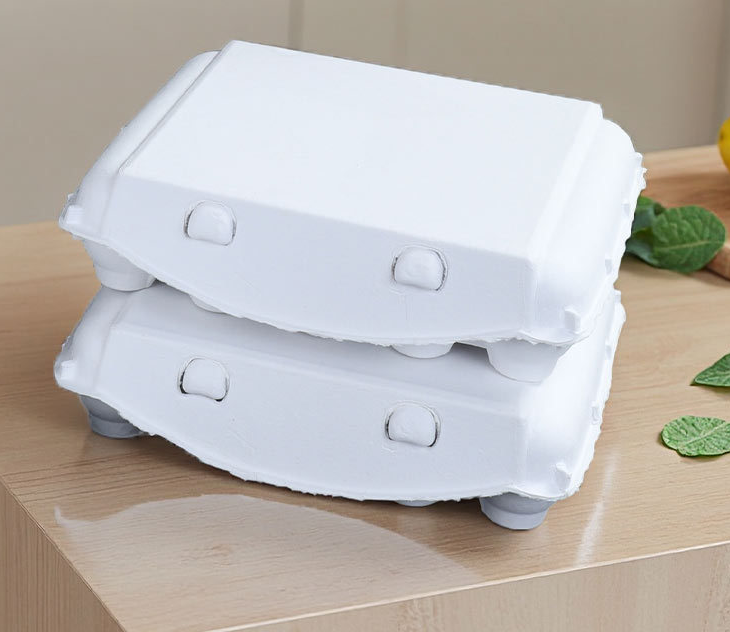
Pulp trays dominate global egg logistics because they strike a workable balance between cost, availability, and regulatory acceptance. Their customization potential exists, but it is narrower than many buyers assume.
Dimensional Adjustments and Cell Design
Pulp trays can accommodate moderate size variation. While the 30-cell format remains the industry workhorse, adjustments for smaller eggs like quail or larger eggs such as duck are technically feasible. These changes typically involve modifying cell depth or diameter rather than altering the overall footprint.
What pulp does not handle well are extreme geometries. Deep cavities, sharp internal contours, or complex asymmetrical layouts tend to weaken fiber distribution, leading to inconsistent strength after drying.
Structural Enhancements
Structural customization in pulp trays is evolutionary rather than radical. Reinforced edges, thicker load-bearing zones, or optimized rib patterns can improve stacking reliability. Multi-layer stacking designs are possible, but height increases remain conservative due to compression limits and humidity sensitivity.
Attempting to push pulp trays into high-load, long-distance roles usually results in higher rejection rates rather than better performance.
Branding Constraints
Branding on pulp trays is primarily functional. Mold-pressed logos, simple embossing, or limited printing are common, but color accuracy varies due to recycled fiber inputs. Multi-color graphics rarely justify their cost, and surface branding degrades quickly in cold or damp environments.
As a result, pulp tray branding tends to support identification and traceability rather than marketing visibility.
Cost and Production Implications
Even small design changes usually require new molds. Although pulp tooling costs are lower than plastic, customization still raises minimum order quantities and extends lead times. For buyers with unstable demand or frequent design revisions, these constraints can erode the value of customization.
Plastic Trays: Broad Customization with Higher Commitment

Plastic trays offer the widest range of customization options, but they also demand greater upfront discipline in planning and compliance.
Material Options and Design Freedom
PET and PP dominate plastic egg tray production. PET is typically used for transparent, single-use trays where product visibility is important. PP is preferred in reusable systems due to its toughness and resistance to repeated washing.
From a customization perspective, PP allows greater structural experimentation, while PET favors dimensional accuracy and surface appearance.
Engineering for Load and Impact
Plastic trays enable precise control over wall thickness, rib placement, and stacking interfaces. Load capacity can be engineered to match specific pallet configurations, transport distances, or automated handling systems. Impact resistance can also be tuned to reduce breakage under known stress conditions.
This level of control makes plastic trays attractive for centralized packing facilities and export-oriented operations.
Hygiene and System Integration
Plastic materials support customization beyond geometry. Surface finishes can be optimized for cleaning efficiency, contamination control, or compatibility with automated washing lines. In closed-loop logistics systems, trays can be designed to integrate directly with sanitation and tracking processes.
For operations facing strict hygiene requirements, these capabilities often justify the higher initial investment.
Branding and Visual Control
Plastic offers superior control over appearance. Color consistency, transparency levels, embossed logos, and high-resolution printing are all achievable. At scale, branding can be integrated into the mold itself, reducing ongoing printing costs.
The trade-off is reduced flexibility once tooling is finalized. Design changes require new molds and longer validation cycles.
Foam Trays: Shrinking Customization Space
Foam and polystyrene trays once played a larger role in bulk egg transport, but their customization potential is increasingly constrained.
While basic size adjustments are possible, structural reinforcement is difficult without compromising cushioning performance. Branding options remain limited, and recycling pathways are inconsistent across regions.
As environmental regulations tighten and buyer expectations shift, foam trays are being phased out of many professional supply chains, particularly those serving retail or export markets.
Mold Materials as a Hidden Customization Driver
The choice of mold material directly affects what level of customization is practical.
Aluminum molds are common for mid-volume customization. They offer sufficient precision at manageable cost and allow design refinement without excessive financial exposure.
Stainless steel molds are built for continuous, high-volume production. Their durability and moisture resistance justify the higher investment only when designs are stable and demand is predictable.
Plastic molds are typically used for trials or limited runs. They reduce initial cost but wear quickly and require frequent replacement.
Hybrid mold systems attempt to balance flexibility and longevity, particularly for buyers transitioning from pilot production to commercial scale.
Size, Shape, and Cross-Application Compatibility
Customization decisions must align with the broader logistics ecosystem. Tray dimensions affect compatibility with cartons, pallets, containers, and handling equipment.
Standard formats—6-, 12-, 18-, and 30-cell—translate across materials, but performance varies. Plastic supports taller, more stable stacks, while pulp remains conservative in height.
Specialty eggs introduce additional constraints. Larger eggs often benefit from plastic trays due to weight and impact considerations, while smaller eggs can still perform well in pulp with proper design control.
Cross-industry reuse, such as adapting trays for fruit or seedlings, is more feasible with plastic due to its dimensional stability and washability.
Matching Material Choice to Production Scale
Order volume fundamentally reshapes material strategy.
Low-volume orders favor pulp or low-investment plastic solutions because they preserve flexibility and limit risk. Mid-scale production aligns well with aluminum-mold plastic trays, balancing customization with cost control.
Large-scale operations benefit most from standardized designs produced with durable tooling. At this level, automation compatibility, lifecycle cost, and reliability outweigh initial unit price.
Trial production plays a strategic role here. Plastic molds allow low-risk validation before committing to long-term tooling.
Sustainability as a Structural Constraint
Environmental requirements increasingly shape customization boundaries.
Pulp trays offer straightforward biodegradability but restrict design complexity. Plastic trays support reuse systems that reduce waste over time but require investment in cleaning infrastructure and reverse logistics.
Different markets impose different compliance standards. Buyers operating internationally must consider how material choice affects certification timelines and long-term regulatory exposure.
Sustainability, in practice, limits customization just as much as it enables it.
Final Perspective: Let the Material Set the Boundary
Customization succeeds only when material behavior, production reality, and supply-chain conditions align.
Pulp remains effective where cost control and regulatory simplicity dominate. Plastic excels where durability, automation, and system integration matter. Foam continues to lose relevance outside narrow use cases.
The most common sourcing mistake is forcing a material into roles it cannot support. Effective customization respects material limits rather than testing them.
In egg tray procurement, the best designs are not the most complex—they are the ones that quietly remove friction from the supply chain instead of adding it.