
In egg tray manufacturing, molds are often treated as a background decision—something to be selected once, paid for, and then forgotten. Buyers usually frame the choice in simple terms: standard molds are cheaper and faster, while custom molds offer differentiation. What this view misses is that mold strategy quietly shapes almost every operational variable that follows, from unit cost stability and defect rates to delivery reliability and long-term production risk.
For suppliers serving consistent volumes, molds are not a one-time expense but a structural component of the cost system. Whether a producer relies on standard molds or invests in custom tooling determines how predictable production becomes, how resilient the operation is to material variation, and how exposed the business is to downtime and rework over time.
Understanding this distinction is essential for buyers who want to avoid hidden losses that only surface after scale is reached.
How Standard Mold Systems Actually Work
Standard molds—often described in the industry as shared or industry-standard molds—are tooling designs built around egg tray formats that have already been validated across years of mass production. These molds exist because certain tray sizes, shapes, and stacking geometries have proven to work reliably across different machines, materials, and logistics environments.
The cost advantage of standard molds does not come from lower material quality, but from shared amortization of development cost across multiple buyers. Plastic versions are typically chosen by new producers or those testing the market, while aluminum standard molds cost more but deliver greater dimensional stability and longer service life. The price difference reflects heat transfer efficiency, wear resistance, and maintenance frequency rather than design capability.
Demand concentration reinforces the dominance of standard molds. 30-cell trays account for the majority of commercial egg logistics worldwide, which keeps lead times short and performance characteristics well understood.
Another often-overlooked advantage of standard molds is machine compatibility. Predictable setup and low commissioning risk reduce operational uncertainty, especially for buyers facing tight delivery schedules or unstable demand.
What Custom Mold Investment Really Represents
Custom molds are frequently discussed as a way to “differentiate” products, but differentiation is only a surface-level outcome. In practice, commissioning a custom mold means assuming responsibility for design accuracy, production validation, and long-term performance risk.
The visible mold price is only one part of the investment. Design interpretation errors or untested structural assumptions can trigger costly redesigns, particularly for first-time buyers. Iteration costs are often underestimated at the planning stage.
Material choice amplifies this effect. Aluminum custom molds balance cost, precision, and durability, making them suitable for mid-scale production. Stainless steel molds demand significantly higher upfront investment but only justify themselves when volumes are stable and operating conditions are harsh.
Time itself becomes a cost driver. Every approval step delays production and postpones revenue, which can outweigh efficiency gains if delivery windows are fixed.
Minimum order quantities further increase exposure. Custom molds push buyers toward larger batch commitments, raising inventory and cash-flow risk in seasonal or volatile markets.
Mold Material and Long-Term Return on Investment
Mold material influences far more than durability—it reshapes production economics over time.
Plastic molds offer low entry cost but degrade rapidly under high-cycle production, increasing defect rates and replacement frequency once scale is reached.
Aluminum molds improve thermal efficiency. Faster heat transfer reduces cycle time and energy consumption, which compounds into meaningful savings at volume.
Stainless steel molds excel in corrosive or high-humidity environments. Extended service life and reduced downtime improve output consistency, making them suitable for continuous operations.
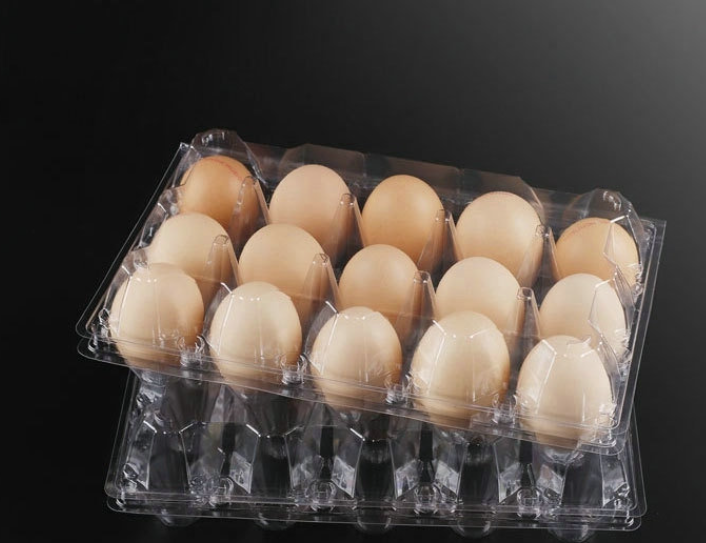
Finished tray quality reflects these differences directly. Edge uniformity, cell consistency, and stacking accuracy depend on mold stability, and failures here often surface later as transport losses rather than immediate defects.
Risk Profiles: Standard vs Custom in Real Production
Every mold strategy carries risk, but the timing and distribution of that risk differ.
Standard molds are built around average material behavior. When raw material properties fluctuate, defects are usually corrected through process adjustments rather than tooling changes, keeping correction costs contained.
Custom molds concentrate risk upfront. Design errors become expensive once tooling is completed, and poor compatibility with existing machines or stacking systems can undermine expected efficiency gains.
Labor costs also diverge. Poorly optimized molds increase manual trimming and handling, quietly eroding margins in labor-intensive environments.
Transport reliability is another hidden factor. Standard molds benefit from years of stacking validation, while custom designs must earn reliability through testing—often after losses have already occurred.
Operational Continuity and Maintenance Reality

Beyond efficiency, molds directly affect operational resilience.
Plastic molds fail fastest under sustained load. Aluminum molds wear predictably but require scheduled maintenance. Stainless steel molds demand stricter cleaning but offer long, stable service intervals.
Unexpected mold failure can halt production entirely. At scale, downtime costs often exceed the original mold investment, which is why standard molds retain an advantage in replacement speed and availability.
Custom molds increase dependency. Without redundancy, a single tooling failure can disrupt the entire supply chain.
Matching Mold Strategy to Business Scale
The optimal mold strategy shifts with production volume.
Low-volume producers benefit from standard molds that preserve flexibility and limit exposure.
Mid-scale operations often find aluminum custom molds provide the best balance between control and cost.
Large-scale manufacturers gain the most from stable, long-life tooling integrated with automation, where small efficiency gains compound rapidly.
Trial production remains critical. Validating designs with low-risk tooling before full investment reduces long-term exposure.
Where Custom Molds Create Real Opportunity
Custom molds create value when they solve problems standard formats cannot. Non-standard egg sizes, branded retail packaging, and cross-industry applications all benefit from tailored tooling—but only when demand is stable and margins justify the investment.
In these cases, customization is an operational lever, not a cosmetic upgrade.
Final Perspective
The real distinction between standard and custom molds is not visual. It lies in how risk is distributed over time.
Standard molds minimize uncertainty and preserve adaptability. Custom molds reward scale, planning discipline, and operational maturity. Problems arise when customization is pursued without sufficient volume, clarity, or production readiness.
In egg tray manufacturing, the most profitable mold strategy is rarely the most complex. It is the one that aligns production reality with demand stability and long-term cost control—quietly supporting the supply chain instead of complicating it.