
Look, we’ve all been there: you’re standing in your kitchen at 6:00 AM, moving with the grace of a zombie, trying to remember why yesterday’s brew was a masterpiece while today’s batch tastes like someone rinsed a dirty cigar in warm water. You haven’t lost your touch; you’ve just been sabotaged by the “scoop paradox.” While the high-brow baristas on TikTok act like using a plastic scoop instead of a $200 digital scale is a culinary crime, most of us just want a solid caffeinated win without doing physics before breakfast.
The problem is that “one scoop” is a dangerously loose term. To stop the morning lottery of “will this be drinkable?”, you have to look past the spoon. It’s about understanding the weird, inconsistent math of volume, the flat-out lies told by coffee machine brands, and how to calibrate your measurements for the specific mug sitting in your hand.

What “1 Scoop” Actually Means (And Why It Matters)
First off, let’s kill the myth: there is no “International Bureau of Scoops.” If you look at three different bags of coffee, you’ll likely find three different plastic spoons, each with its own depth and flair. However, in the professional world, a “standard” coffee scoop is generally accepted as two level tablespoons. This volume—in theory—holds about 10 grams of ground coffee.
But here is where the wheels fall off: the difference between a “level” and a “heaped” scoop. When you’re in a rush, you probably dive into the bag and pull out a rounded mountain of grounds. That little “extra” hump on top can easily add 3 or 4 grams of coffee. If you’re making a 4-cup carafe, that’s 16 extra grams—enough to turn a balanced breakfast blend into a bitter, over-extracted punch to the gut. If you want a consistent cup, you must scrape the top flat with your finger or a knife. It’s the only way to ensure that today’s success can be repeated tomorrow. If you like it stronger, don’t heap the spoon; just add another half-scoop to the total.
The Dirty Secret: A “Cup” of Coffee Isn’t What You Think

Here is the real kicker: a “cup” on your coffee maker is almost never an actual cup. The coffee industry has this annoying, archaic habit of defining a “cup” as 5 or 6 ounces. This traces back to traditional European tea service, but it’s completely disconnected from the reality of the modern American kitchen.
Most of us drink from mugs that hold at least 10, 12, or even 16 ounces. If you are a procurement manager working with a specialized custom coffee cup factory, you’ve already seen the trend data: the demand for 5-ounce vessels is basically dead in the B2B sector. People want massive, heavy-duty mugs. So, when a guide tells you to use “one scoop per cup,” they mean one scoop per 6 ounces of water. If you pour that brew into your 12-ounce “Boss” mug, it will look half-empty and taste half-strength. Before you start counting scoops, grab a measuring cup and find out exactly how many ounces your favorite mug actually holds.
Scoops Per Cup by Size: The Quick-Reference Breakdown
To stop the guessing game, we need a baseline. The specialty coffee world calls this the “Golden Ratio”—usually 1 part coffee to 15 or 18 parts water. Since nobody wants to do long division while they’re still in their pajamas, let’s simplify this into “Scoops per Mug.”
-
The Small Machine “Cup” (6 oz): 1 Level Scoop. This is the intended strength for most automatic drip machines.
-
The Standard Office Mug (10 oz): 1.5 to 1.75 Scoops. This is where most people mess up, usually under-scooping and wondering why the coffee feels “thin.”
-
The Morning Commute Mug (12 oz): 2 Level Scoops. This is usually the sweet spot for medium roasts.
-
The Large Travel Tumbler (16 oz): 2.5 to 3 Scoops.
If you happen to be a professional ceramic coffee cup supplier for wholesale, you know that including a small “scoop math” cheat sheet with your shipments adds massive value for your B2B clients. It prevents their customers from blaming the beautiful mugs for a poorly measured brew.
Scoops by Brewing Method: Drip, French Press, and Beyond
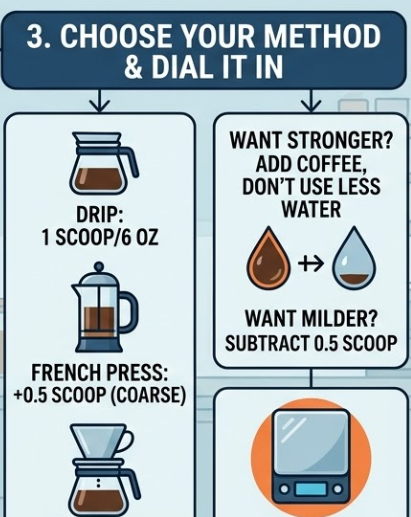
The gear on your counter dictates how aggressively the water pulls flavor out of the beans. For a standard automatic drip machine, the “one scoop per 6 oz” rule is your North Star. But if you switch to a French Press, the rules change.
French Press coffee requires a very coarse grind—think sea salt. Because the particles are larger, the water has a harder time reaching the center of each piece of coffee. To compensate for this, I usually recommend a slightly “heavier” scoop count. If you’re using a 12-ounce press, go for 2.5 scoops instead of 2. This ensures the body of the coffee stays velvety and rich instead of watery.
For those who love the ritual of a pour-over, precision is even more critical. Since the water passes through the grounds and exits quickly, you don’t have much room for error. If you are a boutique hotel manager sourcing from a premium porcelain coffee cup manufacturer for hospitality, you want that guest experience to be flawless. For a 10-ounce pour-over, try 1.75 level scoops. This provides enough resistance for the water to extract those bright, floral notes without letting it become a muddy mess.
Adjusting for Strength Without Ruining the Ratio
One of the most common mistakes I see is people trying to make their coffee “stronger” by using less water. This almost always backfires. When you starve the coffee grounds of water, the liquid that does pass through becomes over-saturated and pulls out the nasty, woody tannins. If you want a more intense caffeine hit, the solution is always to increase the coffee amount, not decrease the water.
You also have to account for the roast level. Dark roast beans are literally “puffed up” by the heat; they are physically larger and less dense than light roast beans. If you’re measuring by volume, a scoop of dark roast might only weigh 8 grams, while a scoop of light roast might weigh 11 grams. If you are a distributor working with an innovative coffee cup set wholesaler, remind your customers that if they switch from a dark roast to a dense light-roast, they should probably back off by half a scoop to keep the intensity balanced.
When to Ditch the Scoop and Use a Scale Instead
Let’s be honest: scoops are a game of averages. They are affected by how fine the coffee is ground, how hard you pack the spoon, and even the humidity in your kitchen. If you find yourself having a “perfect” cup one day and a “mediocre” one the next despite using the same scoop count, it’s time to spend $15 on a digital scale.
In the world of professional brewing, grams are the only currency that matters. A 1:16 ratio (1g of coffee for every 16g of water) is the universal language of great coffee. For a standard 8-ounce cup, that’s about 15 grams of coffee. If you are a brand manager looking for a bespoke coffee cup producer in China, creating a branded digital scale or a “ratio-ready” mug with internal markings can be a genius marketing move. It takes the guesswork out of the equation and ensures your coffee always tastes exactly as intended.
The 60-Second Cheat Sheet

If you’re standing in your kitchen right now and just want the answer, here it is:
-
Stop guessing your mug size. Measure it once with a measuring cup so you know if it’s 8oz, 12oz, or 16oz.
-
The Rule of Thumb: Use 1 level scoop (2 tablespoons) for every 6 ounces of water.
-
Adjust by half-scoops. If it’s too weak, add 0.5 scoop next time. If it’s too bitter, subtract 0.5 scoop.
-
Level is king. Stop heaping the spoon. Scrape the top flat—no exceptions.
Whether you are drinking out of a chipped old mug or a high-end vessel from a luxury ceramic coffee cup factory, the physics doesn’t change. Coffee is a science, but it shouldn’t feel like a chore. By mastering the scoop-to-water ratio, you’re not just making a drink; you’re guaranteeing a better start to your day.
If you are a business owner in the gift or retail industry, sourcing from a reliable decorative coffee cup supplier for retail means providing more than just a beautiful object. It means providing the “canvas” for someone’s daily ritual. When the coffee tastes right, the cup feels better in the hand. Master the scoop, and you master the morning.