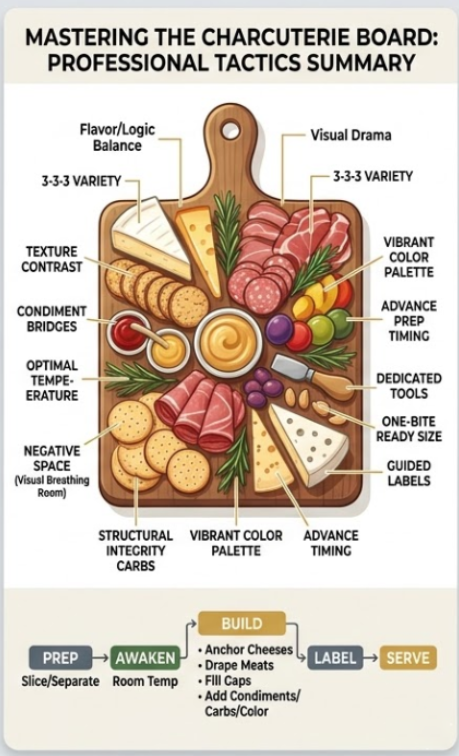
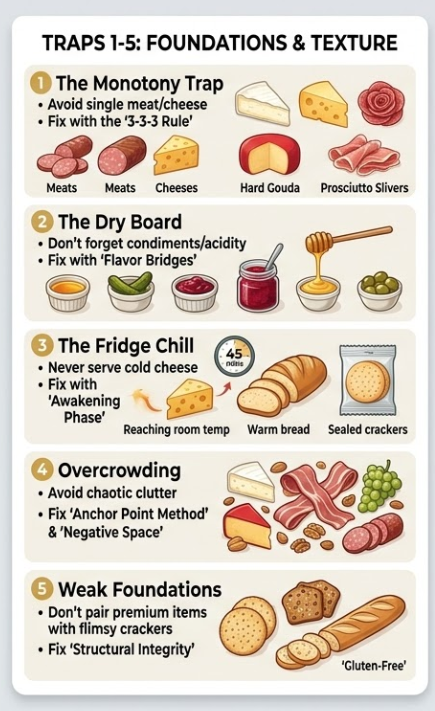
Mastering a charcuterie board is less about following a recipe and more about understanding the delicate friction between flavor, logic, and visual drama. When executed well, these boards become the undisputed centerpiece of any high-end event. Yet, even seasoned hosts often stumble into subtle traps that turn a premium spread into a cluttered mess. Based on raw industry feedback and assembly common sense, here are the 10 most frequent blunders and the professional tactics to fix them.
1. The Monotony Trap: Flavor Without Contrast
Most beginners play it too safe, buying a single pack of supermarket salami and some generic cheddar. This leads to a flat palate experience. A professional setup demands the “3-3-3 Rule”—three meats, three cheeses, and three textures. You need the buttery slip of a Prosciutto alongside the aggressive snap of a peppered salami.
Texture is the silent hero here. Combine the “ooze” of a ripe Brie with the crystalline crunch of aged Gouda. If you are scaling up for a massive gala, working with a premium charcuterie board supplier for global distributors allows you to source pre-curated varieties that maintain this essential contrast without the headache of sourcing each item individually.
2. The Dry Board: Forgetting the Flavor Bridges
Meats and cheeses are the bones, but condiments are the connective tissue. A board lacking acidity or sweetness feels heavy and unfinished. You need that sharp “pop” from cornichons or a sudden hit of honey to cut through the fat.
To keep things tidy, never pour honey directly onto the board; it’s a sticky disaster waiting to happen. Use small ceramic ramekins for physical isolation. For businesses handling upscale delivery, a custom charcuterie container manufacturer with eco-friendly options can provide specialized trays with built-in dividers, ensuring your spicy jellies don’t migrate into your crisp crackers during transit.
3. The Fridge Chill: Serving Cheese While It’s “Asleep”
Serving cheese straight from the cold is a rookie mistake that kills the flavor. Cold milk fats stay locked up, hiding the complex aromas you paid for. It results in a rubbery, muted experience that fails to satisfy.
Think of it as “waking up” the cheese. Take your wedges out at least 45 minutes before the first guest arrives. This “Awakening Phase” lets the fats soften, allowing the creamy textures to truly shine. While the cheese hits room temperature, keep your bread toasted and warm, but leave the crackers sealed until the very last second to prevent them from going limp.
4. Overcrowding: When More Is Actually Less
There is a fine line between “bountiful” and “chaotic.” An overstuffed board makes it impossible for guests to pick up a slice of ham without knocking a pile of nuts onto the floor. Visual breathing room, or negative space, is what makes a board look expensive rather than just “full.”
Try the “Anchor Point Method”: set your cheeses down first as the heavy hitters, then drape the meats like ribbons. Fill the remaining gaps with small fruit or nuts, but stop before the board looks like a pile of laundry. High-volume catering teams often rely on a high-volume charcuterie board factory for hospitality industry to get standardized, ergonomic bases that make this layout foolproof even for junior staff.
5. Weak Foundations: The Cracker Collapse
It is a tragedy to pair a $30-a-pound Prosciutto with a cracker that snaps the moment you try to spread something on it. Your carbs need structural integrity. If a cracker is too thin, it’s useless as a vessel.
Mix it up with sturdy water crackers, crunchy seeded crisps, and chewy baguette slices. Also, don’t ignore the Gluten-Free crowd; it’s a standard hospitality expectation now. Many corporate gift curators now partner with an oem charcuterie accessory supplier for corporate gifting to include specialized, high-strength cracker caddies that keep different artisanal grains organized and intact.
6. The “Bege” Problem: Visual Dullness

If your board looks like a sea of brown and tan, guests won’t be reaching for their phones to take a photo. You need color contrast to trigger the appetite. Throw in some deep purple grapes, bright green herbs, or the vivid red of fresh raspberries to break up the “meat tones.”
Fresh rosemary sprigs are the easiest way to add a “premium” feel for pennies. Also, stop just stacking your meat. Use “Meat Folding”—the salami rose or the accordion fold—to create three-dimensional height. It makes the board look professionally styled rather than just “placed.”
7. Bad Timing: The Oxidation Crisis
Prep work is great, but full assembly is a race against the clock. Apples turn brown, nuts go soft from the humidity of the cheese, and the cheese itself starts to develop a dry, unappealing skin if left out too long.
Stick to the “1 Day + 30 Minute” rule: Slice everything the day before, but don’t put it on the board until 30 minutes before showtime. If you are running an “order-to-go” business, you should consult a wholesale charcuterie packaging factory with moisture-control design to find containers that actually breathe, keeping the crackers crisp even if they sit in a delivery van for an hour.
8. The One-Knife Fiasco: Cross-Contamination
Watching a guest hack at a hard Parmesan with a butter knife is painful. Even worse is using the same knife for a pungent Blue cheese and a mild Brie. You need a dedicated tool for every cheese type to prevent a messy flavor mashup.
Soft cheeses need those “holed” blades to stop sticking, while hard ones need a sturdy spade. Don’t forget a small “discard bowl” for olive pits—nobody wants to hold a pit in their hand. Professional caterers often buy from a bulk charcuterie tool sets manufacturer for retail stores to ensure they have enough matching, high-quality implements for every platter in the rotation.
9. Social Obstacles: Pit and Peel Problems
Some foods are just too much work for a party. Unpitted olives are a dental hazard and an etiquette nightmare. Whole fruit or giant, un-sliced wedges force guests to use both hands, which is impossible if they are holding a drink.
Everything must be “One-Bite Ready.” Slice the apples, snip the grapes into tiny clusters, and pre-cut the hard cheeses. For those doing portable luxury, a charcuterie cup supplier for wedding catering events is the ultimate solution, offering vertical portions where every single item is already prepped for effortless, “one-handed” eating.
10. The Mystery Guest: No Labels
Don’t let your guests play “flavor roulette.” If they don’t know what that dark, crumbly cheese is, they probably won’t touch it. A little bit of guidance goes a long way in making people feel comfortable.
Use small slate markers or hand-written tags. Even better, suggest a pairing: “Try this Gouda with the spicy mustard.” Large-scale operations often use boards from a professional charcuterie equipment factory for food service providers that feature built-in slots for labels, making the whole display look organized, intentional, and high-end.