
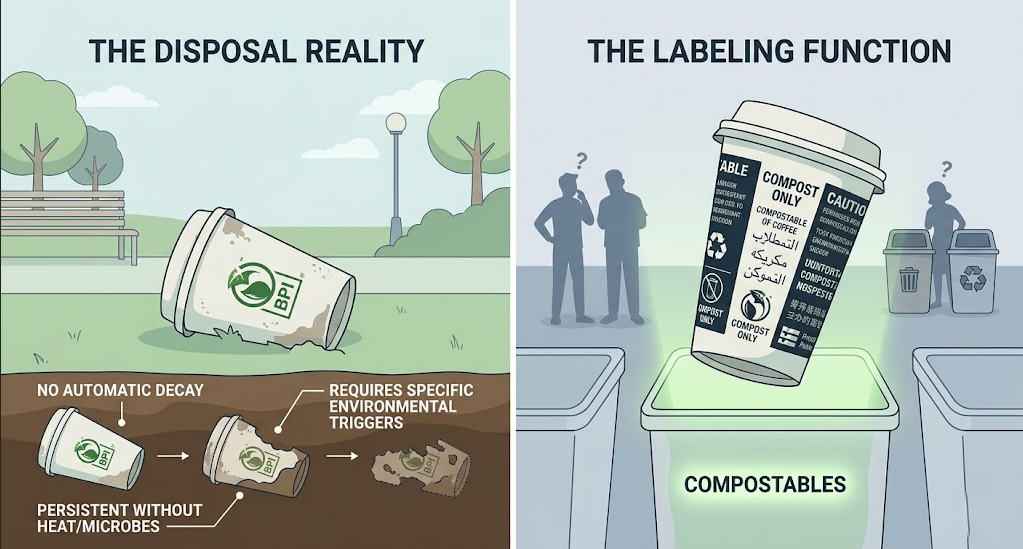
While the global narrative around sustainability often paints a picture of seamless ecological cycles, the operational reality of disposing of compostable packaging is far more gritty. For a custom compostable cup manufacturer managing international accounts, the biggest hurdle isn’t just producing a leak-proof container; it’s ensuring that container doesn’t end up as permanent trash. The “afterlife” of these products involves a complex web of logistics, industrial chemistry, and human error that most marketing brochures tend to gloss over.
The Illusion of Automatic Decay
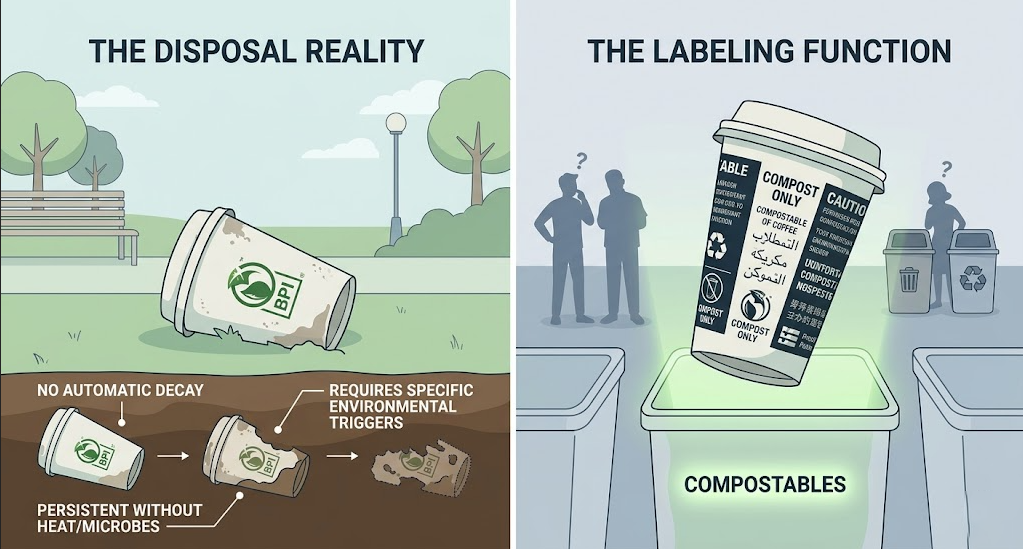
One of the most persistent myths in the B2B packaging world is that “compostable” equals “naturally disappearing.” Many buyers assume that if a cup falls off a truck or is left in a park, it will simply melt into the soil. This is a dangerous misconception. Modern eco-friendly cups typically rely on Polylactic Acid (PLA) or specialized aqueous coatings to handle hot liquids. When a sustainable coffee cup supplier for high-traffic cafes ships a container of goods, they are delivering a product that requires a very specific set of environmental triggers to break down.
In a real-world setting, without the right heat and microbes, these materials can be almost as persistent as traditional plastic. The disposal process begins the moment a customer stands in front of a waste bin. If a wholesale compostable cup factory with ODM services fails to provide intuitive, bold labeling, the cup’s environmental potential is often snuffed out by a single confused consumer.
The Industrial Composting Bottleneck

The primary destination for these products should be a commercial composting facility. These sites function like giant biological reactors, maintaining temperatures above 60°C to shatter the molecular chains of bioplastics. However, the “real scenario” here is often one of scarcity. In many regions, there are simply no facilities capable of processing “packaging organics”—they only want food scraps and yard waste.
For a certified PLA-lined cup manufacturer for global distributors, this creates a massive logistical gap. When cups do make it to an industrial site, they are often treated with suspicion. Facility managers fear that a single non-compostable plastic cup will ruin their entire batch of soil, leading them to “screen out” all cups and send them straight to the incinerator. This is the hidden friction in the circular economy: even a perfect cup can be rejected by a cautious facility operator.
The Landfill Trap and Methane Issues

If a compostable cup is tossed into a standard garbage can—which happens to a majority of them—it enters a landfill. Landfills are designed as “dry tombs” to prevent environmental leaks, meaning they lack the oxygen and moisture necessary for aerobic decomposition.
In this scenario, even the highest-quality product from a premium bio-based cup supplier for the hospitality sector is essentially mummified. Worse still, if the organic components do manage to break down in these oxygen-starved conditions, they produce methane. For a wholesale buyer, this is a nightmare: the “green” product they paid a premium for is now contributing to a more potent greenhouse gas effect than the plastic it replaced.
The Recycling Contamination Problem
Another common real-world failure occurs at the recycling center. Because compostable paper cups look identical to traditional PE-lined cups, they are frequently thrown into the paper recycling stream. This is a major operational headache. The bioplastic lining is a “sticky” contaminant that can clog paper pulping machinery or leave spots in the final recycled paper product.
This is why a bulk compostable paper cup factory serving the franchise industry must prioritize “visual differentiation.” If the cup looks too much like trash or too much like traditional recycling, it will inevitably end up in the wrong place. The eco-friendly beverage container manufacturer for retail partners must balance aesthetics with the brutal necessity of waste-stream sorting, often using color-coded rims or large text to signal the cup’s true identity to both consumers and sorting machines.
Sorting Logic at the Waste Plant
In a high-speed waste sorting facility, human workers and optical sensors have less than a second to categorize an item. If a compostable cup is dirty or crushed, it loses its “signature.” In the real world, a cup that is caked in dried latte or whipped cream might be automatically diverted to the “residual waste” pile—the landfill pile—because the sorting technology cannot verify its material composition.
A reliable compostable cold cup supplier for festival organizers knows that the only way to beat this is through “clean stream” collection. This means setting up dedicated bins where only compostable items are allowed. In these controlled environments, the risk of contamination drops, and the facility manager is much more likely to accept the load without secondary sorting.
The Power of the Certification Mark
In the waste industry, a logo is a legal shield. Facility managers will only process compostable packaging if they see a trusted certification mark, such as the BPI leaf or the TUV “OK Compost” symbol. These marks act as a guarantee that the cup won’t leave behind microplastics or heavy metals in the final compost.
For a professional PLA cup manufacturer with international certifications, these stamps are the most important part of the product. Without them, the cup has no “right of way” in the green waste stream. In real-world disposal, the absence of a logo usually means the item is treated as a pollutant, regardless of what the material actually is.
Shifting Toward Home Composting Solutions
As the limitations of industrial infrastructure become clearer, the industry is pivoting. The next generation of cups is being designed for “home compostability,” meaning they can break down in the lower temperatures of a backyard bin or a simpler municipal setup.
For an innovative compostable cup factory for sustainable brands, this shift is about resilience. By making the cup easier to dispose of in a wider variety of real-world scenarios, we reduce the dependency on specialized (and often unavailable) industrial plants. It takes the pressure off the municipal waste grid and puts the power of disposal back into the hands of the consumer and the small business owner.
Final Thoughts
Disposing of a compostable cup is not as simple as “throwing it away.” It is a high-stakes game of logistics, material science, and clear communication. For B2B buyers, the lesson is clear: the job isn’t finished when the cup is sold. It’s only finished when the cup has successfully returned to the earth. Understanding these real-world disposal hurdles is the first step toward moving beyond “greenwashing” and toward a truly functional sustainable model.