
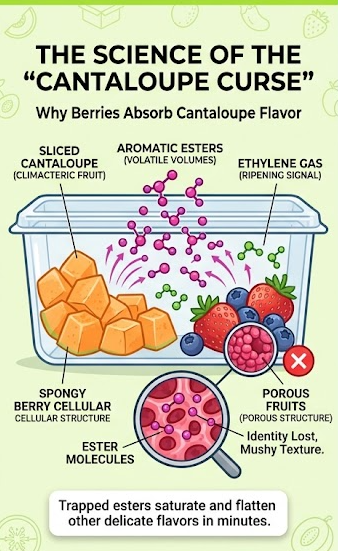
We’ve all seen it happen in the high-stakes world of grab-and-go retail: a premium fruit mix looks stunning with crisp grapes and vibrant berries, only for the customer to open it an hour later and find that everything tastes—and smells—exactly like cantaloupe. In the professional catering and cold-chain industry, this is often called the “Cantaloupe Curse.” While this specific melon is a staple for B2B fruit mixes due to its cost-efficiency, its chemical volatility can single-handedly tank a brand’s reputation for freshness.
The issue isn’t just that the melon has a “strong” flavor; it is a mechanical failure involving volatile organic compounds (VOCs) and the specific gas-barrier properties of your containers. As a long-standing PET plastic fruit bowl manufacturer, our R&D team has spent years analyzing how different polymers react to high-aroma produce. If you are a procurement manager or a food brand owner, understanding the molecular behavior of this “mistake” is the only way to deliver a superior consumer experience that actually drives repeat sales.
The “Gas Factory” Effect: Why Berries Act Like Sponges

Cantaloupe is a total outlier in the melon family because of its massive concentration of esters. These are the aromatic compounds responsible for that signature musky scent. Unlike the more subtle honeydew, a ripe cantaloupe becomes a literal “gas factory” the moment it is sliced. In a sealed environment, these esters are trapped. Because fruits like apples, pears, and especially porous berries are structurally “spongy,” they absorb these airborne esters in real-time, losing their own flavor identity.
Furthermore, cantaloupe is a climacteric fruit, meaning it keeps “breathing” and releasing ethylene gas even after it is processed. This gas doesn’t just spread flavor; it triggers a ripening response in surrounding fruits, making strawberries turn mushy far faster than they should. This is why many recycled rPET fruit bowl suppliers recommend specific headspace ratios or micro-perforated films. Without managing this internal atmosphere, the aroma becomes a trapped pollutant, leading to that generic, slightly fermented taste that kills consumer trust.
Material Science: How the Container Aggravates the Flavor Shift

The choice of packaging material is often the silent culprit in flavor degradation. Most budget-grade containers are designed for “shelf-pop” clarity, but they are often too airtight for mixed-fruit applications. While a tight seal prevents leaks, it creates a pressurized micro-environment where cantaloupe esters are forced into the cellular tissues of more delicate fruits. If you are currently vetting an anti-fog PP fruit bowl factory, you must prioritize designs that manage “aroma scalping.”
Aroma scalping occurs when the plastic itself absorbs the fruit’s aromatic oils and then leaches them back out, or—worse—fails to allow the release of sulfuric compounds common in melons. We frequently see buyers try to cut corners by using thin-gauge materials that warp under the weight of wet fruit. These micro-deflections can actually break the seal just enough to allow oxygen in, accelerating oxidation, without letting the “melon gas” out. Partnering with a clear PLA compostable fruit bowl manufacturer that understands structural integrity ensures your bowl maintains its seal and keeps each fruit’s flavor profile isolated.
The “Mush Factor” and Structural Architecture
It isn’t just the taste that suffers; it is the physical “mouthfeel.” Cantaloupe has an incredibly high water content and a soft cellular structure. In a standard pre-packaged fruit bowl, the weight of the melon pieces usually sits at the very bottom. As the melon undergoes “syneresis”—the leaking of juice—the other fruits begin to “stew” in a concentrated cantaloupe brine.
For B2B buyers aiming for a premium market position, the solution is usually found in the architecture of the container itself. Many of our clients working with a biodegradable sugarcane bagasse fruit bowl designer have moved toward partitioned inserts or tiered layouts. By physically separating the melon from the porous berries, you stop the liquid exchange that leads to mushy textures. If a raspberry sits in melon juice for even ninety minutes, the enzymes will “break down” the berry’s structure, turning the whole bowl into a soggy, unappealing mess.
Industry Secrets: How Pros Prep the Melon

Experienced food processors know that the “Cantaloupe Mistake” is mostly mitigated in the prep stage before the fruit ever hits the container. “Bleeding” the melon is the single most important step. Once cut into chunks, the cantaloupe should be placed on a perforated tray for at least 15 to 20 minutes. This allows the excess surface moisture—the liquid carrying the highest concentration of esters—to drain away before packaging.
Additionally, the “layering” method is far more effective than “tossing.” Instead of mixing the fruit like a salad, pros layer the cantaloupe at the very bottom, followed by a barrier of non-porous fruit like thick-skinned grapes, with the delicate berries placed on top. When choosing a wholesale crystal clear fruit bowl factory, look for deep-base ratios. A wider, shallower bowl distributes the weight more evenly, preventing the bottom-layer melons from being crushed and releasing their pungent juices into the rest of the mix.
Temperature: The “Volume Knob” for Aromatics
Think of temperature as the volume control for fruit flavor. At room temperature, the esters in cantaloupe are highly volatile and move aggressively through the air. This is why a fruit bowl left on a counter for 20 minutes tastes significantly more like “melon” than one kept at a steady 3°C. In the B2B supply chain, cold-chain integrity is your only defense against the “Cantaloupe Curse.”
Packaging insulation also matters. If the wall is too thin, it offers zero thermal buffer during the minutes a product is moved from a refrigerated truck to a retail shelf. Working with an eco-friendly molded fiber fruit bowl producer can provide solutions for products that might face slight temperature fluctuations, as natural fibers offer different thermal properties than thin-film plastics. Finding the balance between “shelf-appeal” and thermal stability is the “sweet spot” for retail success.
Why Quality Packaging is a Non-Negotiable Investment
In the B2B food service sector, a fruit bowl is a high-margin item, but it is also the most prone to quality complaints. A “tasting off” complaint is rarely about the fruit being rotten; it is almost always about the flavor profile being “muddy” or “melon-bombed.” When a customer pays a premium price for a mix, they expect to taste the distinct tartness of the pineapple—not a “melon-flavored medley.”
Investing in high-end, engineered packaging is not a cost; it is a brand insurance policy. The right bowl keeps the cantaloupe in its place, both physically and chemically. It ensures the “Cantaloupe Mistake” doesn’t result in a loss of customer loyalty or expensive retailer chargebacks. Don’t let one cost-effective melon dictate the flavor of your entire product line. Separate the components, manage the gases, and choose a container that respects the science of freshness. Your brand’s growth depends on that first, crisp, melon-free bite.