
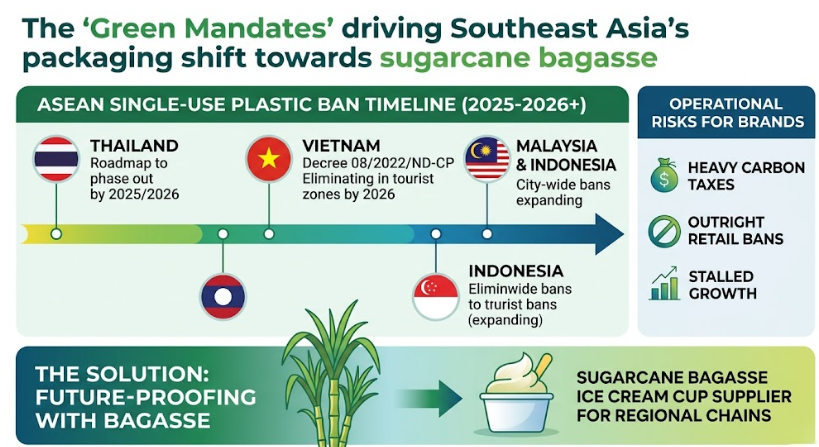
The tropical pulse of Southeast Asia has always driven a relentless demand for cold treats, but the infrastructure supporting this multi-billion dollar industry is currently undergoing a massive, tech-driven seismic shift. From the bustling street corners of Bangkok to the high-end dessert boutiques of Singapore, a green revolution is melting away the long-standing dominance of plastic. This transition, fueled by a combination of aggressive legislative timelines and a radical change in consumer ethics, has left regional dessert innovators with no choice but to pivot. They are no longer asking if they should ditch plastic, but how fast they can transition to sustainable alternatives. Among the top contenders, sugarcane bagasse has emerged as the undisputed champion for frozen applications.
The Legislative Tsunami: ASEAN’s War on Single-Use Plastic
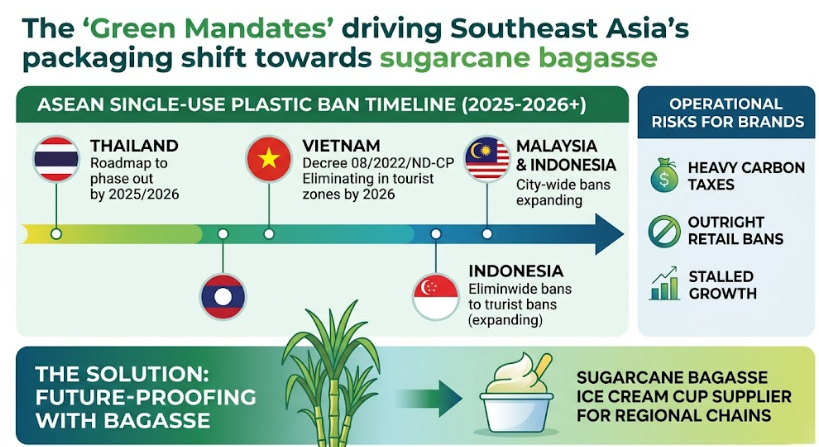
The primary catalyst for this shift is a wave of “Green Mandates” sweeping across ASEAN nations like a tidal wave. Thailand, a regional leader in bio-economy initiatives, has implemented a roadmap that aims to phase out single-use plastics entirely by 2025-2026. This isn’t just a suggestion; it’s a firm regulatory wall that affects every local sugarcane bagasse ice cream cup factory in Thailand and its export partners. Similarly, Vietnam’s Decree 08/2022/ND-CP sets a firm trajectory for eliminating non-biodegradable plastic bags and containers in tourist zones and retail hubs by 2026.
For dessert brands, these laws represent a significant operational risk that could stall growth. Relying on traditional PE-coated paper or plastic cups could soon lead to heavy carbon taxes or outright retail bans. Indonesia and Malaysia are following suit, with Jakarta and Kuala Lumpur already enforcing city-wide bans on straws and plastic carriers. By choosing a sugarcane bagasse ice cream cup supplier for regional chains, brands are essentially future-proofing their logistics against an inevitable regulatory shutdown of the old plastic economy.
Performance Under Pressure: The Science of Bagasse in Frozen Environments
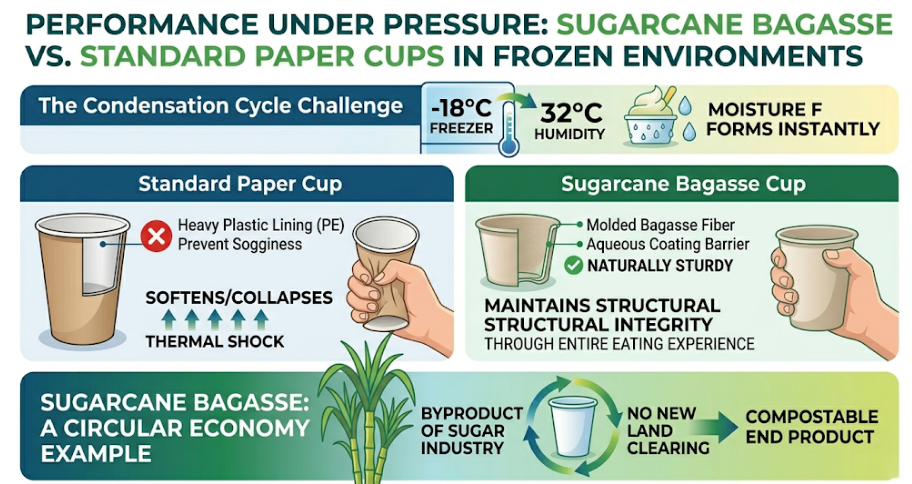
Why choose bagasse over standard paper or PLA? The answer lies in the unique molecular structure of sugarcane fiber itself. Unlike wood-pulp paper, which often requires a heavy plastic lining to prevent sogginess, molded bagasse fiber is naturally sturdy. However, the true challenge for a sugarcane bagasse ice cream cup manufacturer lies in the “condensation cycle.” When an ice cream cup is pulled from a -18°C freezer into the 32°C humidity of a Southeast Asian afternoon, moisture forms instantly on the exterior.
Standard paper cups often soften or collapse under this thermal shock. Sugarcane bagasse, especially when treated with modern aqueous coatings, maintains its structural integrity through the entire eating experience. It doesn’t “sweat” through the base, ensuring that a premium gelato remains a premium experience until the last spoonful. Furthermore, as a byproduct of the sugar industry, bagasse is a classic example of a circular economy. It requires no new land clearing, unlike some bio-plastics that compete with food crops for acreage.
What Makes a Bagasse Ice Cream Cup Truly “Reliable”?

Not all green packaging is created equal. For a sourcing manager, the term “eco-friendly” is far too vague to base a high-stakes procurement strategy on. A truly reliable cup must meet a rigorous trifecta of criteria: thermal stability, chemical safety, and supply chain transparency. The most critical technical hurdle in 2026 is the elimination of PFAS (per- and polyfluoroalkyl substances). Historically used to make fiber packaging grease-resistant, these “forever chemicals” are now being banned globally. A top-tier sugarcane bagasse ice cream cup wholesaler must provide laboratory proof that their grease-resistance is achieved through mechanical refining or safe, bio-based alternatives.
Beyond chemistry, the evaluation rests on “rim consistency.” For brands using automated filling lines, a variance of even half a millimeter in the cup’s diameter can lead to machine jams and costly downtime. Reliability also extends to the “Home Compostable” certification. While many cups claim to be compostable, they often require industrial facilities that simply don’t exist in many parts of Southeast Asia. Brands that prioritize the user experience look for the OK Compost Home mark, allowing customers to dispose of the packaging in their own garden bins.
1. SenAng — Precision Engineering for Large-Scale Customization
Based in the industrial heart of Anhui, SenAng has positioned itself as a high-tech leader in the molded fiber space. Their strength lies in their massive R&D investment into aqueous coating technologies. While many factories still rely on thin plastic linings, SenAng offers a 100% plastic-free barrier that survives the -18°C to 4°C transition without losing its “snap” or stiffness. This makes them a preferred sugarcane bagasse ice cream cup manufacturer for brands that require specific pantone matching and high-definition logo placement on textured surfaces. Their ability to handle high-volume orders with full coating flexibility ensures that the structural integrity of the cup isn’t sacrificed for the sake of aesthetics.
2. Zhejiang Pando — The Hybrid Specialist for Premium Visuals
Zhejiang Pando occupies a unique niche by bridging the gap between traditional paper craftsmanship and modern bio-materials. While they are giants in the paper cup world, their recent pivot toward bagasse-pulp blends has caught the eye of premium dessert parlors. By blending sugarcane fibers with high-grade FSC-certified paper pulp, they produce a cup that feels smoother than raw molded fiber but remains fully compostable. If you are looking for a sugarcane bagasse ice cream cup supplier for high-end dessert boutiques, Pando offers a sophisticated finish that serves as a perfect canvas for complex, multi-colored designs that often look blurred on rougher fiber surfaces.
3. iPack Packing — Championing Agricultural Waste Traceability
Transparency is the core currency of iPack Packing. In an era where “greenwashing” is a constant threat, iPack provides detailed “Farm-to-Table” documentation for their sugarcane waste. They don’t just sell containers; they sell a documented reduction in carbon footprint. Their service is tailored toward brands that have integrated ESG (Environmental, Social, and Governance) goals into their annual reports. As a sugarcane bagasse ice cream cup manufacturer for ESG-focused brands, they provide the data points—such as water usage and energy savings per unit—that allow marketing teams to tell an authentic story to their eco-conscious customers.
4. MVI ECOPACK — Agility and Speed for Emerging Markets
For many independent cafes in Manila or Ho Chi Minh City, the hurdle to going green is often the “Minimum Order Quantity” (MOQ). MVI ECOPACK has solved this by maintaining a vast inventory of standard sizes (4oz to 8oz) that are ready for immediate dispatch. They act as a vital sugarcane bagasse ice cream cup factory for independent shops, allowing businesses to test eco-friendly transitions without committing to a full shipping container of stock. Their presence in regional distribution networks significantly reduces lead times, which is crucial in the fast-moving “limited time offer” (LTO) world of seasonal fruit desserts.
5. Lokyo — Meeting the Rigorous Standards of Global Compliance
Lokyo has built its reputation on the “Single-Use Plastics Directive” (SUPD) compliance required by the European Union. While based in China, their products are designed for the most regulated markets in the world. This makes them an ideal partner for Southeast Asian brands that have export ambitions or those that simply want to adhere to the highest global safety standards. As a sugarcane bagasse ice cream cup supplier for international exporters, Lokyo ensures that every batch passes rigorous “migration tests,” guaranteeing that no chemicals from the packaging leach into the high-fat content of premium ice cream.
6. Huhtamaki — The Global Standard for Chain Reliability
With a massive manufacturing footprint within Southeast Asia itself, including facilities in Thailand and Malaysia, Huhtamaki offers a level of supply chain security that few can match. Their “Future Smart” initiative focuses on using 100% renewable, bio-based materials. For a massive regional franchise, the “landed cost” and logistics are as important as the material itself. Huhtamaki serves as a sugarcane bagasse ice cream cup factory for regional franchises, offering the stability of local production which bypasses many of the shipping delays and import duties that plague cross-border sourcing.
7. Gracz — The Local Hero of the Mekong Delta
Thailand’s own Gracz is perhaps the most significant player for the ASEAN market. By utilizing the massive sugarcane surplus of the Thai agricultural sector, they have created a vertically integrated powerhouse. Their cups are ubiquitous in Thai high-end malls for a reason: they are incredibly well-adapted to the local humidity. Choosing a sugarcane bagasse ice cream cup manufacturer for ASEAN markets allows buyers in neighboring countries like Cambodia, Laos, and Vietnam to benefit from zero-tariff trade agreements (AFTA), making the price point of these eco-friendly cups highly competitive with traditional plastic.
Navigating the Comparison: Choosing the Right Partner
The decision-making process for a brand manager involves more than just picking a name from a list. It requires a strategic alignment of brand values and operational needs. A boutique creamery in Singapore might prioritize the smooth finish and design potential of Lokyo or Pando, whereas a massive supermarket private label in Indonesia will likely require the volume and local logistics provided by Huhtamaki or Gracz.
When comparing these manufacturers, the “Total Cost of Ownership” must be considered. A slightly cheaper cup that has a 5% failure rate in the freezer or jams the filling machine is significantly more expensive than a premium, consistent product. The comparison matrix should always weigh MOQ, lead time, and specific “freeze-thaw” performance data.
Identifying Red Flags: Protect Your Brand Integrity
As the demand for bagasse sky-rockets, “basement suppliers” are entering the market with substandard goods. A common red flag is the “smell test.” Low-quality bagasse that hasn’t been properly processed can retain a faint, earthy, or even fermented odor that ruins the delicate aroma of vanilla or coconut ice cream. Furthermore, always verify the authenticity of certifications. A reputable sugarcane bagasse ice cream cup supplier for wholesale buyers will always have a verifiable license number for their BPI or TÜV certifications. If a supplier refuses to provide the original PDF of the test report, it is a sign to walk away.
From Inquiry to Order: A Practical Roadmap
The transition to sugarcane bagasse is a journey of small, calculated steps. Start by requesting a “Stress Test Sample Kit” which should include not just the cups, but also the matching lids—whether they are bagasse, CPLA, or recycled PET. Test these samples in your actual freezer for 48 hours, then allow them to sit in a humid environment to observe the condensation impact.
When negotiating your first order, emphasize the long-term partnership rather than just the initial price per unit. Many manufacturers are willing to offer “MOQ compression” for the first two shipments to help a brand transition its inventory. By selecting a partner from this list of vetted experts, Southeast Asian dessert brands can confidently step into the future, serving their cool treats in packaging that respects the environment as much as it protects the product.