
In the competitive landscape of the European frozen dessert market, the integrity of packaging is the silent guardian of brand reputation. As logistics chains face increasingly volatile environmental conditions, traditional materials like Polypropylene (PP) or standard PET often reach their physical limits—specifically struggling with brittleness at temperatures below -20°C. For procurement professionals, identifying a heavy-duty CPET ice cream cup factory for industrial food processors has transitioned from a technical preference to a strategic necessity for ensuring product safety from the manufacturing plant to the consumer’s freezer.

The Science of CPET: Engineering Stability for the Cold Chain
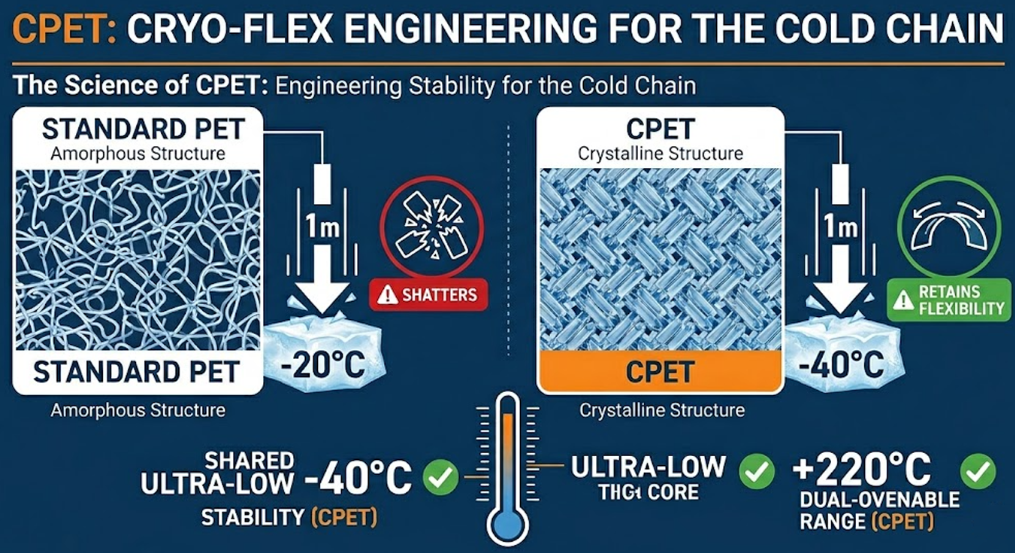
CPET (Crystalline Polyethylene Terephthalate) is distinguished by its partially crystalline structure, achieved through controlled thermal processing and the introduction of nucleating agents. This molecular architecture allows the material to retain structural flexibility even at a staggering -40°C, a threshold where standard plastics often shatter upon impact. Furthermore, its thermal resistance extends up to +220°C, providing a massive safety buffer for pasteurization or high-heat sterilization processes. For businesses managing high-value inventories, partnering with a reliable CPET gelato bowl supplier for European retailers is the most effective way to mitigate “cold crack” loss and ensure the premium texture of the ice cream remains uncompromised by container failure.

Top 10 High-Performance CPET Suppliers in Europe
To assist in your global sourcing strategy, we have curated the top 10 manufacturers across Europe who specialize in CPET and high-stability frozen packaging.
-
Greiner Packaging (Austria): A technical titan in thermoforming, Greiner is the industry leader for innovative CPET frozen treat tub supplier for dairy brands. Their K3® cardboard-plastic combination provides superior insulation for premium pints.
-
Faerch (Denmark): Renowned for its circular economy model, Faerch is a sustainable rPET ice cream cup manufacturer for eco-conscious enterprises. Their CPET solutions feature up to 70% recycled content without compromising structural integrity at -40°C.
-
Mondi Group (Austria/UK): A global leader in high-barrier materials, Mondi offers B2B CPET dessert container manufacturer for supermarket chains that require paper-hybrid options with extreme temperature stability.
-
Fatra, a.s. (Czech Republic): Leveraging vertical integration, Fatra is a high-volume CPET packaging supplier for food service distributors, specializing in rigid sheets and thermoformed tubs for industrial-scale operations.
-
Polo Plast (Italy): Merging Italian design with high-performance plastics, this is a premium Italian-made CPET container factory for boutique gelato parlors that need high-clarity lids and crack-resistant bases.
-
Sabert Europe (Belgium): Specializing in “freezer-to-oven” capabilities, Sabert provides a professional CPET frozen packaging supplier for private label brands looking for dual-ovenable stability (-40°C to +220°C).
-
Waddington Europe (Ireland): A division of Novolex, they focus on advanced CPET ice cream packaging factory for global procurement leaders, offering R&D support for complex, multi-compartment frozen dessert designs.
-
PACCOR / Berry Global (Germany): Now part of Berry Global, they offer a flexible CPET ice cream cup manufacturer for small-to-medium businesses that need standardized, high-volume rPET and CPET solutions with proven cold-chain performance.
-
Huhtamaki (Finland): While known for fiber, Huhtamaki’s multi-layer plastic division acts as a reliable CPET gelato bowl supplier for European retailers who demand high-speed automated filling compatibility.
-
Coveris (Luxembourg/Germany): Focusing on “No Waste,” Coveris is a custom CPET frozen food cup supplier for international distributors, providing specialized films and rigid containers that prevent condensation and brittle-fracture.
Navigating European Compliance: EU 10/2011 and PPWR
In Europe, the regulatory landscape is as rigid as the packaging itself. Any container destined for food contact must strictly adhere to the migration limits set by EU 10/2011. CPET stands out due to its exceptionally low chemical migration rates across extreme temperature swings. Looking toward 2026, the Packaging and Packaging Waste Regulation (PPWR) is reshaping procurement; CPET, as a mono-material, is highly favored for its recyclability. Procurement leaders now prioritize partners who can provide certified RecyClass documentation alongside traditional food safety audits.
The B2B Decision Matrix: Benchmarking Your Partners
A successful procurement strategy requires a multi-dimensional evaluation of the vendor’s laboratory data. Beyond unit price, buyers must verify “Drop Test” results conducted at deep-freeze temperatures. A 1-meter fall at -40°C should yield a failure rate of less than 0.1%. Additionally, the compatibility of lidding films with the CPET flange is critical for leak-proof sealing.
Flexibility in logistics is another deciding factor. While large-scale manufacturers focus on efficiency, the rise of niche “premium” SKUs has created a demand for suppliers who can balance scale with customizability. For brands where visual presentation is paramount, ensuring the “unboxing” experience is as flawless as the product inside requires a partner who understands both the physics of the freezer and the psychology of the consumer.
2026 Trends: Lightweighting and Digital Traceability

The future of CPET in Europe is focused on “doing more with less.” Lightweighting technologies are allowing manufacturers to reduce resin weight by up to 15% without compromising top-load strength. Furthermore, the integration of digital watermarking is becoming standard, allowing recycling facilities to identify CPET from mixed waste streams with 99% accuracy.
Conclusion
Selecting CPET is more than a material choice; it is an engineering insurance policy against the rigors of the modern cold chain. From the precision of Austrian manufacturing to the elegance of Italian design, Europe’s top suppliers are setting new benchmarks for extreme temperature stability. By auditing for mechanical performance, regulatory compliance, and sustainability, enterprises can build a resilient packaging strategy that protects both the product and the bottom line.