
For most buyers, the question isn’t whether a ramen bowl can be customized. It’s whether customization will solve a real business problem—or just add cost without impact. On paper, standard options look efficient and safe. In practice, the decision becomes clearer only when you tie packaging back to operations, brand visibility, and repeat purchasing patterns.
This is not a design discussion. It’s a procurement decision that affects margin, workflow, and long-term scalability.
The real reason standard ramen bowls are still the default choice
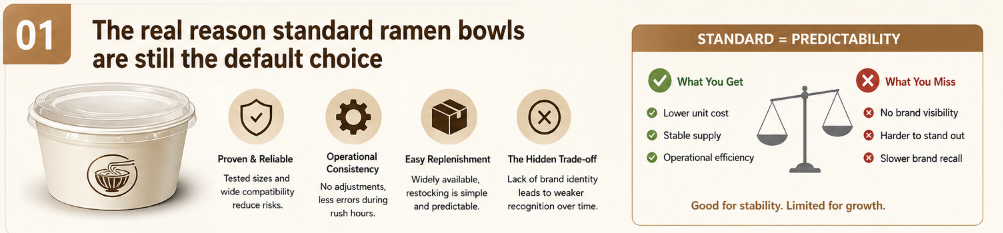
Standard ramen bowls haven’t stayed dominant by accident. They solve a very specific set of risks that many businesses quietly try to avoid.
When you’re sourcing from a ramen bowl manufacturer for bulk distribution, what you’re really buying is predictability. Standard sizes are already tested across kitchens, lids are widely compatible, and replenishment is rarely an issue. That matters more than aesthetics when your priority is keeping operations stable.
There’s also a hidden operational advantage. With standard bowls, your team doesn’t need to “adapt” during service. No second-guessing portion fit, no lid mismatches during rush hours. That consistency reduces small errors that add up over time.
But the trade-off becomes visible once your business moves beyond pure functionality. Standard bowls don’t carry identity. In a dine-in setting, that might be acceptable. In delivery-heavy models, it becomes a limitation. Customers remember the food, but not the brand behind it.
Over time, that lack of differentiation starts behaving like a cost—just not one that shows up on your invoice.
Where standard options quietly become expensive
At first glance, standard bowls look cheaper. No setup fees, lower unit prices, minimal commitment. But that’s only true if you evaluate them in isolation.
Once you factor in frequency of reorders, lack of brand recall, and inefficiencies caused by “almost right” sizing, the cost structure shifts. Businesses sourcing from a standard ramen bowl supplier for restaurant chains often find themselves reordering more frequently than expected, simply because the product doesn’t fully match their menu needs.
There’s also the issue of missed branding opportunities. Every bowl leaving your kitchen is a touchpoint. If it looks identical to competitors, you’re effectively paying for packaging that promotes no one.
The result isn’t immediate loss—it’s slower growth, weaker recognition, and less control over how your brand travels beyond the store.
What you’re actually paying for in custom ramen bowls
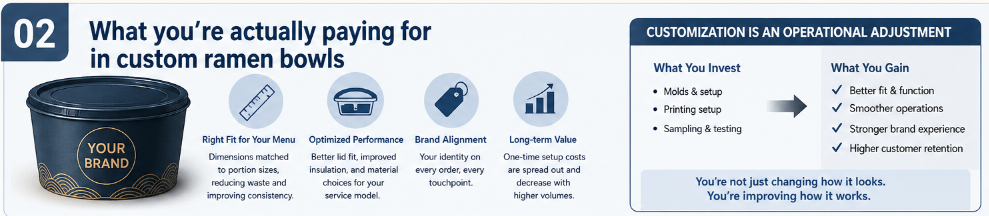
Customization is often misunderstood as a design upgrade. In reality, it’s closer to an operational adjustment.
Working with an oem ramen bowl manufacturer for foodservice brands means you’re not just changing how the bowl looks. You’re influencing how it performs within your system. Dimensions can match portion sizes more precisely. Lid fit can be optimized for transport. Material choices can reflect whether your focus is dine-in durability or delivery insulation.
Then there’s the one-time cost layer—molds, printing setup, sampling cycles. These are real expenses, but they behave differently from unit costs. They decrease in impact as your order volume increases.
What matters more is what customization removes. Less product mismatch, fewer service disruptions, and a packaging experience that aligns with how your food is meant to be presented.
That’s where the return starts to appear.
The hidden value most buyers underestimate
The most valuable part of customization rarely shows up in product specs.
Consider businesses sourcing through a custom printed ramen bowl supplier for takeaway businesses. Their primary concern isn’t the bowl itself—it’s how the packaging performs once it leaves the store. In delivery scenarios, the bowl becomes part of the customer’s first impression. It frames the food, affects perceived quality, and often determines whether the brand is remembered.
There’s also a workflow benefit. When packaging is designed around your menu, staff spend less time adjusting portions or securing lids. These small efficiencies reduce friction during peak hours, which directly impacts service speed.
Customization, in this sense, is less about standing out visually and more about removing operational compromises.
When customization becomes the smarter financial decision

Customization only makes sense under certain conditions. Without them, it can feel like an unnecessary upgrade.
If your business has stable ordering cycles, the equation changes. Buyers working with a ramen bowl factory for recurring procurement contracts can spread initial costs across multiple orders, making the per-unit difference less significant over time.
The same applies to brands heavily dependent on delivery platforms. When visual consistency affects customer retention, investing in recognizable packaging isn’t optional—it’s strategic. In these cases, sourcing from a odm ramen bowl supplier for cloud kitchen operations often leads to better long-term performance, even if the upfront cost is higher.
Expansion is another turning point. As soon as multiple locations are involved, inconsistency in packaging becomes a liability. Different bowls across outlets weaken brand identity and complicate supply management. Customization restores control.
On the other hand, if your menu is still evolving or order volumes are unpredictable, standard options remain the safer choice. Flexibility matters more than optimization at that stage.
Where most customization decisions go wrong
Problems don’t usually come from customization itself. They come from how it’s approached.
One common mistake is overcommitting too early. Businesses eager to differentiate sometimes jump into full customization without validating demand. Working with a bulk ramen bowl manufacturer for private label projects under these conditions often leads to excess inventory and tied-up capital.
Another issue is focusing too heavily on appearance. A visually appealing bowl that leaks or doesn’t seal properly will create more problems than it solves. Function has to come first, especially for delivery-focused models.
There’s also a tendency to underestimate minimum order requirements. Custom production typically involves higher MOQs, which can strain cash flow if not planned carefully. This is particularly relevant when dealing with a ramen bowl supplier for international distributors, where logistics and lead times add another layer of complexity.
Avoiding these pitfalls isn’t about avoiding customization—it’s about timing and scope.
A more practical way to approach the decision
Instead of treating customization as a yes-or-no choice, it helps to see it as a progression.
Many businesses start with standard bowls to stabilize operations. Once demand becomes predictable, they introduce light customization—usually printing or branding elements. At this stage, working with a custom ramen bowl factory for brand differentiation allows them to test how packaging influences customer perception without committing to structural changes.
Only after these steps prove effective does full customization make sense. This might involve adjusting dimensions, materials, or lid systems to better align with the menu.
This phased approach reduces risk while still moving toward a more controlled and brand-aligned packaging system.
The decision comes down to what you’re optimizing for
If your goal is to secure a reliable container at the lowest immediate cost, standard ramen bowls will do the job. They’re efficient, widely available, and easy to manage.
But if your focus extends beyond basic functionality—if you’re building a brand, scaling operations, or relying on delivery channels—then packaging becomes part of your business strategy.
At that point, the question isn’t whether customization is worth it. It’s whether continuing with standard options is quietly limiting your growth.
Because in the long run, a ramen bowl isn’t just a container. It’s part of how your product is experienced, remembered, and reordered.