
The North American frozen dessert market is hitting a massive pivot point. For today’s eco-conscious brands, the real challenge isn’t just perfecting a vegan gelato recipe—it’s figuring out the vessel that holds it. As plastic bans sweep through states from California to New York, Polylactic Acid (PLA) has emerged as the “hero” material. However, there is a massive, expensive gap between “green marketing” and “compost reality.” Many businesses fall into the greenwashing trap because they fail to vet the technical specifications of their supply chain. Picking a reliable eco-friendly PLA ice cream cup manufacturer for sustainable brands means looking past the “leaf” logo and digging into the actual material chemistry and regional certifications that define true sustainability.
The Great Compostability Myth: Industrial vs. Home Realities
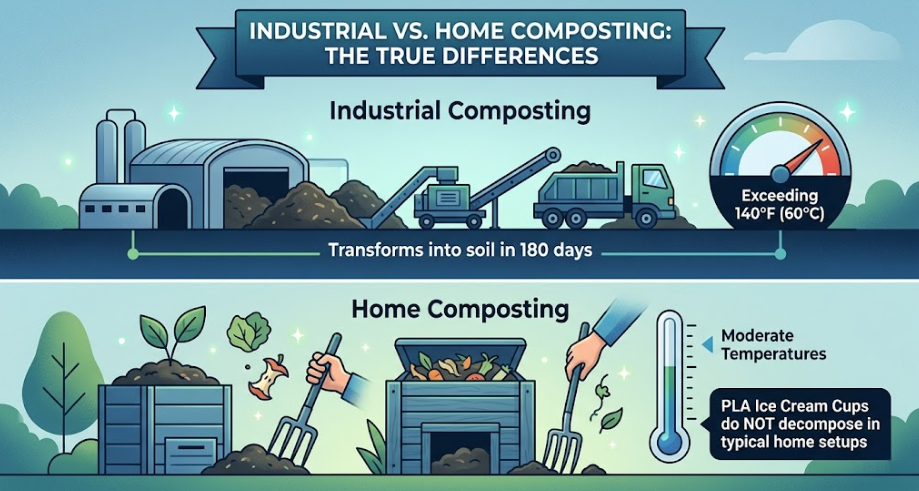
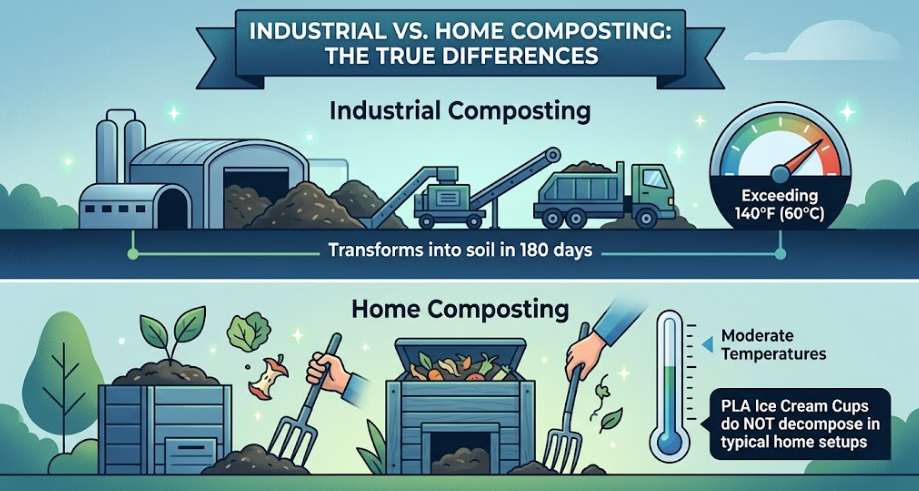
The biggest mistake founders and procurement managers make is assuming a “compostable” cup will simply vanish if tossed into a backyard pile or a standard trash bin. It won’t. Most PLA-lined products are engineered for industrial-scale composting—high-heat environments exceeding 140°F (60°C) that trigger the molecular breakdown. When you source from a custom PLA ice cream cup supplier with BPI certification, you are essentially buying an insurance policy for your brand’s reputation.
These certifications, such as ASTM D6400 in the U.S. or EN13432 in Europe, provide documented proof that the cup will transform into nutrient-rich soil within 180 days at a professional facility. Without this paperwork, your brand is one FTC audit away from a “deceptive claims” lawsuit. Furthermore, the distinction between “biodegradable” and “compostable” is a legal minefield. In the packaging industry, “biodegradable” is often considered a fluff word; technically, even a piece of wood is biodegradable over a century. “Compostable,” however, has a strict functional clock. For a fast-growing dessert business, locking in a high-volume compostable ice cream bowl factory for North American distribution ensures your packaging actually fits the local waste infrastructure. If your customers live in a city without industrial composters, that expensive PLA cup ends up “mummified” in a landfill for decades, behaving exactly like traditional petroleum-based plastic.
The Elite 8: Top Factories for North American Eco-Brands
Navigating the global supply chain requires filtering for three non-negotiables: compliance, capacity, and customization. Based on current market standards and export track records, here are the eight facilities that lead the industry for B2B buyers:
1. Green Paper Products (USA)
For brands prioritizing domestic speed and absolute regulatory certainty, this facility is a heavyweight. They operate as a reputable USA-based compostable cup wholesaler for quick-service restaurants, maintaining a vast inventory of BPI-certified stock. By sourcing domestically, brands can bypass the nightmare of ocean freight volatility and the 25% Section 301 tariffs on Chinese imports. They are the “safe bet” for startups needing quick turnarounds without the complexities of international customs.
2. Good Start Packaging (North America)
Good Start has carved out a niche with their signature “NoTree” line, which swaps traditional wood pulp for sugarcane bagasse. This creates a textured, organic feel that immediately signals “eco-friendly” to the consumer. They act as a premier integrated eco-packaging factory for private label ice cream brands that want their packaging to look as natural as their organic ingredients. Their hybrid approach—combining sugarcane fiber with a thin PLA lining—offers excellent rigidity in the freezer.
3. Emerald Brand (USA)
Emerald focuses on the ethical origin of materials, emphasizing FSC-certified (Forest Stewardship Council) paper alongside PLA coatings. Their value proposition is a “closed-loop” manufacturing philosophy. They provide a dual-layer of credibility: ensuring your cup doesn’t contribute to deforestation while remaining fully compostable in commercial programs like those managed by Recology or Cedar Grove.
4. Huhtamaki (Global/Finland/USA)
As an enterprise-scale giant with a massive manufacturing footprint across North America, Huhtamaki offers incredible production consistency for regional and national chains. If you are looking for a high-volume compostable ice cream bowl factory for North American distribution, Huhtamaki provides the industrial stability and ESG data reporting required for multi-state rollouts. Their bio-based coatings are some of the most advanced in the world, often containing less than 10% plastic-like polymers.
5. Hyde Package (China)
Hyde is a favorite for boutique brands because of their immense tooling range. While domestic suppliers often stick to 8oz and 16oz standards, Hyde is a premium PLA-lined paper cup supplier for artisanal creameries that need everything from 4oz “taster” cups to 32oz family-sized tubs. Their strength lies in high-definition custom printing and lid compatibility, often at lower MOQs than domestic giants.
6. SenAng Packing (China)
This factory is at the forefront of the “Aqueous Coating” movement. As a versatile custom printed PLA cup manufacturer for large-scale franchises, they are helping brands move away from traditional PLA films toward water-based barriers. These “plastic-free” coatings are often easier for paper recycling facilities to pulp, offering a backup pathway if the cup misses the composting bin.
7. Naturepoly (Global)
Naturepoly is renowned for its rigorous technical documentation. They don’t just claim compostability; they provide detailed heavy metal residue tests and PFAS-free certifications for every batch. This makes them a reliable eco-friendly ice cream packaging manufacturer for B2B buyers who face strict environmental audits or sell through high-end organic grocers like Whole Foods.
8. Bamboo Yoshi (China)
This factory specializes in a specialized blend of bamboo pulp and cornstarch-derived PLA. Bamboo grows significantly faster than softwood trees, making the raw material base even more sustainable. Their cups are known for superior condensation resistance—a vital feature for premium ice cream that must withstand the “freeze-thaw-freeze” cycle of home storage.
The Composition of Quality: Beyond the Marketing Label
PLA comes from fermented plant starch, but the cup’s performance is determined by the “barrier” technology. Cheap, non-certified factories often sneak in PE-blended (Polyethylene) coatings to save costs. It might contain some plant matter, but it will never fully break down, leaving harmful microplastics behind in the compost pile. To dodge this, you need a professional wholesale PLA dessert cup manufacturer with FSC paper sourcing to prove the whole unit is chemically clean.
Thermal stability is the other “silent killer” of ice cream packaging. While the product is cold, the shipping journey often isn’t. A specialized PLA food container supplier for regional distribution will hand over “heat deflection” data sheets. If a factory dodges your questions about temperature limits, it is a massive red flag. Low-grade PLA formulations can warp or become “soggy” if exposed to humidity in a delivery truck, ruining the consumer’s unboxing experience.
Logistics and the “Carbon Paradox”
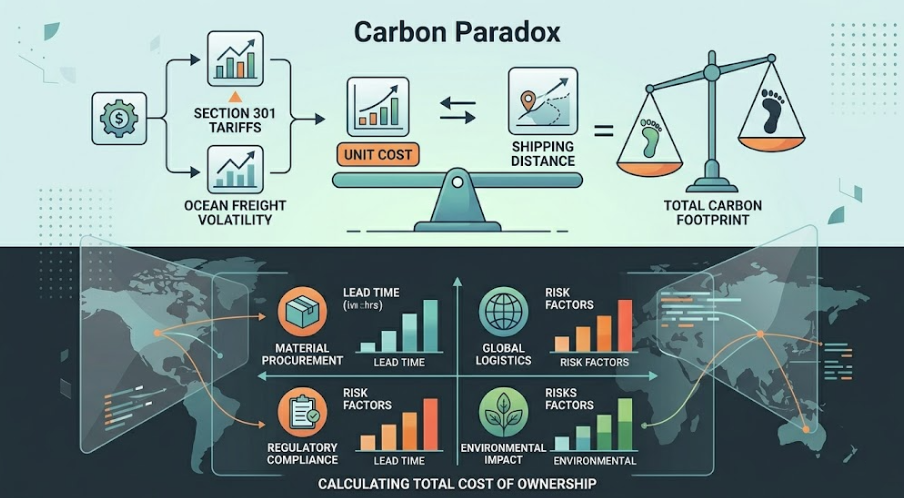
Sourcing from a certified compostable packaging factory for international export involves a complex math problem. A lower unit price from an overseas factory must be weighed against the carbon footprint of shipping “air-filled” cups across the Pacific. To mitigate this, savvy brands are looking at “near-shoring” or selecting suppliers with localized warehousing. This “just-in-time” (JIT) inventory model keeps your cash flow healthy and prevents you from sitting on six months of inventory that might have a printing error you didn’t catch in time.
Final Verification: How to Audit Your Supplier

Before signing a long-term contract or wiring a 30% deposit, you must play the role of a forensic auditor.
-
Check the Database: Don’t trust a “Self-Certified” sticker. Log into the BPI or DIN CERTCO databases and search for the factory’s registration number. If the names don’t match exactly, you are likely dealing with a middleman using a borrowed certificate.
-
Ask for the CMA Letter: In North America, the Compost Manufacturing Alliance (CMA) tests how products perform in real-world facilities. A cup that is “CMA Accepted” is the gold standard for operational compostability.
-
Request a Leak Test: Ask for a 24-hour leak test report specifically for high-fat dairy products. Ice cream contains fats and sugars that can degrade weak PLA linings faster than water does.
Conclusion: Future-Proofing Your Brand
The transition to compostable packaging is no longer a “nice-to-have” option; it is the new baseline for entry into the competitive North American dessert market. Consumers can spot a fake “green” claim from a mile away, and the backlash for “greenwashing” can be fatal for a startup. By partnering with a dedicated plant-based ice cream cup manufacturer for wholesale orders, you are protecting your business from future legislation and building a foundation of radical transparency with your audience.
The goal is to create a “closed-loop” experience: your customer enjoys the dessert, tosses the cup into a green bin, and that cup eventually becomes the soil for the next season’s harvest. Achieving this requires a partner who values chemistry and certification as much as you value your secret recipe.