
In the high-stakes world of modern food logistics, the transition from kitchen to doorstep is a brutal journey for packaging. While many categories have successfully moved toward fiber-based solutions, the delivery of Biryani—a dish defined by extreme heat and high moisture—remains a technical frontier. For global procurement managers and restaurant chains, selecting a vessel is a calculation of thermal physics. This report breaks down why professional operators are increasingly securing their supply chains through a heavy-duty PP Biryani bowl manufacturer to prevent the catastrophic failures common in paper alternatives.
The Thermal Profile of Biryani: A Packaging Stress Test
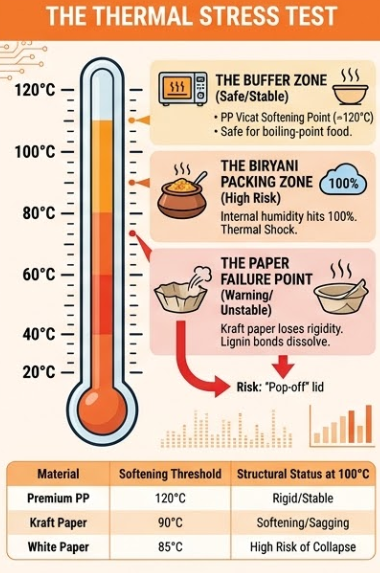
Biryani is a thermal outlier. Unlike standard fast food, it is typically packed at blistering temperatures between 90°C and 110°C. This creates an immediate “thermal shock” inside the container. Within minutes of sealing, the internal relative humidity hits 100%, creating a pressurized greenhouse effect. When a delivery driver stacks multiple orders in a thermal bag, this ambient heat is trapped, attacking the container’s structural integrity from both sides.
For an industrial CPET Biryani container supplier, the engineering challenge is clear: the vessel must endure a 90-minute window of cumulative heat stress without the base buckling. While paper is often marketed for its organic aesthetic, its hydrogen-bonded molecular structure is fundamentally weakened by the very steam that keeps the rice fluffy and aromatic.
Heat Resistance Head-to-Head: The Deformation Threshold
The failure of paper in high-heat scenarios is rooted in its “softening point.” Polypropylene (PP) features a Vicat softening temperature of approximately 120°C, offering a generous safety buffer for boiling-point foodstuffs. In sharp contrast, even premium Kraft paper begins to lose structural rigidity at 90–95°C, while standard white paper can fail as low as 85°C.
This 25°C gap is the “danger zone” where delivery accidents happen. As steam infiltrates the paper fibers, it dissolves the lignin bonds. This is exactly why a custom microwave-safe PP Biryani bowl factory focuses on high-heat polymers; it ensures the bowl stays rigid even if a customer reheats the meal later. The thermal stability of PP maintains the lid-to-rim tension, stopping the “pop-off” effect caused by expanding paper rims.
The 45-Minute Delivery Simulation: Real-World Data
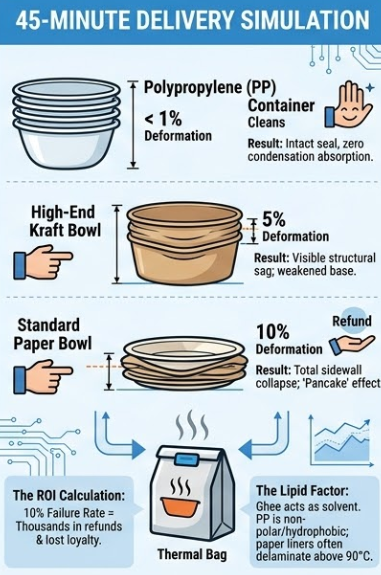
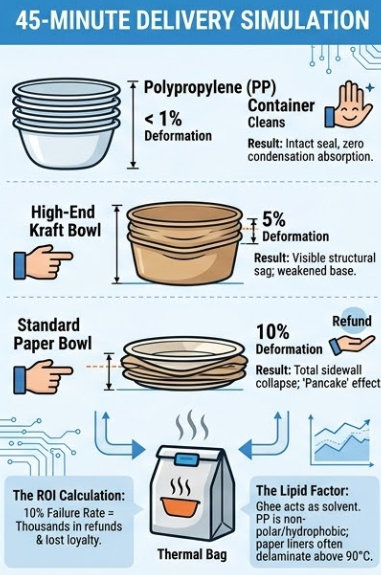
In controlled stress tests, the performance gap is undeniable. During a 45-minute simulation at 85°C, PP containers showed a negligible deformation rate of under 1%. Under identical conditions, high-end Kraft bowls suffered a 5% structural sag, while standard paper options saw a 10% total collapse of the sidewalls.
For a high-volume business, a 10% failure rate translates to thousands of dollars in refunds and lost loyalty. Sourcing from a reliable Sugarcane Bagasse Biryani bowl partner who utilizes advanced PFAS-free oil barriers is an alternative for eco-conscious brands, but for pure thermal resilience, polymers remain the benchmark. When a base softens, the weight of the Biryani forces the bowl to bow outward, breaking the airtight seal.
Leak Resistance and Oil Barrier Performance Under Pressure
Biryani is a lipid-heavy dish, often containing significant amounts of ghee. At high temperatures, these oils act as aggressive solvents. Most paper bowls rely on thin PE or PLA linings for water resistance, but above 90°C, the combination of steam and oil causes these liners to delaminate or develop microscopic pinholes.
Polypropylene is naturally non-polar and hydrophobic. It creates a seamless barrier against oils without needing chemical coatings. A professional PP Biryani bowl exporter provides a vessel that won’t degrade during a 60-minute transit. Furthermore, PP’s wet strength is absolute—it doesn’t absorb condensation—whereas paper can lose 60% of its stacking strength once the fibers become damp.
Mechanical Durability: Stack Strength in Transit
The logistics of delivery apps often require “vertical stacking,” where the bottom container supports the weight of the entire bag. Paper’s burst strength is volatile and drops as humidity rises. Once a delivery bag reaches peak saturation, paper bowls often “pancake,” ruining the food presentation.
This mechanical risk is why procurement teams seek a wholesale CPET Biryani bowl source for catering chains that offers injection-molded designs. Molded PP and CPET allow for reinforced vertical ribs and a structured rim that holds its shape under pressure. This ensures the “unboxing” experience is as professional as the in-restaurant service.
The Environmental Trade-Off: A Pragmatic Assessment
Sustainability is often misunderstood in the packaging sector. While paper seems “greener,” the plastic coatings required for heat resistance often make them unrecyclable, leading them straight to landfills. Conversely, PP is a mono-material and stands as one of the most widely recycled plastics globally.
By partnering with a specialized PP Biryani bowl vendor for global markets, businesses can tap into closed-loop recycling systems. Moreover, the sheer durability of high-heat polymers prevents food waste—a massive environmental footprint that occurs when meals are tossed due to packaging leaks.
How to Choose the Right Delivery Vessel

When auditing your packaging, data should drive the decision. Key specs include a wall thickness of at least 0.6mm, a “snap-fit” lid mechanism, and strategic steam venting. A vented lid prevents the “bloating” effect while maintaining the core temperature.
While the upfront cost of polymers might be slightly higher, the long-term ROI is found in reduced “leaked order” credits. Buying from an affordable PP Biryani bowl supplier for B2B procurement allows for scaling without sacrificing the customer experience. When a brand moves thousands of units daily, the reliability of the bowl is the silent partner of the chef.
Conclusion: Performance is the Ultimate Goal
In the competitive world of food delivery, the container is the final touchpoint. If it arrives soggy or collapsed, the quality of the ingredients no longer matters. The data confirms that for high-heat, oil-rich dishes like Biryani, paper cannot yet compete with the thermal resilience of high-grade Polypropylene or stabilized Sugarcane Bagasse. Choosing the right manufacturing partner ensures your signature dish arrives exactly as intended—hot, intact, and premium.