
Let’s be brutally honest: chasing that “perfect” home brew often feels like an expensive, high-stakes gamble. You drop forty bucks on a bag of single-origin beans, mimic some fancy circular pour you saw on TikTok, and yet—the result is a thin, disappointing mess that tastes more like wet paper than the “stone fruit and jasmine” promised on the label. By 2026, we’ve finally moved past the “voodoo” of coffee making. It’s no longer about luck or having an expensive mustache; it’s about raw physics. Whether you’re a kitchen-counter enthusiast or a food-grade plastic coffee cup factory in China trying to stress-test how your containers handle the relentless thermal shock of a daily caffeine habit, mastering extraction is the only way to stop flushing money down the drain.
Why Your Morning Cup Tastes Like Battery Acid
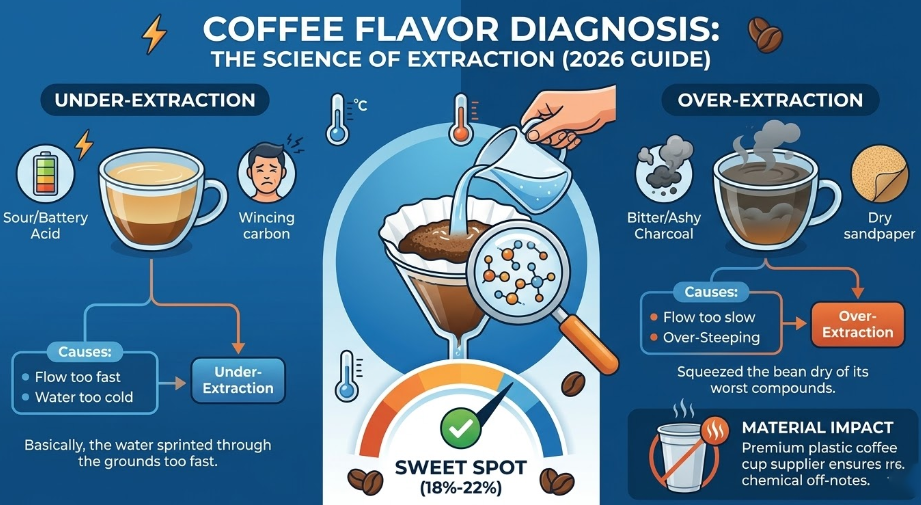
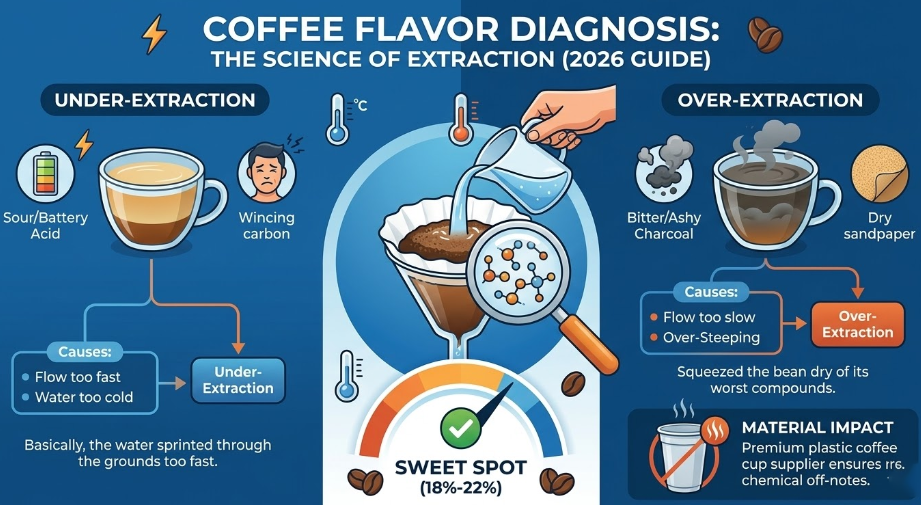
If your coffee tastes sharp enough to make you wince, you’re likely dealing with under-extraction. Basically, the water sprinted through the grounds too fast to grab any sweetness. On the flip side, if it tastes like ashy charcoal or leaves that weird, dry “sandpaper” feeling on your tongue, you’ve over-extracted it. You’ve squeezed the bean dry of its worst, most bitter compounds. The “sweet spot” in 2026 remains a precise 18% to 22% window—that narrow territory where acids, sugars, and bitters find their balance.
But here’s the kicker: the vessel matters as much as the bean. If you’re sourcing for a large-scale operation, choosing a premium plastic coffee cup supplier for office use is a strategic move for flavor, not just the balance sheet. Cheap, “no-name” plastics have a nasty habit of leaching chemical odors when they hit that critical 200°F threshold. These micro-odors act like a cloaking device, slaughtering the delicate floral notes of a light roast before you even take a sip. If your cup smells like a chemical plant, those $90 Geisha beans never stood a chance.
The “No-BS” Foundations: Weight, Heat, and Timing
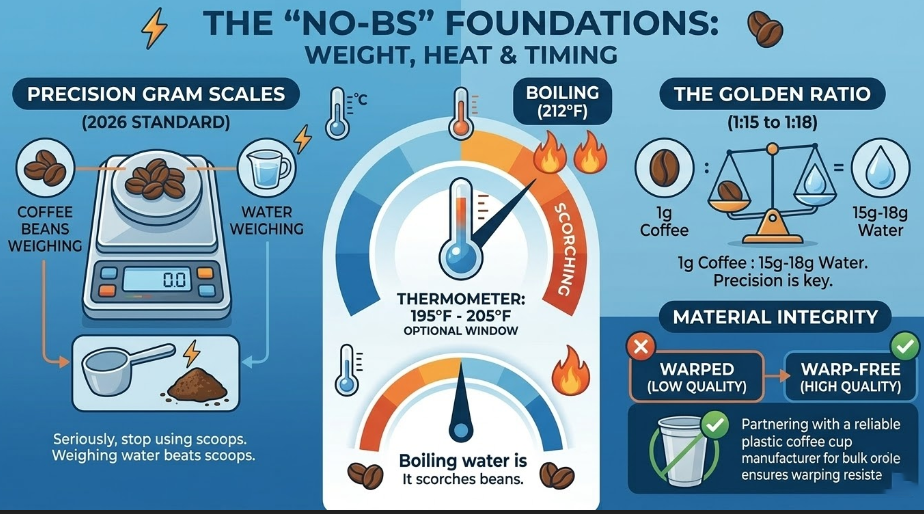
Seriously, stop using scoops. If you’re still using a plastic spoon to measure your coffee in 2026, you aren’t brewing; you’re just guessing. Coffee density is all over the place—a scoop of dark roast weighs way less than a scoop of light roast because the beans are more porous. The “Golden Ratio” is 1:15 to 1:18. That’s 1 gram of coffee for every 15 to 18 grams of water. It sounds nerdy, but this one change kills 90% of your brewing inconsistency. When you weigh your water, you create a repeatable map to a great cup.
Then there’s the temperature. Boiling water is the enemy. If you pour 212°F water directly onto your grounds, you’re scorching the soul out of them. Aim for the 195°F to 205°F range. If your kettle doesn’t have a screen, just count to thirty after it clicks off. Also, don’t ignore the water itself—if your tap water tastes like a public swimming pool, your coffee will too. For those in the high-volume hospitality game, partnering with a reliable plastic coffee cup manufacturer for bulk orders ensures your cups can handle these high-precision temperatures without warping or losing heat so fast that the coffee turns sour before the first sip.
Picking the Right Bean Without Getting Scammed
Stop looking at “Best By” dates. They are a marketing lie designed to keep stale coffee on grocery shelves for months. You want the “Roast Date.” Coffee hits its flavor peak between day 7 and day 21. If the bag is older than a month, it’s basically a “zombie bean”—dead inside and devoid of the aromatic oils that actually make coffee worth drinking.
You also need to match the roast to your gear. Light roasts thrive in a V60; they need that fast, clean flow. Dark roasts are built for the heavy-hitting immersion of a French Press. If you are a custom plastic coffee cup mold designer, you know that ergonomics and airflow are everything—roast aromatics need a well-designed lid vent to actually reach the user’s nose. If the lid is poorly designed, the olfactory experience is half-dead, no matter how good the brew was.
The Ritual: Pour-Overs, Pressing, and Pressure
The pour-over is the ultimate test of patience. The “bloom” is where the chemistry happens. Pour just enough water to wet the grounds, then wait 45 seconds. You’ll see it bubble and swell—that’s the CO2 leaving the building. If you don’t let that gas out, it acts as a physical barrier, blocking the water from reaching the flavor compounds. It’s like trying to wash a car through a plastic sheet.
If you want a cup that feels “heavy” and rich, go for the French Press. Just remember the “No-Press” secret: after four minutes, don’t just mash the plunger down. Stir the top crust, let the silt sink for another five minutes, then plunge only halfway. It’s the difference between a cup of muddy sludge and a velvety brew. For the grab-and-go crowd, a durable plastic coffee cup factory for commercial use often designs their rims to fit these manual drippers perfectly, making the “brew-to-go” workflow a breeze for busy mornings.
AeroPress and the Cold Brew Revolution

The AeroPress is basically the 2026 survivalist’s tool for the office. It’s virtually indestructible, fits in a backpack, and works in under two minutes. It uses air pressure to force water through a fine puck, giving you an espresso-adjacent concentrate. It’s the perfect match for an eco-friendly plastic coffee cup supplier for retail brands, as both focus on being lightweight, durable, and suited for a mobile lifestyle.
Meanwhile, Cold Brew is the “set it and forget it” king. 12 to 24 hours of cold steeping yields a chocolatey, low-acid syrup. But watch out for the dilution trap. When you’re serving cold brew over ice, you need a vessel with serious thermal integrity. High-volume event planners usually hunt for a wholesale plastic coffee cup manufacturer for events that offers double-walled insulation. You want the coffee cold and the ice solid, not a watery, lukewarm mess ten minutes into a party.
Troubleshooting: The “Fix It” Matrix
Is your coffee tasting sour? Your grind is too chunky. Go finer. Is your coffee tasting bitter or harsh? You’re likely grinding too fine or brewing too long. It’s a simple set of levers: adjust one variable at a time until the flavors click into place.
Consistency is the boring, unglamorous secret to great coffee. If you switch beans, you have to “dial in” again because every bean has a different density. For the pros, like a high-quality plastic coffee cup producer for global distributors, that same obsession with consistency ensures the user’s experience isn’t ruined by a leaky lid seal or an unstable base.
Closing the Loop
At the end of the day, brewing at home in 2026 is about reclaiming your morning. It’s a five-minute window where you aren’t checking emails or scrolling through some doom-feed—you’re just managing heat, water, and beans. It’s tactile, it’s sensory, and it rewards precision. Master these basics, and you’ll never feel the need to stand in a ten-person line for a mediocre, overpriced latte again. You have the tools, you have the science, and now you have the guide.