
If you’ve ever looked at a truly good sandwich tray, you’ll notice something immediately: it doesn’t feel random. It looks full without being messy, structured without being stiff, and appetizing before you even pick anything up. That balance doesn’t happen by accident.
In real kitchens—whether it’s a small café, a catering prep room, or a large-scale food operation—sandwich trays are assembled with a mix of habit, efficiency, and small visual tricks that make a big difference. And interestingly, a lot of that result also depends on the tray itself, especially when businesses are sourcing from a custom sandwich tray OEM partner or coordinating with a sandwich tray supplier for catering distribution channels.
Start With a Clear Use Scenario
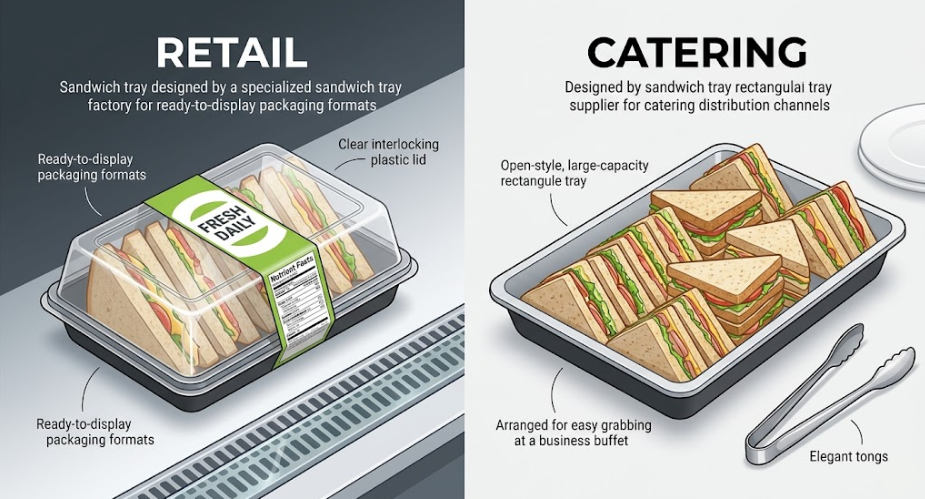
One of the most common mistakes is treating every sandwich tray the same. In reality, the tray you’d prepare for a convenience store shelf is completely different from one meant for a business meeting or an event buffet.
Retail trays usually need to look neat from above, often sealed with a transparent lid. Catering trays, on the other hand, need to be easy to grab from and refill quickly. That difference alone changes how you place every sandwich.
This is why many food businesses work closely with a sandwich tray factory for ready-to-display packaging formats, adjusting layout depth and spacing depending on how the tray will actually be used.
Don’t Overcomplicate the Sandwich Selection
There’s a temptation to include everything—five breads, ten fillings, multiple spreads. But in practice, simpler combinations often look better and sell better.
A good tray usually sticks to three or four types. Enough to create variation, but not so much that it feels chaotic. You want contrast—maybe something creamy, something fresh, something savory—but still a sense of order.
From an operational standpoint, this also makes assembly faster. Teams using trays from a standardized sandwich tray manufacturer for quick-service operations often rely on repeatable combinations because consistency matters more than novelty at scale.
Cutting Matters More Than People Expect

You can use great ingredients and still end up with a tray that looks average. The reason is often the cut.
Triangle cuts tend to look more dynamic because the layers are visible. Finger sandwiches feel cleaner and more compact. Straight halves are practical but less visually interesting.
What really matters is consistency. If one piece is thick and another is thin, the whole tray starts to look off. That’s why some operations align their prep process with trays sourced from a precision sandwich tray supplier for portion-aligned presentation, so every piece sits correctly without forcing it into place.
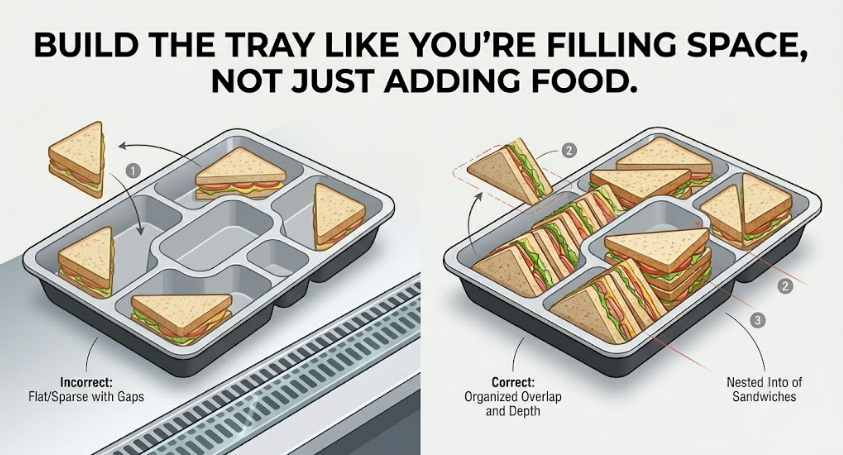
Build the Tray Like You’re Filling Space, Not Just Adding Food

Instead of thinking “place sandwich, place another,” it helps to think in terms of space. You’re filling an area, not just adding items.
A common approach is to start from the outside and work inward, or vice versa, but always with slight overlap. That overlap creates depth, which is what makes a tray feel full and inviting.
If everything is laid flat with gaps in between, the tray looks unfinished—even if the quantity is the same.
Trays designed by a multi-compartment sandwich tray factory for organized food layout systems can make this easier, especially when you’re dealing with multiple sandwich types in one tray.
Use Color Without Overdoing It
Color is one of those details people notice subconsciously. White bread next to whole grain, green lettuce next to a darker filling—it all helps the tray look more alive.
But too much contrast can backfire. If every sandwich looks completely different, the tray starts to feel disjointed.
A simple trick is grouping similar types together while still alternating lightly across the tray. It keeps things balanced without becoming repetitive.
Some businesses even test layouts when working with a visual-optimized sandwich tray OEM manufacturer for retail presentation design, especially for high-visibility display products.
The Tray Itself Is Doing More Work Than You Think
It’s easy to focus only on the food, but the tray plays a big role in the final result.
A flimsy tray makes everything feel lower quality, no matter how good the sandwiches are. A well-structured tray keeps spacing intact and prevents shifting during transport.
Material also affects perception. Clear plastic highlights freshness, while fiber trays suggest sustainability. Each sends a different message.
That’s why many brands now source from a sustainable sandwich tray supplier for eco-friendly packaging solutions, especially when environmental positioning is part of their identity.
Make It Easy to Handle and Serve
A tray might look perfect in the kitchen but fail the moment someone tries to pick from it.
If pieces are too tightly packed, they’re hard to grab. If they’re too loose, they slide around. The goal is that middle ground where each sandwich can be taken without disturbing the rest.
This becomes even more important in delivery or large events. Companies relying on a durable sandwich tray manufacturer for high-volume logistics environments tend to prioritize lid fit, tray rigidity, and stacking stability just as much as appearance.
Keep Portion Control Practical, Not Perfect
In theory, every sandwich should be identical. In reality, small variations happen—and that’s fine.
What matters is that the tray as a whole feels balanced. No obvious gaps, no overcrowded sections.
Using trays designed with capacity in mind helps guide this naturally. Businesses sourcing from a cost-efficient sandwich tray factory for bulk food preparation workflows often find that the tray itself reduces guesswork during assembly.
Small Details That Make a Big Difference
Sometimes it’s the smallest adjustments that elevate the tray. Slightly angling sandwiches instead of laying them flat. Wiping edges clean before closing the lid. Making sure fillings are visible but not spilling out.
Even the way the lid closes matters. A tight, clear lid can make the tray look more premium instantly.
For brands, this often connects to packaging strategy. Working with a private label sandwich tray OEM supplier for branded presentation solutions allows them to align the tray design with their overall image.
Why Good Sandwich Trays Feel Effortless
The interesting thing about a well-made sandwich tray is that it doesn’t look complicated. It feels natural, almost obvious. But behind that simplicity is a series of small, deliberate choices.
From selecting a few balanced sandwich types, to cutting them consistently, to arranging them with just enough overlap—every step contributes to the final look.
And in a business context, those steps are often supported by the right packaging partner, whether it’s a flexible sandwich tray manufacturer for customized foodservice applications or a supplier focused on efficiency and scale.
At the end of the day, a sandwich tray isn’t just about holding food. It’s about presenting it in a way that feels complete, convenient, and worth picking up.