
In the high-stakes world of the casual dining and quick-service restaurant (QSR) industry, the battle for customer loyalty is often won or lost before the first bite is even taken. For a dish as culturally significant and “ceremonial” as biryani, value perception is inextricably linked to the visual promise of abundance. This phenomenon, often referred to as the “Overflow Illusion,” is not merely a plating trick; it is a sophisticated interplay of cognitive science, container geometry, and consumer psychology. For restaurant operators, understanding how bowl depth dictates perceived portion size is the key to balancing food cost with high satisfaction scores.
The Cognitive Bias: Why Our Eyes Deceive Us in the Presence of Grains
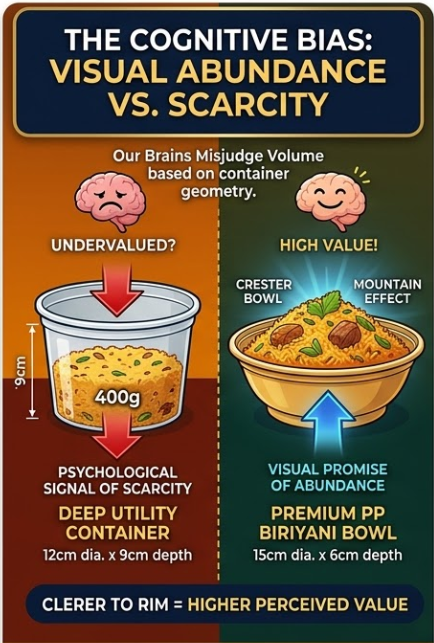
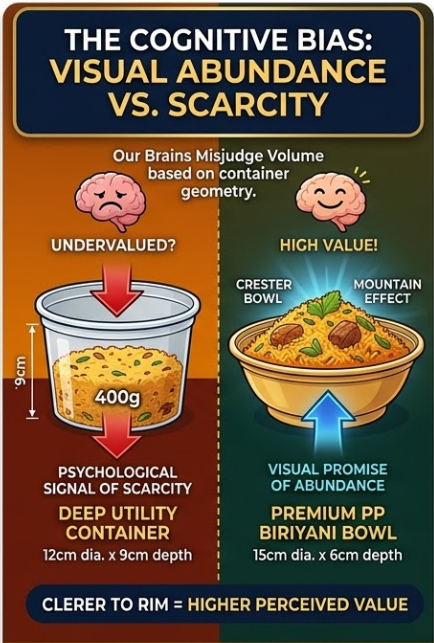
Humans are notoriously poor at estimating volume, especially when dealing with granular textures like Basmati rice. This stems from a well-documented cognitive bias known as the Vertical-Horizontal Illusion, where the brain systematically misjudges depth versus width. When a portion of biryani is served in a deep container, the rice often “sinks” toward the bottom, leaving a large gap between the food and the rim. This gap acts as a psychological signal of scarcity, triggering a subconscious feeling of being undervalued.
To combat this, leading brands often partner with a premium PP plastic biryani bowl manufacturer for bulk orders to develop vessels that prioritize surface area over verticality. By increasing the diameter and slightly reducing the depth, the rice is forced to spread across a wider plane, creating a “mountain effect” that suggests a more generous portion. In the mind of the customer, a bowl that looks full to the brim is worth a higher price point than a larger, deeper vessel that appears only two-thirds full. It’s a simple shift: the container’s rim serves as the frame of reference, and the closer the food gets to that frame, the higher the perceived value.
Bowl Geometry 101: The Mathematical Reality of Perceived Volume
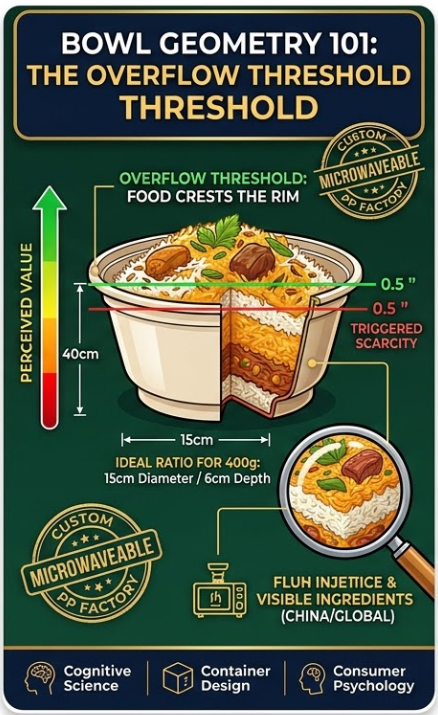
Transitioning from a standard utility container to a strategic serving vessel requires a deep dive into dimension ratios. In the B2B food packaging sector, the most effective designs for rice-based dishes follow a specific diameter-to-depth ratio that maximizes visibility. For a standard 400g portion, a bowl with a 15cm diameter and 6cm depth creates a vastly different emotional response than one with a 12cm diameter and 9cm depth. The former allows the birista (fried onions), saffron streaks, and protein chunks to sit prominently on the surface, while the latter “swallows” the most expensive ingredients.
When a restaurant works with a custom microwaveable plastic biryani bowl factory for restaurant chains, they can specify these precise dimensions to ensure consistency. The goal is to reach what we call the “Overflow Threshold”—the exact point where the food crests the rim without causing operational spillage. This specific engineering of the vessel ensures that the customer perceives “generosity” the moment the lid is removed. If the biryani sits even half an inch below the rim, the consumer focuses on the “missing” part of the meal rather than the portion they actually received.
The Biryani-Specific Value Equation: A Dish of High Expectations
Biryani is not just a meal; it is an indulgence. Unlike a simple curry or stir-fry, it carries a “ceremonial” mental weight. Customers expect layers, textures, and a sense of bounty. This makes the dish uniquely vulnerable to portion perception bias. When biryani is packed into a deep, narrow plastic tub, the weight of the rice often compresses the lower layers, resulting in a dense, unappealing look that masks the fluffiness of the grains.
To maintain the integrity of the dish’s visual “fluff,” savvy operators often seek a reliable bulk injection-molded plastic biryani bowl supplier in China or other manufacturing hubs to source high-grade, wide-base bowls. These containers allow the long-grain rice to breathe and retain its layered structure. Moreover, the color of the interior matters; a light-colored or white interior reflects light back onto the rice, amplifying the visual volume, whereas a dark interior absorbs light and makes the portion look “tucked away” and smaller than it truly is.
The Cloud Kitchen Challenge: Maintaining the Illusion During Delivery
In the modern era, the “Overflow Illusion” faces its toughest test during the last-mile delivery. In a dine-in setting, a chef can hand-garnish a bowl to perfection. However, in a cloud kitchen, the steam from the hot rice, the pressure of the lid, and the vibration of a delivery bike often cause the biryani to settle and collapse. By the time the customer opens the package, the “overflow” has vanished.
To solve this, many high-growth Indian food brands are moving away from traditional deep tubs and toward food-grade MFPP plastic biryani bowl manufacturers for eco-friendly brands. These manufacturers are creating reinforced, wider-based mineral-filled bowls with slightly domed lids. The dome provides a “buffer zone” for the rice to sit high without being crushed by the lid, while the wide base ensures that the shaking during transit doesn’t cause the food to migrate to one side. This structural integrity is crucial for maintaining the brand’s promise of a “hearty meal” in the eyes of the consumer.
When the Illusion Backfires: The Deep Bowl Trap
While maximizing perceived volume is a goal, there is a fine line between strategic plating and perceived deception. The “Deep Bowl Trap” occurs when a restaurant uses a massive container but fills it only halfway. This activates “loss aversion”—a psychological trigger where the pain of feeling cheated outweighs the pleasure of the meal itself. A customer who sees a half-empty deep bowl will immediately focus on the “empty space,” leading to negative reviews that claim the restaurant is “skimping on portions.”
This is why many brands are now investing in a professional ODM stackable plastic biryani bowl factory for QSR brands to create “stepped” or “tapered” bowl designs. These vessels have a narrower base but a significantly wider top. This design uses less material and holds the same volume as a standard bowl, but it forces the food to rise toward the top, creating an honest yet optimized visual presentation. It’s about aligning the physical reality with the psychological expectation.
The ROI of Visual Abundance: Metrics for Operators

Does changing a bowl really affect the bottom line? The data says yes. Restaurants that have transitioned to optimized, wide-rimmed bowls often see a measurable increase in their Net Promoter Score (NPS) and a higher frequency of social media mentions. In the age of Instagram and Zomato, the “unboxing” experience is the primary marketing tool for cloud kitchens. A biryani that looks like it’s spilling over with meat and aromatics is far more likely to be photographed and shared than one hidden at the bottom of a plastic bucket.
For a brand looking to scale, collaborating with an export-oriented heat-resistant plastic biryani bowl supplier for global distributors ensures that they can maintain this visual standard across international borders. The return on investment is found in the reduction of “portion-related” complaints and the ability to justify a 5% to 10% price premium based on perceived value alone. When the customer feels they are getting “more than they paid for” due to the overflow effect, their loyalty is secured.
Practical Framework for Bowl Selection
Choosing the right vessel is a science that requires mapping portion weight to specific bowl specs. For a 500g “Jumbo” portion, a 170mm diameter bowl with a 55mm depth is often the sweet spot. Anything deeper will hide the meat; anything shallower risks spillage. Additionally, the material choice—be it high-clarity PP or textured matte plastic—should complement the brand’s identity while supporting the “fullness” narrative.
If you are an operations manager or a procurement lead, your next step should be to audit your current vessel’s “fill line.” If your biryani sits more than 1.5cm below the rim, you are losing perceived value every time an order leaves the kitchen. Engaging a dedicated recycled plastic biryani bowl factory for high-volume takeaway to sample wider, shallower formats could be the most cost-effective marketing move you make this year. By engineering the “overflow,” you aren’t just selling rice and meat; you are selling the feeling of abundance.