
In the current global landscape of plastic bans and heightened environmental awareness, transitioning to sustainable packaging is no longer a luxury—it is a strategic necessity for survival. However, for many procurement managers and coffee shop owners, this shift often comes with significant “green anxiety” regarding ballooning costs. You may have noticed that since deciding to swap traditional plastics for eco-friendly alternatives, your packaging budget has surged by 20% or more. Much of this overpayment stems from information asymmetry in the supply chain and a fundamental misunderstanding of material performance. To help your business balance ecological responsibility with bottom-line profitability, this guide deconstructs how to stop overpaying and secure the most cost-effective solutions.
Identifying Price Water and Marketing Markups in Green Packaging
When you first receive a quote from an eco-friendly compostable cup supplier in China, the figures can be jarring. Why does one compostable cup cost double another despite looking identical? First, it is essential to break the myth that “green” must mean “expensive.” A significant portion of the markup often pays for redundant international certifications. While certifications like BPI or OK Compost are vital for entering specific markets, if a vendor uses these purely as a justification for extreme premiums, you are likely paying for their marketing overhead rather than product value. The core of your cost analysis should always return to the raw material—whether it is Polylactic Acid (PLA), aqueous coatings, or bagasse.
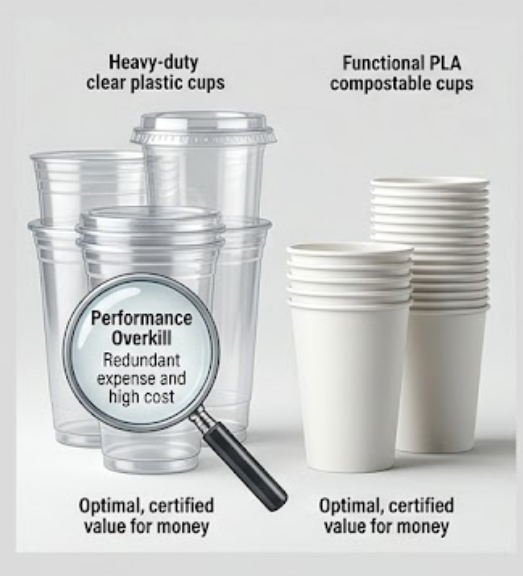
Another common pitfall is “performance overkill.” Many buyers, driven by a desire for a premium eco-friendly image, insist on ultra-thick, fully transparent cups. However, if your business model relies heavily on rapid-delivery takeout where the cup is discarded within thirty minutes, paying for heavy-duty structural integrity is an unnecessary drain on resources. By identifying a professional PLA compostable cup factory for global distributors, you can request samples of varying weights and thicknesses to find the “sweet spot” where the cup is functional but not over-engineered.
Material Selection Based on Real-World Usage Scenarios

The secret to avoiding the green premium lies in scenario-based procurement. If you run a high-end specialty coffee roastery where visual clarity and the sound of ice clinking against the rim are part of the customer experience, high-transparency PLA is your best bet. In this instance, you should negotiate with a customized compostable cup manufacturer to ensure that the clarity and structural rigidity align with your brand positioning. While PLA carries a higher unit price, its aesthetic value can justify a slightly higher menu price, effectively neutralizing the cost increase.
Conversely, if your volume is driven by fast-food delivery or corporate catering, “cost-per-unit” and “operational stability” are your primary KPIs. In these high-frequency scenarios, sugarcane bagasse or aqueous-coated paper cups are far more efficient. Specifically, new aqueous coating technologies eliminate the need for traditional plastic linings while remaining more price-competitive than full PLA options. For a savvy buyer, the goal here is to secure a water-based coating compostable cup vendor for franchise brands who can provide aggressive tiered pricing for high-volume, recurring orders.
Optimizing the Supply Chain and Hidden Logistic Costs

Many decision-makers focus solely on the FOB price while ignoring the impact of logistics and warehousing on the final Landed Cost. Sustainable cups, particularly molded fiber products, are often bulkier than traditional plastic and require specific climate-controlled storage to prevent degradation. Ordering from a factory deep inland might result in inland trucking fees that wipe out any savings gained on the unit price. Therefore, prioritizing an export-oriented compostable cup supplier for bulk orders located near major shipping hubs is a critical move for controlling hidden expenses.
Furthermore, Minimum Order Quantities (MOQs) act as a significant barrier. Large-scale factories often demand high MOQs to unlock their lowest rates, which can trap growing brands in a cycle of high storage costs and potential inventory spoilage. A smarter strategy involves finding an OEM compostable cup factory for small businesses that offers a “modular” approach—using generic unprinted cups combined with custom-printed sleeves or stickers. This allows you to benefit from the bulk pricing of generic stock while maintaining a branded look with minimal financial exposure.
Avoiding Post-Purchase Loss Through Rigorous Testing
Finalizing a supply contract based solely on a digital catalog is a recipe for operational disaster. Sustainable materials are inherently more sensitive to environmental variables. For example, PLA cups can soften or warp if stored in a warehouse that exceeds 40°C during summer months. A reliable plastic-free compostable cup manufacturer for food service providers will be transparent about these thermal limits and provide specific storage guidelines to protect your investment.
Before signing a long-term deal, conduct a “72-hour stress test.” Fill the cups with beverages of varying temperatures and acidity levels, then monitor for leakage, lid-fit degradation, or unusual odors. These small details directly correlate to your customer retention rates. Only a wholesale compostable cup factory that passes these real-world environmental tests is worthy of your long-term capital.
Building a Long-Term Strategic Procurement Mechanism
The final step in ending the cycle of overpayment is establishing a dynamic price-monitoring system. The market for bio-based materials is closely tied to the commodities market, such as corn and timber. We recommend maintaining an open dialogue with an industrial compostable cup manufacturer for long-term partnerships regarding their raw material stockpile. Locking in prices when raw material costs are low, or signing annual volume commitments, typically provides a price buffer of 5-8% compared to spot-buying.
Ultimately, finding the right cup solution is not about compromising on quality; it is about finding the intersection between your specific needs, the material’s properties, and the supplier’s logistical strengths. By stripping away unnecessary marketing fluff and focusing on functional fit, you protect both the planet and your profit margins. Do not let “sustainability” become a financial burden—let the right supplier become the engine of your brand’s growth.