

Egg packaging decisions are rarely made in conference rooms. They are made after pallets arrive damaged, after moisture ruins an entire batch in storage, or after an overseas buyer asks for proof of recycled content that a supplier cannot provide. In those moments, packaging stops being a background detail and becomes a bottleneck. Recycled plastic egg trays enter the conversation not as a marketing upgrade, but as a response to very specific operational failures.
Unlike molded pulp trays, which have dominated egg packaging for decades, rPET trays sit at the intersection of logistics performance, regulatory pressure, and environmental accountability. Their value cannot be understood by material descriptions alone. It has to be evaluated through how eggs actually move, sit, stack, and survive across real supply chains.
Understanding What rPET Egg Trays Actually Are

In commercial use, recycled plastic egg trays are almost always produced from recycled polyethylene terephthalate. This recycled content can come from two main sources. Post-industrial material is recovered from manufacturing waste before it reaches consumers. Post-consumer material is collected after products such as bottles have been used and discarded.
These two sources behave very differently in production. Post-industrial recycled PET is relatively consistent, clean, and predictable. Post-consumer PET carries stronger environmental value, but introduces variation in viscosity, color, and contamination risk. Because egg trays must meet strict dimensional and food-contact standards, most manufacturers rely on controlled blends rather than pure recycled content.
This blending is not a shortcut. It is a stabilization strategy. Egg trays must stack uniformly, hold shape under load, and protect fragile contents under vibration. Pure recycled material can meet these requirements in small batches, but consistency becomes harder to maintain at industrial scale without virgin input.
From a manufacturing perspective, rPET trays are formed using standard thermoforming processes. The complexity happens earlier, during sorting, washing, decontamination, and testing of recycled feedstock. These steps do not change the appearance of the tray, but they determine whether it can legally and safely contact food.
Environmental Impact Beyond Simple Material Labels
Comparisons between rPET, molded pulp, and virgin plastic trays are often reduced to slogans. Pulp is biodegradable. Plastic is persistent. Recycled plastic is circular. None of these statements fully describe what happens after trays leave the packing line.
rPET trays generally have a lower carbon footprint than virgin plastic trays because recycled polymer avoids energy-intensive raw material production. Most of the emissions savings occur upstream, before trays are ever formed.
Molded pulp trays are often assumed to be environmentally superior, but their impact depends heavily on disposal conditions. In composting systems, pulp can break down efficiently. In landfills, where oxygen is limited, decomposition can generate methane, which has a much higher warming effect than carbon dioxide. Whether this becomes a problem depends entirely on local waste management practices.
Transport efficiency further complicates the picture. Plastic trays are lighter and stack more densely than pulp trays. Over long distances, this reduces the number of truckloads required to move the same number of eggs. In export-oriented operations, transport-related emissions can outweigh differences in material production.
Recyclability also depends on systems rather than theory. rPET trays can enter existing PET recycling streams in many regions, but only if contamination is controlled. Pulp trays are recyclable in principle, yet moisture damage and residue often lead to rejection in practice.
Performance Under Real Transport Conditions
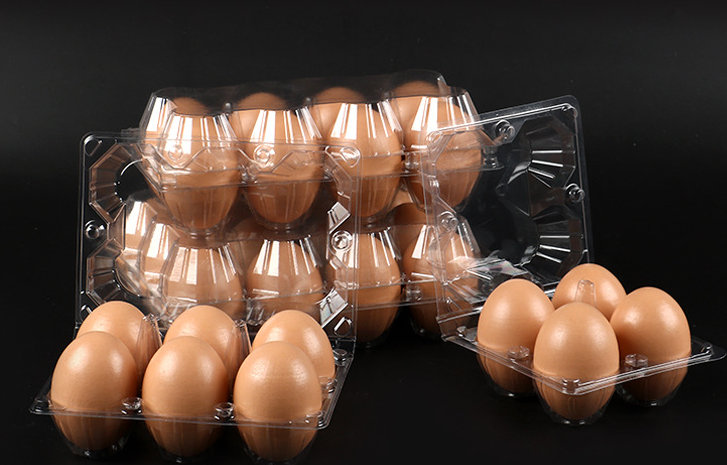
Egg breakage rarely results from dramatic impacts. Most losses occur gradually through vibration, stacking pressure, and repeated handling. rPET trays approach protection differently from pulp trays.
Pulp trays rely on fiber compression to absorb shock. This works well initially, particularly in short transport routes. Once fibers deform, however, structural strength declines. Protection decreases with each handling step, even if the tray still appears intact.
rPET trays rely on rigidity and dimensional control. Their cell structure limits egg movement, reducing repeated micro-impacts during vibration. This becomes more important as transport distance increases and handling events multiply.
Humidity resistance is another differentiator. rPET trays maintain shape and strength in conditions that soften pulp trays. In automated systems, this stability reduces jams, misfeeds, and alignment errors long before visible damage occurs.
Transparency is often mentioned as an advantage, but its operational value depends on context. In retail packaging, visibility can influence consumer trust. In bulk logistics, it has little impact on performance.
Cost Considerations That Go Beyond Unit Price
At face value, rPET trays are rarely the cheapest option. Molded pulp trays usually offer the lowest unit cost, particularly for short runs. Virgin plastic trays fluctuate with resin markets and often sit at the higher end.
However, focusing only on unit price ignores where real costs accumulate. Breakage, repacking, rejected shipments, and additional labor all carry financial weight. In long-distance or multi-stage supply chains, these indirect costs can exceed the price difference between tray materials.
rPET trays can reduce total cost per egg by lowering breakage rates and improving stacking efficiency. For medium and large producers supplying distant markets, these savings often offset higher purchase prices.
That said, rPET trays are not universally economical. In short, local supply chains with minimal handling, performance gains may not justify the additional cost. Without reuse or extended transport exposure, rPET behaves like a premium disposable.
Durability and the Reality of Reuse

Durability is frequently cited as a benefit of rPET trays, but durability only creates value when reuse is intentional. A tray discarded after one cycle does not recover its higher upfront cost.
Pulp trays are designed for single use. Limited reuse is possible in dry environments, but performance declines unevenly. Once moisture is absorbed, strength drops rapidly and contamination risk increases.
rPET trays degrade more gradually. Their performance remains predictable across handling cycles, allowing limited reuse in controlled systems. Some large operations take advantage of this, but reuse introduces new requirements: cleaning, inspection, tracking, and return logistics.
Without infrastructure to manage these steps, durability remains an unused attribute.
End-of-Life Outcomes in Practice
What happens to rPET trays after use depends largely on regional recycling infrastructure. In markets with strong PET collection systems, trays can be recycled effectively. In regions without those systems, they may still be treated as general waste.
Design choices matter. Mixed materials, incompatible inks, or added components reduce recycling efficiency. Small design decisions can determine whether a tray is recovered or discarded.
Closed-loop systems, where used trays are collected and remanufactured into new trays, exist but require coordination across the supply chain. They are most viable for large, centralized operations with predictable return flows.
Regulatory and Food Safety Realities
Food-contact regulations strongly influence how rPET trays are produced and sold. Recycled materials are permitted, but only under strict controls. Material sourcing, decontamination processes, and migration testing must meet regulatory standards.
For buyers, the main concern is documentation rather than regulation itself. Without traceable material statements and third-party test reports, rPET trays introduce compliance risk.
As a result, supplier capability often matters more than material choice. A poorly documented rPET tray can be more problematic than a conventional alternative.
When rPET Trays Are the Right Choice
rPET egg trays perform best in operations exposed to long transport routes, high humidity, or automation-heavy handling. They align well with buyers who must document recycled content as part of sustainability commitments.
They are less suitable in short, local supply chains with established composting systems and extreme cost sensitivity. In those cases, molded pulp trays often remain the practical solution.
As recycled material quality improves and regulatory pressure increases, rPET trays are likely to become more common. Their adoption, however, will continue to be driven by operational fit rather than environmental messaging alone.