
In the high-stakes B2B food supply chain, the sandwich tray is far more than a simple carrier. It is a functional component that dictates stackability, moisture retention, and the ultimate landed cost of the product. For procurement officers, the choice between synthetic polymers and molded fibers involves a complex calculation of mechanical limits and logistics overhead. Identifying a reliable PET sandwich tray manufacturer is no longer just about sourcing; it is about finding a technical partner who understands the difference between a 24-hour shelf-life and a 5-day distribution cycle.
Mechanical Integrity: Stacking Loads and Transit Stress

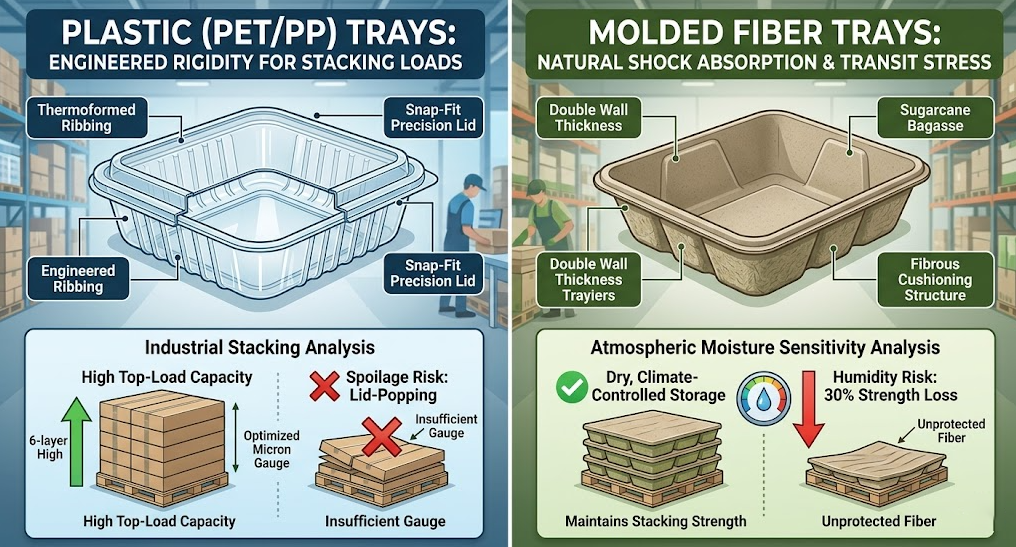
In any industrial warehouse, the “top-load” capacity of a tray is the most critical metric. Plastic trays, typically thermoformed from PET or PP, utilize engineered ribbing to achieve high structural rigidity. This allows for aggressive pallet stacking—often five to six layers deep—without the bottom units collapsing. When dealing with an anti-fog plastic sandwich tray factory, technical buyers focus heavily on the “micron gauge” of the plastic. A thinner gauge saves money on the invoice but often leads to high spoilage rates during long-haul trucking due to lid-popping and tray deformation.
Molded fiber trays, derived from sugarcane bagasse or wheat straw, operate on a different physics principle. While they lack the elastic “snap-fit” precision of plastic, their wall thickness is usually double that of synthetic alternatives. This thickness acts as a natural shock absorber during transit. However, fiber is susceptible to atmospheric moisture. If your storage facility isn’t climate-controlled, you must ensure your sugarcane fiber sandwich tray supplier uses reinforced master cartons. Without this protection, fiber trays can absorb ambient humidity, losing up to 30% of their stacking strength before they even reach the assembly line.
Thermal Dynamics: Condensation and Bread Integrity
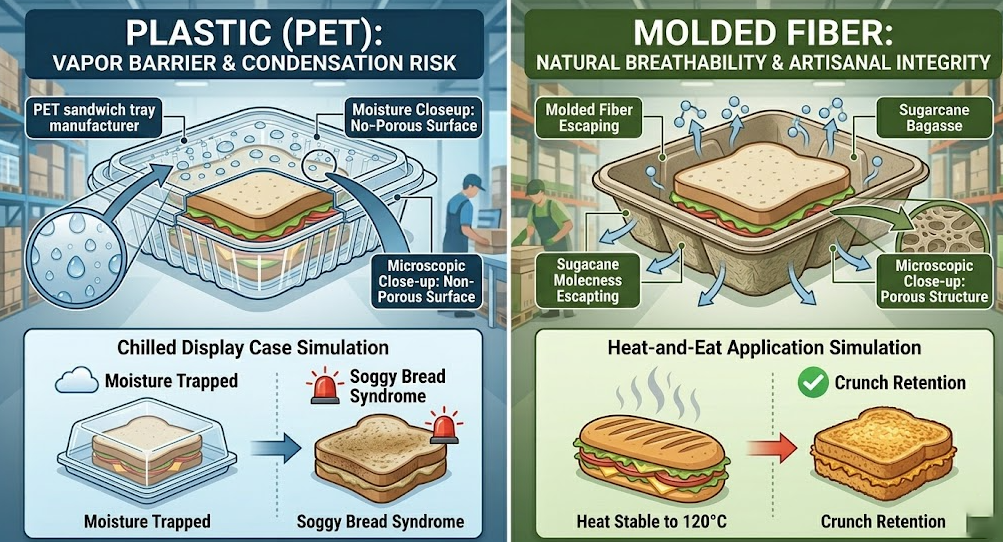
The “soggy bread” syndrome is the primary cause of sandwich waste in the retail sector. Plastic is a non-porous vapor barrier. While this is excellent for keeping external contaminants out, it is disastrous for warm-packed food. In a chilled display, the temperature differential creates condensation on the interior walls of a PET tray. This moisture has nowhere to go but into the bread crust. To mitigate this, high-volume operators often consult a clear PET sandwich tray wholesaler to design specific venting channels that allow moisture to escape without compromising the seal.
Fiber is naturally breathable. Its microscopic porous structure allows a controlled rate of gas exchange, which prevents steam from turning into liquid water. This makes fiber the undisputed champion for “heat-and-eat” products like toasted subs or breakfast paninis. Because fiber is heat-stable up to 120°C, it eliminates the need for secondary heat-sleeves. Many upscale deli chains now utilize a compostable fiber sandwich tray source to maintain the “crunch” of artisanal sourdough far better than any plastic resin ever could.
The Landed Cost Equation: Units vs. Pallet Density

A common mistake in B2B procurement is focusing solely on the unit price. Plastic remains the baseline for affordability because of the raw speed of thermoforming production. If you are purchasing from a bulk PP sandwich tray distributor, the per-unit cost of plastic will always look better on a spreadsheet. However, you must factor in “nesting density.” Plastic trays are paper-thin and nest tightly; you can fit nearly 40% more plastic units on a standard pallet compared to fiber. This dramatically lowers the freight-per-unit cost, especially in sea-freight scenarios.
Fiber trays are bulkier and have a lower nesting ratio. This increases the warehouse footprint required for the same number of SKUs. But the financial landscape is shifting. With the rise of “Plastic Taxes” and Extended Producer Responsibility (EPR) fees, the “cheap” plastic tray is becoming expensive at the tail end of the supply chain. To counter this, savvy brands are working with a molded fiber sandwich tray ODM to develop “ultra-thin” fiber walls that maximize pallet density while skirting the legislative costs associated with fossil-fuel-based packaging.
Sales Velocity: Transparency vs. Brand Perception
In the retail “grab-and-go” sector, visual clarity is a major driver of impulse purchases. Plastic’s 100% transparency allows the customer to inspect the fillings, the freshness of the greens, and the overall build quality. For high-volume supermarket contracts, transparency is often a non-negotiable requirement. If the food is hidden, the sales velocity drops unless the brand has significant existing equity.
However, there is a clear “plastic fatigue” among modern consumers. Fiber packaging, with its earthy texture and matte finish, communicates a “premium” and “natural” message that plastic cannot replicate. It changes the consumer’s perception from “mass-produced” to “freshly prepared.” For mid-to-high-end brands, the increased cost of fiber is often treated as a marketing expense. By partnering with a biodegradable bagasse sandwich tray factory, companies can leverage the “compostable” narrative to justify a higher retail price point, effectively turning a packaging cost into a profit margin.
Operational Stability and Supply Chain Hedging
The supply chain for plastic is inextricably linked to the volatility of the global oil market. Sudden price spikes in resin can destroy a distributor’s margins overnight. Fiber, while subject to agricultural cycles, offers a more localized supply chain potential. As more industrial-scale pulp mills come online, the price stability of fiber is improving.
The most resilient B2B strategies in 2026 involve a “dual-track” procurement model. This involves maintaining a traditional plastic line for high-velocity, low-margin products while simultaneously building a fiber-based line for premium or hot-food offerings. This approach ensures that if a sudden plastic ban is enacted or a resin shortage occurs, the business has already established the vendor relationships and technical specs needed to pivot the entire product line. Many companies are now seeking a sustainable wheat straw sandwich tray supplier to hedge against these market fluctuations.
Final Technical Verdict
-
Choose Plastic if your primary KPIs are maximum pallet density, lowest initial unit cost, and a shelf-life exceeding 72 hours under strict refrigeration.
-
Choose Fiber if your product involves heat-and-eat functionality, requires artisanal “crunch” retention, or targets a consumer demographic that actively avoids single-use polymers.