
For food supply chain decision-makers, fresh e-commerce operations directors, and retail grocery procurement managers, every vegetable tray on the shelf is far more than a simple container. It is a commercial vehicle that directly impacts produce shrinkage, logistics lifespan, and brand compliance. In recent years, driven by global plastic reduction mandates, the market demand for eco-friendly packaging has intensified. However, when enterprises attempt to upgrade their supply chains, they often find themselves trapped in a severe double bind. On one hand, overly aggressive sustainable materials often lack mechanical rigidity, leading to collapsed pallets during cold chain transit, or poor barrier performance that shortens shelf life and spikes waste costs. On the other hand, relying strictly on traditional fossil-based plastics risks missing out on policy incentives and invites heavy plastic tax penalties. Discovering the optimal equilibrium between safeguarding produce freshness—the practicality baseline—and adhering to market compliance—the sustainability mandate—has become a vital operational challenge for every packaging buyer.
Deconstructing Real Demands: Shifting Focus to the Produce Shrinkage Baseline

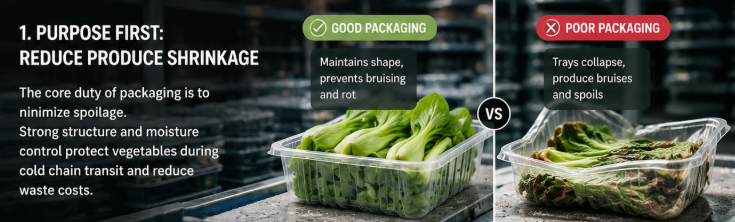
Before evaluating any novel sustainable material, a non-negotiable commercial premise must be established: the primary duty of packaging is to minimize product spoilage. Vegetables are living agricultural goods characterized by active respiration and high moisture content, placing strict demands on the physical and chemical properties of their containers. If a company prioritizes absolute sustainability by adopting materials with insufficient mechanical strength or low moisture resistance, the consequences manifest quickly during long-distance cold chain distribution. High humidity paired with stacking pressure can cause the bottom trays to deform severely, bruising the produce inside and triggering widespread rot. The carbon footprint and financial losses incurred from such packaging failures far outweigh the environmental benefits saved by the material itself. Therefore, pursuing genuine sustainability does not mean blindly cutting all ties with polymers; rather, it requires engineering existing supply chains via sophisticated technical means. Frequently, partnering with a dependable custom bio-based veggie tray supplier to implement tailored formulations based on a specific vegetable’s respiration rate and packaging line stress is the safest path to mitigating large-scale commercial risks.
Material Substitution: Matching Physical Properties to Specific Crop Categories

Different vegetable categories present vastly diverse requirements for tray performance, meaning there is no single universal eco-friendly tray capable of solving every bottleneck. For high-moisture, high-respiration commodities like salad greens, mushrooms, and cherry tomatoes, anti-fogging capabilities and gas transmission rates dictate shelf life. Traditional setups rely heavily on PET or PP because they successfully lock in the necessary micro-environment. Eliminating plastics entirely from this category is currently unrealistic; instead, the industry-accepted solution centers on maximizing the integration of post-consumer recycled content. A specialized rPET veggie tray factory for food packing companies can supply trays that meet strict food safety regulations while maintaining excellent transparency and rigidity, enabling brands to immediately cut down on virgin petroleum-based inputs without altering their existing automated top-sealing machinery. Conversely, for hard root vegetables such as carrots, potatoes, and broccoli, where water loss is slower and visibility is less critical, molded agricultural waste fiber or sugarcane bagasse trays offer high practical value. These fibrous compositions naturally absorb excess condensation and offer superb structural cushioning during turbulent cold chain transits.
Hidden Supply Chain Levers: Bridging the Financial Gap of Green Upgrades
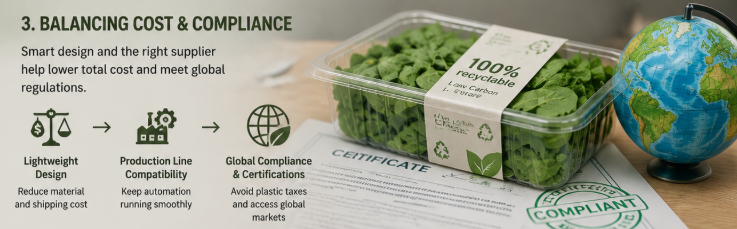
When procurement teams present sustainable packaging transitions to executive boards, financial directors frequently veto the initiative due to higher per-unit material costs. This rigid accounting method overlooks the dynamic nature of Total Cost of Ownership. To achieve a soft landing on expenditures, the first critical lever is optimizing the structural design through lightweighting. Utilizing advanced finite element analysis allows engineers to refine geometric patterns, edge thickness, and bottom ribbing, making it possible to trim raw material usage by fifteen to twenty percent while preserving original top-load compression strength. This mass reduction directly offsets the premium of eco-friendly resins while simultaneously lowering overall freight shipping weight. Another hidden expense often ignored by management is production line compatibility. Forcing uniquely shaped, non-plastic trays into high-speed lines can cause automated weighing systems, robotic denesters, and sealing jaws to jam frequently, harming operational efficiency. Astute buyers bypass this by prioritizing vendors with established industrial integration experience, ensuring they source from an OEM degradable product tray exporter for supermarkets whose tray flange tolerances and corner radii align perfectly with current tray sealers to keep line modification downtime to zero.
Policy Compliance and Navigating the Global Trade Arena
Within globalized food supply chains, environmental regulations have evolved past moral persuasion into tangible financial tariffs. Multiple European nations impose steep taxes per ton on non-recyclable plastic packaging, while Extended Producer Responsibility laws rapidly expanding across North American states continuously drive up the compliance risks of traditional materials. Against this backdrop, forward-thinking exporters and fresh produce brands are actively aligning their sourcing with international green certifications. At this stage, instead of expending internal corporate resources on blind trial-and-error testing, it is far more efficient to connect with a supply chain that possesses verified global compliance credentials. By engaging with a certified, customizable eco friendly packaging tray supplier whose materials offer documented traceability, zero heavy metal residues, and certified home-compostable attributes, brands can effortlessly penetrate premium overseas retail networks. This strategic pivot allows companies to offset the initial capital expenditure of packaging upgrades by systematically avoiding costly carbon penalties and plastic duties.
Resolving the Friction Between Shelf Visibility and Consumer Purchase Habits
In the retail arena, packaging functions directly as a tool for visual marketing. For the vast majority of fresh produce shoppers, assessing the physical freshness of the food with their own eyes is the primary step in building purchasing trust. While all-paper or solid fiber trays convey a powerful sustainable message, their opacity blocks the consumer’s view, creating doubts about whether the underlying vegetables have begun to spoil, which ultimately slows down shelf rotation. To strike a balance between sustainable perception and structural visibility, hybrid windowed packaging has emerged. This configuration utilizes a high-strength molded pulp base tray for load-bearing stability, topped with an ultra-thin, highly transparent bio-based compostable film featuring micro-perforations for heat sealing. Executing such complex, multi-material designs requires collaborating with manufacturers capable of advanced material blending. By partnering with an experienced odm plastic vegetable tray factory, brands can leverage advanced mold engineering and material science to seamlessly fuse clear films with functional sustainable bases, resolving the retail conflict between product visibility and eco-conscious shopping preferences.
Commercial Implementation Guide: A Practical Blueprint for Sourcing Executives
Successfully executing the balance between environmental responsibility and operational utility requires procurement directors to establish an objective, application-specific testing protocol. Procurement teams must move past the generic marketing claims of packaging brokers and demand hard data regarding vibration drop tests under simulated logistics extremes, top-load retention curves in high-humidity cold storage, and mean time between failures on high-speed automated lines. Simultaneously, to protect supply chain continuity, businesses should adopt a multi-sourcing strategy. This involves identifying versatile manufacturing partners located near core agricultural hubs and distribution networks, specifically securing a relationship with an adaptable veggie blister tray manufacturer for agricultural brands. Partnering with a source that offers large-scale production capacities and flexible regional logistics ensures that food brands avoid packaging bottlenecks during peak harvest seasons while fine-tuning tray specifications over time to maximize yields, minimize costs, and maintain regulatory compliance.
Ultimately, in the modern fresh produce marketplace, packaging is no longer just a line-item expense; it is a strategic asset for building brand differentiation and insulating the enterprise from regulatory liabilities. By thoroughly understanding the biological preservation needs of vegetables, utilizing lightweight engineering to lower structural costs, and cooperating with an advanced PLA veggie tray supplier for food processing factories, food companies can safeguard their margins against produce shrinkage while smoothly transitioning into a low-carbon, sustainable business model.